Showing posts with label Jack Nicholson Month. Show all posts

Friday, April 28, 2017

The Bucket List

For the finale of “Jack Nicholson Month Part 2,” I will review “The Bucket List,” released in 2007.

The paths of cancer-patients Edward Cole (Jack Nicholson) and Carter Chambers (Morgan Freeman) would never have encountered, if they weren’t in the same hospital with serious rules, two patients per room policy. The former is a billionaire businessman who owns the hospital, could easily have asked for a private room. However, cancer has taken its toll on him, and he sees that he is stuck in bed next to an auto mechanic.

Honestly, their difference in their jobs doesn’t mean anything currently, seeing how they’re both cancer patients, grouchy and have been told the same sad news of living for less than a year. Kam Williams said in his review, “The commiserating curmudgeons soon discover that they also share an aversion to the idea of just resigning themselves to their fates and slowly wasting away attached to tubes, monitors and hi-tech machines.”

Planning to die in their own ways rather than let cancer take them, they start writing a “Bucket List” of things they want to do before passing away. Writing down their wildest imaginations, they write down everything from getting tattoos to visiting the Great Wall of China, the Pyramids and the Taj Mahal to car racing and skydiving to climbing the Himalayan Mountains to finding the perfect woman to joining the proverbial Mile High Club while cruising at 30,000 feet in the air on Edward’s private jet.

Sadly, Ed only has one visitor in the hospital, his respectful, glass-wearing assistant, Thomas, played by Jack McFarland from NBC’s “Will & Grace,” Sean Hayes, means that the rich old man basically has no friends and can do whatever he wants. However, Carter, a devoted family man, has the wishes of his wife of 47 years (Beverly Todd) and three focused children (Alfonso Freeman, Brian Copeland and Serena Reeder) to consider. Williams stated, “However, once well-heeled Edward offers to foot the entire bill for their hedonistic getaway, Carter can’t resist the chance to spend his waning days doing everything he ever dreamed of.”

They decide to ignore their doctors’ orders, they decide to go off on their “Bucket List” adventures with the help of Thomas who handles the arrangements at each airport of call. As the courageous gradually check off everything on their checklist, they reminisce, philosophize, and above everything else, misbehave.

Here you have the story to “The Bucket List,” a surprisingly lighthearted film for such a sad theme. Directed by Rob Reiner, the movie co-starts Jack Nicholson and Morgan Freeman in roles they’ve basically embodied. Williams said, “Nicholson steals the show as that bombastic bon vivant we’ve all come to adore, opposite Freeman’s equally-endearing portrayal of a wizened sage wise beyond his years.”

The only problem in this else bubbly friend adventure’s medicine comes when Carter is shortly tempted to cheat on his wife with a ready-and-willing, seductive woman, played by Rowena King. There’s nothing to worry about. Williams jokes, “When was the last time you saw Morgan Freeman touch a woman in a movie who wasn’t dead?”

A feel-good, before dying movie that manages to go beyond its sad subject-matter and surprisingly lifts your spirits.

I know that this film may not be a good film, but it will leave you with a good feeling after seeing it. You have grandparents, and even your parents can watch this with you, definitely see this film. It’s a good film that I feel was unjustly hated.

Well that concludes “Jack Nicholson Month Part 2.” I hope everyone enjoyed my additional reviews on Jack Nicholson movies and I hope I made good recommendations. Stay tuned next month for more reviews coming right at you.

Friday, April 21, 2017

The Two Jakes

This is how Roger Ebert started out the review of the 1990 “The Two Jakes,” “Here at long last is Jack Nicholson's "The Two Jakes," seven years in the trade papers, center of prolonged teeth-gnashing at Paramount Pictures, and it turns out to be such a focused and concentrated film that every scene falls into place like clockwork; there's no feeling that it was a problem picture. It's not a thriller and it's not a whodunit, although it contains thriller elements and at the end we do find out whodunit. It's an exquisite short story about a mood, and a time, and a couple of guys who are blind-sided by love.”

The movie is set in post-war Los Angeles – Ebert said, “The 1940s of the baby boom and housing subdivisions – instead of the 1930s city where “Chinatown was set. It’s not the loving city it once was. Private eyes like J.J. Gittes, reprised by Jack Nicholson, are a little more tired with time and care. Ebert said, “The Gittes of "Chinatown" was the spiritual brother of Philip Marlowe.” However, not that the war is over, and Gittes has moved out of the two-room suite into his own building with his own staff of detectives. He is owned by a country club, has a fiancée and has gained some weight. Ebert said, “One of these days he's going to stop calling himself an investigator altogether and become a security consultant.”

However, he still solves some of the cases he’s used to. The cases where a furious husband breaks into a motel room and finds his wife in bed with an adulterer, and then the investigator jumps in with a camera and takes photos that will help him in divorce court. He knows, Gittes says narrating the film’s beginning, that he shouldn’t take one these horrible cases anymore. He’s way past them and they’re not on his level. Sometimes, he still does the cases.

That’s how he meets the other Jake – Jake Berman (Harvey Keitel), a property developer who thinks his wife (Meg Tilly) is cheating on him with his partner (John Hackett). Gittes tells Berman how he should act when he breaks in through the door, and what to say, and then they find a motel where the cheating is supposed to happen. However, Berman doesn’t follow the steps. A gun appears out of nowhere, and the partner is shot, and the partner’s wife, played by Madeline Stowe, thinks that maybe it wasn’t a cheating case at all. Maybe it was cold-blooded murder, and Berman wanted to kill his partner so that he and his wife could get his partner’s money on the property development. That might be why Gittes is needed for the murder.

So far, what we see is the type of story that any private eye movie might have been happy for. However, “The Two Jakes” uses the story only when it needs the deeper and more worrying things it has to say.

Everyone who worked on this movie looks like they have gone through the private eye genre and come out on the other side. The screenplay is by Robert Towne, who at a time was supposed to direct the movie in the difficult history it had being made. He doesn’t only brought together some characters from his “Chinatown,” added some new ones, and put them in the plot. Ebert said, “This movie is written with meticulous care, to show how good and evil are never as simple as they seem, and to demonstrate that even the motives of a villain may emerge from a goodness of heart.”

Jack Nicholson directed the film, and Vilmos Zsigmond photographed it, in the same way. Ebert said, “This isn't a film where we ricochet from one startling revelation to another. Instead, the progress of the story is into the deeper recesses of the motives of the characters.” We see that Gittes – fiancée and all – still is really scarred by the murder of the Faye Dunaway character in “Chinatown.” He will never forget her.

We see that the property being made by Berman has been seen before by Gittes, so long ago. We see that love, pure love, is a reason necessary to defend shocking actions. We also see that the past has been so important to us, it will never leave our memories.

Ebert said, “The movie is very dark, filled with shadows and secrets and half-heard voices, and scratchy revelations on a clandestine tape recording. Out in the valley where the development is being built, the sunshine is harsh and casts black shadows, and the land is cruel - the characters are shaken by earthquakes that reveal the land rests uneasily on a dangerous pool of natural gas.”

The performances are dark and depressing as well, especially Nicholson’s.

Ebert said, “He tones down his characteristic ebullience and makes Gittes older and wiser and more easily disillusioned. And he never even talks about the loss that hangs heavily on his heart; we have to infer it from the way his friends and employees tiptoe around it.”

Ebert goes on to say, “Right from his first meeting with the Keitel character, when he notices they are wearing the same two-tone shoes, he feels a curious kinship with him, and that leads to a key final confrontation that I will not reveal. And he feels something, too, for the Meg Tilly character, who has been deeply hurt in her past and is afraid to express herself. She is like a bird with a broken wing.”

The moral of “The Two Jakes’ is that love and loss are more important than the automated circulation of guilt and justice. When Nicholson and Keitel, as the two Jakes, have their final meeting of shocks, it is such a good scene because the normal considerations of a crime move are put on halt. The movie is all about the values that people have, and about the things that mean more to them than life and freedom. It’s a deep movie, and a thoughtful one, and when it has ended you will not easily forget about it.

If you haven’t heard of this movie, now you have. If you haven’t seen the movie, see it, especially if you saw and liked “Chinatown.” This is a powerful movie, and an underrated one that I don’t think people must have heard of, or didn’t really like. It’s actually a good one for everyone to see it, so definitely see it and give it a chance.

Stay tuned next week for the finale of “Jack Nicholson Month Part 2.”

Friday, April 14, 2017

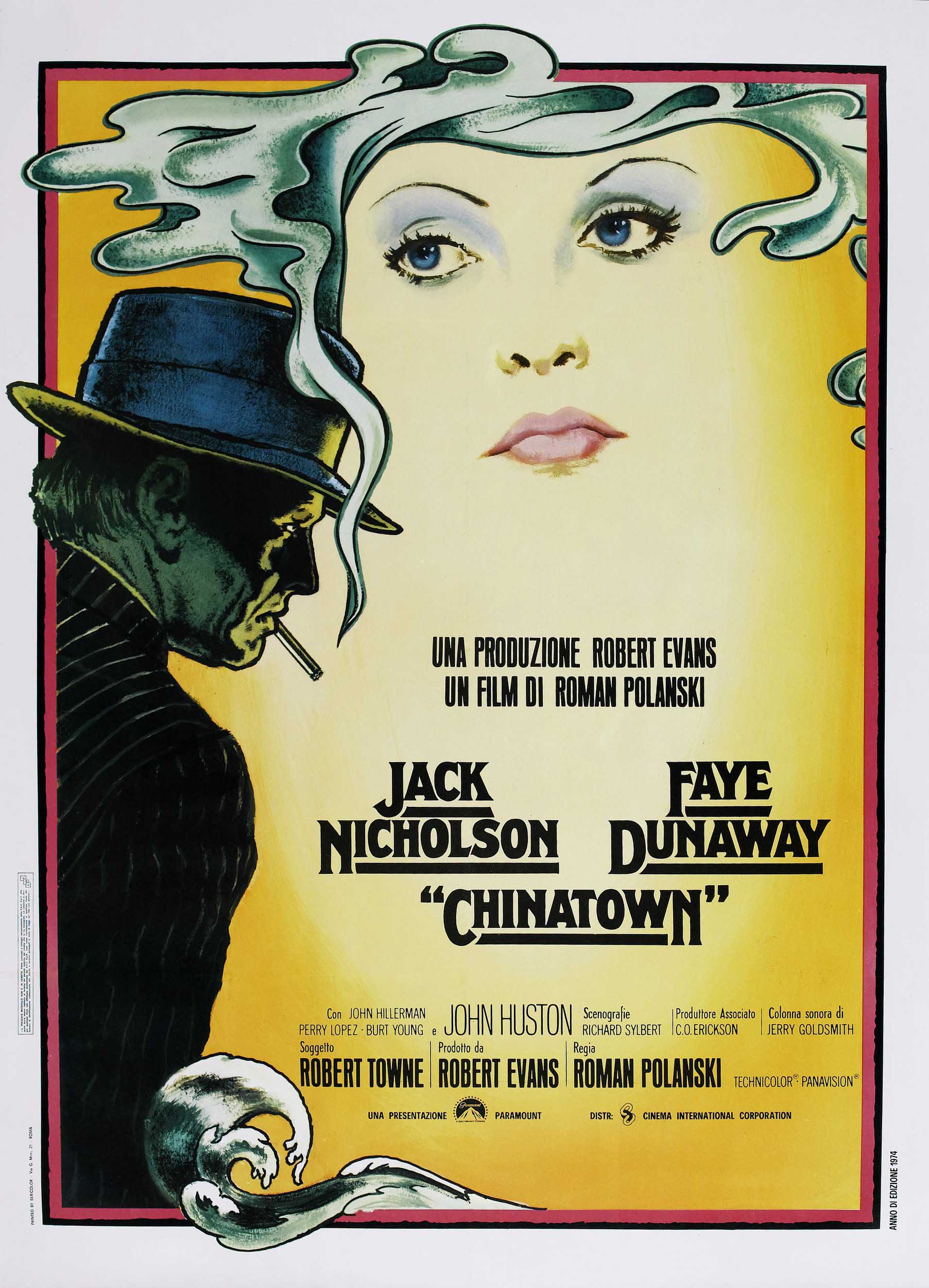
Chinatown

From the great screenwriter Robert Towne and the look of director Roman Polanski was made a modern film noir that gives us a look at from long ago of dark, complex and slow-paced detective stories that had sleazy and cool characters, every one of them dangers and desperate besides intelligent.

“Chinatown,” released in 1974, takes place in Los Angeles in 1937. Private investigator Jake Gittes (Jack Nicholson), who formerly worked for the Chinatown’s police department, is assigned a case to settle the betrayal of Hollis Mulwray (Darrel Zwerling), the Chief Engineer for the city’s water company. Los Angeles has been in a season of a drought. The people are pushing workers to build a new dam. Mulwray is trying to figure out a midnight plan to mysteriously row large amounts of water from the city’s lake. Jake takes photos of Mulwray with a young woman. Soon, Mulwray is found murdered.

As Jake looks around one of the city’s water lakes to uncover who murdered Mulwray, his nose is cut open by a Man with a Knife, played by director Roman Polanski, who was hired to scare him off. It doesn’t take Jake long to find himself accidentally pulled into a huge difficult scheme involving a fake water crisis being planned for a few magnates to get control over large amounts of real-estate and design the future of the city.

Evelyn Mulwray (Faye Dunaway), the widow of Hollis, is stuck in the middle of her late husband’s legacy and her powerful father’s (John Huston) clean foul, and goes to Jake for help. As another murder is done, the police, including Jake’s former partner, played by Joe Mantell, start to look all over Jake, and he slowly begins to realize that Evelyn is hiding a deep, dark secret that threatens to be the end of her and anyone standing too close.

Ace Black Blog stated in their review, “For Chinatown, Polanski re-creates a depressed Los Angeles as a small town filled with the thin veneer of respectability, but with a rotten core almost punching through to the surface. Jack Nicholson portrays Jake Gittes as a smart mouth happy to make a good living cruising through the underbelly of LA, who nevertheless soon realizes that he is facing events much bigger than he can handle. Faye Dunaway oozes, in turn, power, mystery, danger, seductiveness, and ultimately sheer vulnerability as she loses her husband and finds her life hurtling towards sudden destruction.”

In a fantastic reference to the golden era of film noir, John Huston comes in as Noah Cross, the man behind the plan to get the power back in his hands once taken over the entire city. Ace Black Blog said, “In 1942, Huston wrote the screenplay and directed The Maltese Falcon, one of the foundation stones of the noir style.”

Towne’s “Chinatown” script gives the film to collect the details of depression and destruction as the story is told. Every time Jake learns more about Hollis, Evelyn, or Noah, he figures out hwo little he knows about what is unfolding, and how much larger the plan being played out around him really is.

With Jake trying but not able to control the awesome people uniting around him and Evelyn, the film slowly but certainly goes towards a dark ending inevitably in Jake’s old Chinatown field. In the end, with nothing form Jake’s plan having worked, Towne writes one of the best movie lines in history for someone who has lost: “Forget it Jake, it’s Chinatown.”

Jake will not forget what happened that night, just as “Chinatown” is a smart unforgettable movie, and one of the best ever made.

Forget reading my review on this movie, go out and see it. This is one of those movies that just have to be seen to be believed, and is another one of my favorite movies.

Look out next week when he look at the sequel to this movie in “Jack Nicholson Month Part 2.” Also, I will be going with my cousin to see the new Smurfs movie. Review to come later in the day.

Saturday, April 8, 2017

The Last Detail

I really want to apologize to everyone. I was really occupied yesterday that it completely slipped to post my weekly Friday movie reviews. Don’t get me wrong, I was thinking it, but then I completely forgot. So today, I will post my review. I want to apologize for posting this late, and hopefully I don’t forget again.

For April, I’m thinking of doing another “Jack Nicholson Month” where I review other famous movies that he starred in. Let’s get it started again with the 1974 classic, “The Last Detail.”

This is one amazingly funny, hysterically smart performance, plus two others that are excellently good, which work very well given the reflective harshness that it looks like a new definition for anti-comedy. Vincent Canby said it best when he said, “It's a good movie but an unhomogenized one.”

Canby went on to say, “"New" is perhaps a poor word to use in connection with the film. Like the recent "Cinderella Liberty," which was also based on a novel by Darryl Ponicsan, "The Last Detail" considers the lives of career United States Navy sailors with a gravity that recalls the atmosphere of the late nineteen-forties and fifties, when World War II was still freshly won, Korea was being brought to a close, and Ike was going to throw the rascals out of Washington. In the years that preceded the political and social upheavals of the nineteen-sixties and seventies, ignorance still possessed some innocent charm.”

Canby continued, “It doesn't any more. It seems frivolous and a bit scary. So much so that I suspect that Hal Ashby who directed "The Last Detail," and Robert Towne, who wrote the screenplay, may have thought of their leading character, who is 20 years behind the times and only vaguely aware of the fact, as a lot more representative of many American lives today than the rest of us would care to think.”

This character, greatly played by Jack Nicholson, is Signalman First Class Buddusky, a 20-year Navy man of funny and frequent unnecessary confidence. Buddusky and Gunner’s Mate First Class Mulhall, played by Otis Young, are tasked to take from Norfolk, Virginia to the naval prison in Portsmouth, New Hampshire, an 18-year-old sailor sentenced to eight years in jail for trying to steal $40 donations for polio.

“The Last Detail” is the story of this travel, which takes up a good amount of a week and performs the growing anxiety of Buddusky as he tries to show the prisoner what he thinks is a good time. The three have a beer party in their Washington hotel room, where Buddusky gets the kid inebriated for the first time and tries to make him happy. “Think of it this way,” he says in result, “you’ll get two years off for good behavior.”

In New York, they go into a Nichiren Shoshu prayer meeting and en up at a Village Party where Buddusky tries to sleep with a pretty, completely serious young woman, played by Luana Andres, by talking about the romance of the sea, while she would rather talk about President Nixon or race relations.

On their last day in Boston, Buddusky and Mulhall take the prisoner to a corrupt prostitute club where they show him their introduction to intercourse by paying his tab. This experience, with a girl, played by Simka Dahblitz-Gravas from “Taxi,” comedian Carol Kane, who is softly sweet and a down-to-earth professional at the same time, is what finally disturbs the prisoner who, up to that point, has more or less accepted what’s going to happen.

Jack Nicholson controls the film with looks like a collection of boastings optimistic, knowing, angry, foolish and lonely. It might be the best performance he ever did. Canby said, “If anything it's almost too good in that it disguises with charm the empty landscape of the life it represents.”

Otis Mulhall, by being African-American and playing a man who is as thoughtful and persistent as Nicholson is naughty, is the one person who gives the movie an up-to-date look. Canby noted, “In World War II, black sailors seldom got out of the galley.”

Randy Quaid, who had a small role in “The Last Picture Show,” is a genius stop for Nicholson as the always polite prisoner who, for a good majority, refuses to share Buddusky’s anger at the injustice of his sentence. Early on, he has admitted to Buddusky that he had trouble with the police before enlisting in the Navy. Buddusky professionally asks, “Was it in the nature of a felony or a misdemeanor?” The prisoner responds, “It was in the nature of shoplifting.”

Hal Ashby continues in making comedies that are never as funny as the behaviors he gives them would have you believe. Canby credited, “"The Last Detail" is his most interesting and contradictory so far. You'll laugh at it, not through your tears but with a sense of creeping misery.”

As I have stated, this movie has to be seen to be believed. It’s actually a good movie to watch and you’ll love it, especially if you’re a Jack Nicholson fan. This even has the line where Nicholson yells, “I am the mother****ing shore patrol mother****er, I AM THE MOTHER****ING SHORE PATORL!” Yes, I did censor that, and you know why.

Check in next Friday when I review a masterpiece in “Jack Nicholson Month Part 2.”

Friday, May 29, 2015

The Departed

Now it’s time to wrap up “Jack Nicholson Month” with Martin Scorsese’s 2006 gangster flick, “The Departed.” You may have heard the whole talk all over the Internet that “The Departed” is an old-school film, relieved by insight. You probably will think the same thing if you don’t pay any attention to what’s going on. Or maybe you’ll see “The Departed” for what it is: a new American crime classic from the legendary Martin Scorsese, whose talent shows here on its highest toll.

The title card places us in the setting: Boston, some years ago. Now we’re off, watching Leonardo DiCaprio as a cop pretending to be a cover and Matt Damon as his opposite. Both are stuck in circumstances where you can’t tell the good from the bad.

Peter Travers of the Rolling Stone mentioned in his review, “All the actors bring their A games to this triumphant bruiser of a film, its darkly wanton wit the only defense against complete chaos.” DiCaprio and Damon give explosive, emotionally complex performances, but it must be mentioned that Jack Nicholson reaches unimaginable-of heights corrupt evil as Irish mob kingpin Frank Costello. If he’s waving a gun or a female’s toy, buying off cops, insulting Catholic priests as degenerates, deceiving children into a life of crime, bringing in cocaine for favored prostitutes or chatting elbow-deep in blood, Nicholson is electrifying. Unemotionally finishing a woman on a beach, Costello says to his henchmen Mr. French, played by the terrific Ray Winstone, “She fell funny.” However, Costello is no campy Joker. Travers noted, “Channeling James Cagney in White Heat and Paul Muni in Scarface, Nicholson leeches out the glamour to create a landmark portrait of evil.”

Travers went on in his review to say, “William Monahan's stinging script, a revelation after his murky meandering in last year's Kingdom of Heaven, transfers the plot of the terrific 2002 Hong Kong thriller Infernal Affairs to his native Boston so he can drill down to its depraved core. Those familiar with the gangs of Beantown will see Whitey Bulger — the Irish thug still being pursued by the FBI — in Nicholson's sick twist of a character.” This is essential, instinctive filmmaking, indebted to Michael Ballhaus’ vivacious cinematography and Howard Shore’s suggestive score, boosted by Scorsese’s typically smart soundtrack choices – a unique combination of the Rolling Stones, John Lennon, Nas, Van Morrison, the Beach Boys and Patsy Cline. Once again, Thelma Schoonmaker turns editing into art form. Travers described her as “the wizard at Scorsese's side, getting the action to jump off the screen while setting up psychological provocations that reverb hellishly in your head.”

At the time, irrelevant fan-boys would ask: Will Scorsese finally win his Oscar? Is “The Departed” as brilliant as “Goodfellas?” Is it too gory to be a blockbuster? “The Departed,” flawed by a few underwritten characters and some stressed imagery (the symbolic rat), takes you to the edge of your seat.

Billy Costigan (DiCaprio) and Colin Sullivan (Damon), oblivious to one another, are both novices at the Massachusetts State Police Academy. For Billy, it’s a goodbye to the Southerners, the South Boston criminal element that made him. For Colin, it’s a chance to play mole for Costello, who taught him since he was a child. The drama builds up when Billy is told that he will never wear the State uniform. His father figure, Captain Queenan, played by Martin Sheen, wants Billy to go undercover and penetrate Costello’s crew. Billy’s identity will be known only by Queenan and his hard enforcer, Sergeant Dignam, played by Mark Wahlberg, who Travers described as “locked-and-loaded and gives a supporting role major dimensions.” Colin, who thinks the State uniform makes you look “dressed to invade Poland,” joins the suits led by Captain Ellerby, played by Alec Baldwin, in the Special Investigations Unit. Now the two rookies, assigned to rat out the people they work with, begin to loosen from the strain of maintaining identities antithetical to their true natures.

Travers says, “As in Infernal Affairs, there's a heap of coincidence.” You might want to cancel the film’s dramatic license when Billy and Colin both fall in love with Madolyn, played by Vera Farmiga, the shrink who treats Billy and moves in with Colin. Luckily, Farmiga is a glorious actress, an explosive mix of intelligences and love appeal, who reveals that Madolyn is as lost and off-the-rails as the two men.

What about the violence? Most of it is saved for the film’s final act, where it’s enough to give you whiplash. Scorsese rightly refuses to go weak on the corruption that extends from Costello’s arsenal of vipers to the State House, whose gold dome Colin sees from the window of his elegant apartment on Beacon Hill. Damon, building on his no-nonsense turns in “Syriana” and the two Jason Bourne movies, brings looped-spring intensity to Colin, whose double life is taking its toll (for one, he’s often powerless). Scorsese allows mentioning flashes of the child in these men. Colin dreads betrayal of Costello, the gangster who filled his skinny twelve-year-old arms with groceries and made him his slave. Billy uses drugs to deaden his fear but can’t find anything – family, friend, lover, church, government – to trust. DiCaprio does himself proud in a dangerous role that stabs at the heart as Billy’s audacity loses the battle to his clattering nerves. Despite that DiCaprio and Damon share only one big scene, their climactic rooftop face-off reflects the film’s unwelcoming view of a world where nothing is held sacred.

Scorsese doesn’t need gore to make his point. A scene with Billy and a vibrating cell phone matches Hitchcock for suspense. Travers also notes, “Another, deftly borrowed from The Third Man, simply involves Madolyn walking past Colin at a funeral, her impassive gaze deadlier than a speeding bullet. Issues of sin, redemption, identity and loyalty resonate in Scorsese's films, including the atypical Kundun, Age of Innocence and The Aviator.” Each new film absorbs the other, creating a body of work that can stand with the greatest. Scorsese tops the list of American directors because, even when he fails, he attempts passionately to make movies that matter. “The Departed,” a boldly uncompromised vision of a society decomposing from the inside, is one of his best. Act accordingly.

If you haven’t seen this movie, you have to. Stop reading this review, and go out and see it. You will absolutely love it, if you have seen other Scorsese movies. This is another one of my absolute favorite gangster flicks, and I sincerely think everyone should check this one out. You will be thinking throughout what is going to happen and what role is everyone playing. The resolution does not disappoint at all.

Thank you for joining in on “Jack Nicholson Month.” I hope you have enjoyed, and I hope that I made some good recommendations. Stay tuned next month to see what else I have in store for everyone.

Friday, May 22, 2015

Anger Management

Today we are looking at a strangely executed movie known as “Anger Management,” released in 2003. After a misunderstanding on a plane, Dave Buznik, played by Adam Sandler, is ordered to take anger management sessions or get locked up in prison. However, his counselor, Dr. Buddy Rydell, played by Jack Nicholson, has some rather nonstandard methods treatment and, before long, Dave is in more trouble than ever.

Empire stated in their review, “Like a visit to the dentist or an overdue tax demand, the arrival of a new Adam Sandler film is something that strikes fear into the hearts of many - especially the discerning cinemagoer who finds his brand of humour too broad to swallow.”

Along with this, Empire stated, “With a track record that includes Mr. Deeds, Little Nicky and Eight Crazy Nights, it's easy to see why there are plenty who feel this way. But while Sandler has more than a few turkeys under his belt, it's unfair to assume he's incapable of making a good film.” If you remember “The Wedding Singer,” that was an enjoyable hit, and his scary turn in “Punch-Drunk Love” showed that he is capable of channeling his trademark silliness.

That is exactly the case in “Anger Management,” which, not having its own flaws, it’s far more watchable and entertaining than the films that gained Sandler his reputation in the first place. At the very least, the fact that is grossed past the $100 million mark in the USA after three weeks of its release, dragging American cinemas out of their wartime sadness, hints that he must be doing something right.

Now Empire also said, “That said, the film's success doesn't so much hinge on Sandler's pratfalls as on his screen relationship with Jack Nicholson - and it's here that Anger Management hits its stride.” From the legitimately hilarious airborne opening sequence – where Sandler’s simple request for a pair of headphones goes brilliantly into the fear of travelling in such security-alert times – to the many set pieces where the two share the screen, this is an inspired partnership that works far better than anyone ever had a right to expect.

It’s hard to imagine anyone other than Nicholson playing the nonstandard doctor. Rydell is a bizarre creation whose methods to cure his patient of his so-called “mood swings” including moving into his apartment, making inevitable moves on his girlfriend, played by the hot Marisa Tomei, and, at one part, encouraging Dave to sing songs from West Side Story in the middle of a crowded New York highway.

Empire commented, “Sandler, for once upstaged by somebody more over-the-top than himself, is in more restrained form than usual (although it would be hard to be anything but, given he has Nicholson's frantic mugging to contend with).” As such, he makes for an impressive outwit, looking slightly confused throughout but saying enough one-liners to hold his own role against his co-star. This is the kind of buddy movie where everybody – not least the two stars – seems to be enjoying themselves, something that is obvious from the first moment that Sandler and Nicholson are together on screen. It’s unfortunate, then, that the pair’s relationship is at the expense of everybody and everything else, with a superb supporting cast – that includes Luis Guzman, Woody Harrelson, January Jones, Krista Allen and John Turturro as Sandler’s “anger buddy” – given far too little to do.

Tomei, as the romantic interest, is also underused. While screenwriter Dorfman twists enough laughs out of the script, he never realizes the full potential of his dark idea, opting instead for a storyline that never quite answers the question of whether Sandler really has anger management issues or not.

The ending feels lame, most likely in an effort to give audiences their feel-good fix but, as crowd-pleasures go, this delivers the laughs and it won’t do Sandler’s reputation any harm. Besides, any film that cameos John C. Reilly as an aggressive Buddhist monk is likely to bring a smile to the face of even the aforementioned “discerning cinemagoer.” Also, expect a cameo from the drop dead gorgeous Heather Graham. Best part about it, she’s in a Red Sox bikini, which will excite men.

A better script and more attention to other cast members would have helped it but, as it is, Empire declared it as, “the best Adam Sandler comedy since The Wedding Singer.” If you want to see it, go ahead, but I won’t highly recommend it, but I will only just suggest that you should check it out.

Look out next week for the finale of “Jack Nicholson Month.”

Friday, May 15, 2015

As Good As It Gets

Moving right along with “Jack Nicholson Month,” we have one of the popular movies ever made, “As Good As It Gets,” released in 1997. The basic story is a chronic sourpuss grump learns the value of love and charity when he is forced to care of his neighbor’s dog.

Meet Melvin Udall, played by Jack Nicholson, described by Empire as “the Archie Bunker of the 90s.” Melvin has Obsessive Compulsive Disorder (OCD) in this outrageous, politically incorrect comedy from the wave that brought us Broadcast News and produces the hit adult cartoon “The Simpsons,” James L. Brooks. Empire mentioned, “Brooks also steered Jack Nicholson to an Oscar in Terms Of Endearment, a feat the duo repeated here.”

Nicholson is on top of his sneering, eyebrow-arching game as Melvin the hater, obnoxious and offensive to everyone who encounters him. He’s racist, xenophobic, anti-Semitic, homophobic, misogynist and, the cherry on this hater sundae, cruel to small dogs. The only excuse given is that he suffers (believably so) from OCD. Empire described, “Ergo he's nutty as a fruitcake - which gives him license to howl such disgraceful one-liners as would probably get a real person (or an actor less devilishly delicious than Nicholson) beaten up or arrested. “

Melvin earns his living, oddly, writing tasteless romance novels, and lives as reclusively as he can in his Manhattan apartment. One of his obsessive traditions is eating breakfast daily at a café where only tough waitress Carol, played by the actress who played Jamie Buchman from the hit sitcom “Mad About You,” the beautiful Helen Hunt, a single mom with her own stressful sadness, will tolerate Melvin’s criticisms and fight him back.

When Simon (Greg Kinnear), the gay artist who lives across the hall, is hospitalized, old misery-guts Melvin is pressurizes by Simon’s agent (Cuba Gooding Jr.) into caring for his hated neighbor’s ugly but charming dog (Jill the dog) and, of course, bonding is soon started as the dog walks its way into Melvin’s decayed heart. Empire said, “Thus softened up, Melvin is reluctantly but irrevocably goaded into a series of grudging good deeds which are entirely motivated by self-interest but which inch him in the general direction of humanity and improbable but superb redemption.”

Hunt, who for a long time was a TV sitcom star, is wonderfully skilled as comic wordplay as the long-suffering Carol, giving it out as well as she takes it, but she’s also genuine and moving, while former chat show host Kinnear is surprisingly effective in the teary, somebody-needs-a-hug part of the nicely plotted and well-paced happenings. The star trio gets hilarious back-up from Gooding Jr., Yeardley Smith (who voiced Lisa Simpson from “The Simpsons”), veteran Shirley Knight as Carol’s mother, Jesse James as Carol’s son and Skeet Ulrich as the street gangster who brings disaster into Melvin and Simon’s apartment building.

Final Verdict: A healthy sense of irony is required to accept the unacceptable outbursts from Melvin’s mouth and the less nasty jokes, the film being intended in the spirit of Nicholson’s sing to Monty Python’s Always Look On The Bright Side Of Life.

This is another believable role that Nicholson played in. He gets all the traits of someone with OCD down just pitch perfect. I know this because I have friends who have OCD so I know how they act. This also has another one of the best quotes ever: “You make me want to be a better man.” Who knows if that has ever worked on a girl before, but I won’t say if you should try it. Still, check this movie out when you get the chance.

Look out next week where we look at another review for “Jack Nicholson Month.”

Friday, May 8, 2015

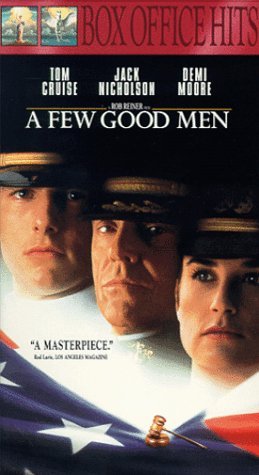
A Few Good Men

Welcome back to “Jack Nicholson Month” where today we will look at one of the most powerful courtroom drama, “A Few Good Men,” released in 1992. The role doesn’t have to be big, but if it’s good, and if the actor playing it is great, the results can be completely altered. Witness Jack Nicholson’s vicious, funny, excellently reptilian role in Rob Reiner’s entertaining movie, adapted by Aaron Sorkin from his hit Broadway courtroom drama.

Nicholson doesn’t steal the film, which would mean that he somehow separates himself from everybody else in it. Rather, in the course of only a handful of scenes, he seems to fill the entire production, giving it weight, density and point that might not otherwise be apparent.

The role, magnificently written, is made to Nicholson’s order. It’s that of Colonel Nathan R. Jessep of the United States Marine Corps, a tough, racist Vietnam veteran, a career officer shaped by decades of Cold-War politics. By chance, Jessep is stationed in that last corner of the Earth where the Cold War goes on as if there were no yesterday.

Vincent Canby of the New York Times mentioned in his review, “He's the commander of the marines stationed at the American naval base on the southwestern coast of Cuba at Guantanamo Bay, on a small bit of arid real estate protecting one of the best anchorages in the western Atlantic, a legacy of the Spanish-American War. It's there that the United States and Cuba, separated by barbed wire and command posts, have continued to co-exist through the Bay of Pigs invasion, the great missile crisis and a continuing, crippling economic embargo, in one of the strangest examples of symbiosis to be found in all of international relations.”

This geographic fact becomes a central look in the film adaptation, which stylishly opens up the story of a military court-martial without allowing the stress to evaporate. There are times when the movie seems to forcefully spoon-feed the audience important information, and when the audience might as well think whether the emotional disaster of the defense lawyers really are of more interest than the fates of the two men on trial.

However, such things are built into the structure and nature of the drama, which is less about the jobs of the military than about the procedure of this particular question. The story is this: in the course of what appears to be a hazing incident at Guantanamo, a Marine private has died, apparently poisoned by a rag stuffed into his through before his mouth was taped. Two enlisted men are charged with the murder. As often happens during proceedings of this type, the victim and the men on trial become less important than the politics around the case.

The Marine Corps would like to get it over with quickly and efficiently as possible. To this case, a hot-shot young naval lawyer, Lieutenant Daniel Kaffee, played by Tom Cruise, is assigned to the defense with the understanding that he’ll persuade the defendants to accept a plea bargain. Also on the defense is Lieutenant Commander JoAnne Galloway, played by the hot Demi Moore, who acts as Kaffee’s conscience, eventually convincing him that there is a strong possibility that the two enlisted men were, in fact, acting on orders from their officers.

The investigation, mainly started by Kaffee with some lack of enthusiasm, uncovers the fact that the victim, Private William T. Santiago, played by Michael DeLorenzo, had for some time been trying to transfer out of his unit. Also, he ignored both the Marine Corps code and its chain of command. He had wrote letters to Washington, offering to testify that he had witnessed an incident in which a member of his unit had by chance fired on a Cuban watchtower near the base.

As the investigation continues, Kaffee and Galloway, who clearly have never been to the theaters, read a book or spend a lot of time talking to career service personnel, are surprised to discover a kind of military mind that, to them, seem ancient. The two defendants at first behave like robots. Private Louden Downey, played by James Marshall, is so silent that he seems seriously impeded. His co-defendant and spokesman, Lance Corporal Harold W. Dawson, played by Wolfgang Bodison, refuses all offers of help. Canby mentioned, “He will stoically accept whatever punishment is meted out. The two men simply parrot the Marines' code of fidelity to unit, corps, God and country.”

On the evidence-finding trip to Guantanamo, Kaffee, Galloway and their assistant Lieutant Sam Weinberg, played by Kevin Pollak, have their first run-in with Jessep at a scary lunch, during which the Colonel happily lies through his teeth. For Galloway’s benefit, he also describes the special kind of high one can get when sleeping with a superior officer. According to Jessep, that’s one of the few benefits of an integrated service.

Canby noted, “"A Few Good Men" doesn't pack the surprises of "Witness for the Prosecution," nor does it probe very deeply into the psyche of men who exercise the power of dictators in a society that congratulates itself on its freedoms. It's no "Full-Metal Jacket." "A Few Good Men" recalls something of "The Caine Mutiny Court Martial," though it is most troubling not for the questions it raises, but for the casual way it finally treats its two lost, utterly bewildered defendants.”

The screenplay is a good one, directed with care and acted, for the most part, with terrific confidence. Among the supporting cast who do exceptional work are Donald Sutherland’s son, Kiefer Sutherland (aka Jack Bauer from the famous “42” sitcom), as a Marine officer who is going to become exactly like Jessep, J.T. Walsh as an officer fatally damaged by conscience, Kevin Bacon who appears as the military prosecutor, and Bodison, a new young actor whose performance as the more famous defendant gives the film its depressed shock value.

I agree with Canby when he said, “Mr. Cruise, Ms. Moore and Mr. Pollak are perfectly adequate in less flashy roles, which, unlike the others, appear to have been constructed to keep the plot moving right along. They have to play it reasonably straight, which must be crazy when the actors around them are having such an enjoyable time.

Nicholson is in his own league. His Jessep is both a joy to watch because of Nicholson’s skill, and an explanation of why the United States base at Guantanamo Bay, whatever its military value, continues to exist. “A Few Good Men” is a big commercial entertainment of unusually satisfying order. It also has the famous line from the 90s, “You Can’t Handle the Truth!” In the last scene when Cruise and Nicholson are at each other’s throat is something we see a lot in court, for those who watch courtroom shows.

Once again, if you haven’t seen this movie, why are you reading this review? Go out and rent the movie because it’s one of the best courtroom films out there and you’ll absolutely love it. Stay tuned next week to see what I will review next for “Jack Nicholson’s Month.”

Friday, May 1, 2015

One Flew Over the Cuckoo's Nest

This month I would like to review movies that star one of the greatest actors of all time that is known to play crazy, demented roles, Jack Nicholson. Today I will start off with one of the greatest cinematic achievements of all time, “One Flew Over the Cuckoo’s Nest.”

Frederic and Mary Ann Brussat started off their review by saying, “Ken Kesey's 1962 novel One Flew Over the Cuckoo's Nest has achieved cult status among high school and college youth. In a parabolic way, the book catches two very persistent and basic American fantasies: (1) the individual with personal freedom and complete independence, and (2) the rebel standing up to and subverting structures of oppression. Dale Wasserman adapted the novel for the stage, and Kirk Douglas starred in a successful Broadway version of the story in 1963. The drama subsequently played across the country in large and small cities.”

This novel adaptation on a book that I never read should be able to please fans of the book and convert new fans to this modern American classic. Released in 1975, it won Academy Awards for Best Picture, Best Director Milos Forman, Best Actor Jack Nicholson, Best Actress Louise Fletcher and Best Adapted Screenplay Bo Boldman and Lawrence Hauben.

Randle Patrick McMurphy, played by Jack Nicholson, is transferred from a prison work farm to an Oregon state mental hospital for 90 days of psychiatric observation. Dr. Spivey, played by Dean Brooks, the mild-mannered hospital administrator, does not quite know what to make of this man whose papers describe him as aggressive, lazy, resentful and violent. It turns out that he is tough primitive who enjoys people and hates bureaucratic structures.

McMurphy slowly freaks out his fellow patients: Cheswick (Sidney Lassick), a fidgety and disturbed man; Harding (William Redfield), who thinks of himself as an intellectual; Billy Bibbit (Brad Dourif), a stuttering, hesitant kid; Martini (Louie De Palma on the hit sitcom “Taxi” and Frank Reynolds on the recent sitcom “It’s Always Sunny in Philadelphia,” Danny DeVito), a juvenile good-natured simpleton; Taber (making his film debut who also starred in “Taxi” as Reverend Jim 'Iggy' Ignatowski, the great Christopher Lloyd), a fearsome looking patient; Chief Bromden (Will Sampson), a giant deaf-mute Native American; and an eccentric assortment of other characters. The ward is ruled by the condescending, controlling and strict Nurse Ratched, played by Louise Fletcher, and her strong-armed orderlies. It doesn’t take long for McMurphy to see that she has made weak wonders out of all the patients. Anesthetized by drugs and afraid of the electro-shock therapy used to punish outlaws, the inmates cringe before her during therapy sessions and free time.

Frederic and Mary Ann Brussat mentioned, “McMurphy sets up his own version of Monte Carlo in the ward and bets the men that he can get Nurse Ratched's goat.” His first attack on the synchronized life of the mental institution is an attempt to change the daily schedule so that they can watch the World Series on television. When he doesn’t get what he wants, McMurphy and the men watched the turn-off TV set and pretend they’re watching the game. In another very funny moment, he uses the 6’4” Chief as the center on the awkward inmate basketball team. They beat the orderlies. Then for a real change of pace, he seizes the institution’s bus and takes his inmate friends down to the ocean for a boat ride. The men – most of them self-committed to the institution – experience a combination of joy and dread on the open sea. McMurphy has broken the rules and given them a sense of life on the outside. The capstone of his freedom mission is an all-night party with alcohol and girls.

Jack Nicholson is McMurphy in all his mischievous and rebellious fullness. He shows energy, quick wit, and a flashy smile that signals a rebel’s will not to be broken by the system. Fredericand Mary Ann Brussat said, “It is a role quite in line with Nicholson's depiction of other outsiders in Easy Rider, The Last Detail, and Five Easy Pieces.” In one of the movie’s most alive scenes, McMurphy sits in front of the open window after the all-night party and stares into the camera. Frederic andMary Ann Brussat also said, “But McMurphy realizes in one epiphanous moment that the other inmates have projected their hopes for independence onto him.” Instead of leaving them, he stays to be a man with his punishment for breaking the rules.

Czech director Milos Forman has refused to make McMurphy and Nurse Ratched into cartoon-strip characters. Louise Fletcher underplays the nurse so that her villainy comes across as it should – not crude, but subtle. Nurse Ratched’s humorlessness and obsession for control are convincingly expressed. By toning down the “Them” against “Us” tension of the novel, Forman gives the story more humanity than the stage versions of the work. The director’s great way with the actors shines through in their excellent performances.

Will Sampson’s depiction of Chief Bromden is especially moving. In the last analysis, it is this character who truly understands the meaning and value of McMurphy’s freedom crusade. The Native American is given back to himself. His escape from the hospital in the movie’s emotionally high-pitched finale strikes a note for freedom that is especially rich in its imagery and impact.

After seeing this movie, I don’t think anyone would want to go anywhere near a mental institution. I know I don’t after I saw this, but that’s the power that this amazing movie has. When I was in High School, my cousin invited us over to his school one night since his school was doing a production of the book. I enjoyed myself completely, especially the boy who was playing McMurphy. After seeing that play, I ended up seeing the movie. If you haven’t seen this movie, go out and see it because you will love it.

Stay tuned for next week to see the next review on “Jack Nicholson’s Month.”