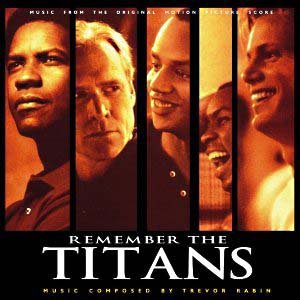
Welcome back to the Black History Month reviews. Today, we are actually
going to look at another biographical film, but not about any Civil Rights
Movement activist or leader. Instead, this will be a sports film. What sports
film do you ask? None other than the 2000 football film, "Remember the
Titans," one of my favorite sports films. This film is about Herman
Boone who coaches a football team during the early 70s, when segregation was coming
to an end, of a mixture of Blacks and Whites.
“Remember the Titans” is a story about racial agreement, cooked to the story
of a sports movie. Racism and opposite teams winning change so fast that
sometimes we’re not sure if we’re rooting for tolerance or touchdowns. Real
life is never as simple, but that’s what the movies are for – to improve life,
and give it the daydream of form and purpose.
To start off, the main attraction to this film is, once again, Denzel
Washington as Coach Boone. Any role that Denzel plays is so believable because
he captures every single essence of the character that makes him as amazing as
an actor to have in any film. When Boone takes the coaching position at the
desegregated school of T.C. Williams High School in Alexandria, Virginia, the
former head coach, Bill Yoast, played by Will Patton, denies Boone's offer to
be his assistant. That is until his fans make a riot that they will
boycott the team, which he then decides to take it. This is believable, because
like I had mentioned before, segregation was still going on at the
time. So the cast that play the parents are believable because we as an
audience get to see how the people were like during segregation. Younger
audiences who did not live during that time will get the feeling of what
segregation was like and how unfair it was to Blacks. Will Patton is another
great actor who really plays the assistant coach well, and helps Boone make the
team one of the best that has ever been made.
Coach Boone at first ridicule's the White players because they refuse to
play nice alongside the Black players, but then they both work together after a
very heated fight between captain Gerry Bertier, played by Ryan Hurst, and
Julius Campbell, played by Wood Harris. They both start a fist fight, and then
after their argument, Gerry starts yelling at the White players to make them
play football with the Black players, especially when offensive lineman
Louie Lastik, played by Ethan Suplee, enters the team unexpectedly. The
Black players learn to accept him in as well, since he was the first White
football player to join. The parents, at first, start a riot when the boys get
back and they desegregate the high school, which sounds about right since
segregation was starting to get resolved around this time. Since the
players learned to get along with each other when they went off to camp, the
parents eventually learn as well when the kids come back from camp and
start going to school, as along with the other students. Another reason that
could have started the team to work together was when Boone wakes them up at
3AM to show them the graveyard of the Battle of Gettysburg, where he gives them
a lesson about hatred. This is really strong and has a legitimate argument that
all this racial hatred should stop.
When we get to the training camp, it has the usual kids that we have seen so
many times in kid sports movies that at first fight, then bond. We’ve seen it
before, but the director, Boaz Yakin, brings old circumstances to new life and
brings us along in the wave of a master popular entertainment. Even Ebert
admitted, “I like the way he shows Boone forcing the blacks and whites to get
to know one another.”
They are certain funny moments in this film that I think I will mention. One
is when Boone asks Louie about the football player he is roomed with, who
happens to be another Offensive Lineman, Darryl "Blue" Stanton,
played by Earl C. Poitier, and they break out into singing an oldie song, which
is hysterical. Another scene is after Ronnie "Sunshine" Bass, played
by Kip Pardue, joins the team as Quarterback, and that locker room segment is
just hysterical. The "Yo Mama" jokes, Sunshine kissing Gerry
and Gerry flipping out, especially the singing of "Ain't No Mountain
High Enough" with Blue, Louie, and at the end with Defensive Back Alan
Bosley, played by Ryan Gosling, all put together makes it a memorable
scene, and one of the best.
Ebert admitted, “I admired the way the screenplay, by Gregory Allen Howard,
doesn't make Boone noble and Yoast a racist, but shows them both as ambitious
and skilled professionals.” There are moments when Boone treats his players
more like war soldiers than high school kids, and Yoast points that out. Also
there are moments when Yoast tries to calm the black players who Boone has been
hard on, and Boone blames him for overprotecting blacks as he would never
overprotect his fellow whites.
The scenes are difficult, and Washington and Patton find just the right way
to settle them. Washington has the ability to deliver big speeches without
sounded arrogant or looking to hurt. There’s an early morning training jog that
leads the boys to the Gettysburg battlefield, and his speech there places their
experiences in a big picture.
A note to mention is that this film had some differences to the real-life
event. The film shows that Gerry got into an accident near the end of the
season, when his accident happened after the championship was over. Yoast says
that he lost his chance to make it in the Virginia Hall of Fame, when that
didn't exist in 1971. Sheryl Yoast, played by Hayden Panettiere, is shown as
Coach Yoast's only daughter, when he had four, and Sheryl passed away in 1996.
No evidence is shown that the Titans had a warm-up dance, and it could have
been made up just for entertainment in the film. Finally, the film shows that the
Titans were underdogs, but by the end of the season, they were 13-0
and ranked second in the nation. In reality, they dominated almost every
single one of the games they played, shutting them out in nine of their
thirteen games, outscoring by a margin of 338-38. Unlike the film, the
championship game was a blowout as well.
Ebert ended his review by saying, “The movie is heartfelt, yes, and I was
moved by it, but it plays safe.” On the soundtrack, we hear songs like “I’ve
seen fire and I’ve seen rain”and“Ain’t a mountain high enough,” but not other
songs that must have also been sung in Alexandria, Virginia in 1971, like “We
shall overcome.”
If you would like to watch a good film in Black History Month, or want to
watch a football film in general, "Remember the Titans" is a must.
It's one of the best football films ever made, even though there are slight
differences from the actual event, but I still would recommend that everyone
watches this. Alright, the 18th is President's Day, so I think I will review a
certain President film that I think fits for that day. Next week will be the
final entry in the Black History Month film reviews. What will it be? Stay
tuned next week to find out.
Friday, February 15, 2013
Thursday, February 14, 2013
Titanic
Ok, today is Valentine's Day, which is a holiday that I completely hate with a passion. I don't understand why people go crazy about showing their loved one how much they love them. You have 365 days of the year to show your loved one how much you love them, why go crazy and show it on Valentine's Day? I'm sorry, but no matter what anyone says, I will never get into Valentine's Day! And to show how much I hate Valentine's Day, I will talk about a film that I hate, yet everyone else seems to love. Come on, we all have those films that we hate but everyone seems to love, and when they ask why, you explain to them. Well...what film am I going to talk about today? How about director James Cameron's highest-grossing film for 12 years before it became the second highest-grossing film of all time: Titanic.
Before everyone starts sending their hate mails about me negatively reviewing Titanic, just calm down and hear me out. Now, I don't hate James Cameron, I think that he is a great director, maybe even one of the greatest. For crying out loud, everyone loves the first two Terminator movies, so that's a good enough reason to like James Cameron. However, Titanic I just couldn't get into, and I'll tell you why. I was nine when I saw this film, and boy was I in for a surprise. The sinking of the Titanic is told by the Old Rose, played by Gloria Stuart. Now, onto my points for hating Titanic. For starters, I just couldn't get into the romance, and I hated it completely. Maybe it's because the romance is similar to my most hated play by William Shakespeare, Romeo & Juliet, which people like to call "The Eternal Love story," but that's a whole another topic, we're talking about Titanic. It's like if James Cameron decided to completely detract from the history of this tragic sinking of the "unsinkable ship," and instead focus on a love story that was irrelevant to the history. Second, Leonardo DiCaprio starring as Jack Dawson. Granted, this is a role that he did when he was younger, and back then, I despised him. He was just a pain to look at every single time he was on screen, and looked like an actor just for the girls to go crazy over. What do you know...girls went crazy for him when this film came out. I had refused to see him in any of his other films for years. That is until I saw Inception, which he was amazing in. He's probably improved over time, so I guess I'll start liking him, but who knows. Now with Kate Winslet staring alongside DiCaprio as Rose DeWitt Bukater, I have to say was a huge help for me, because she is undeniably one of the hottest British actresses out there. Admit it men, you enjoyed it when she was taking her portrait wearing only the Heart of the Ocean necklace. I will admit, that's probably the only part that I will watch over and over again of the entire film.
Now the length of this film just got really tiring, and it really dragged out, making it a bore. The one scene that really sticks out in my head and I really can't understand is when after the Titanic sinks, Jack and Rose are in the ocean, Rose is on the door, and Jack is still in the ocean. After having a long talk that Rose will die as an old lady warm in her bed, a shipman starts looking around with his flashlight and yells, "IS THERE ANYONE ALIVE OUT THERE!? CAN ANYONE HEAR ME!?" When Rose notices, she starts calling, "COME BACK!" while trying to get Jack to notice, but he dies. Then she tells him, "I'll never let go," and what does she do? She lets him go and he sinks! Talk about a hypocrite. With the remaining passengers that survived, one of them is Rose's stuck-up and snobby, jerk fiancé, Cal, played by Billy Zane. She remains hidden from him after the Titanic sinks, and later finds out that Cal killed himself after he lost all of his money in the Wall Street Crash in 1929. Did somebody say dark twist? Apparently this film was so popular, that the main theme song, "My Heart Will Go On," (which in my opinion has been overused over the years and has died) was sung by none other than the famous Canadian Artist, Celine Dion.
My main reason as to why I can't watch Titanic is because it's too sad. For those of you who don't know, this is based off of a real-life event. The RMS Titanic was a British passenger liner that sank in the North Atlantic Ocean on April 15, 1912. Even though James Cameron made the ship and the crew that controlled the ship real, the passengers weren't real though. We don't know that maybe there was a Jack and a Rose on the ship at that time that may or may not have known one another, but the surviving passengers might remember it, if anyone of them are still alive today. Since this is based off of a real-life event, obviously I would feel sad while watching it. No, I didn't cry, and don't say that I'm denying it because I'm saying it, I honestly did not cry. Still, give me a break, I was only nine at the time, so it would be sad to see all of those people that went on the boat for a vacation and head to another destination, and an iceberg came in and practically killed almost all of them. You want to hear a shocking fact: I was able to sit through this the whole way through....twice. So that says a lot.
There, those are my reasons why Titanic is a movie that I hate, but everyone else seems to love. That doesn't mean that it's a bad movie and I'm saying don't watch it. I'm not one of those people that when I hear if someone were to like or hate a film that I like or hate, I won't go, "You're terrible!" no, I'm not like that. Instead, I would like to hear why they like or hate the film and then give my reasons as to why I either like or hate the film we're talking about. Anyways, I'm going to say Happy Single's Awareness Day everybody, since I hate Valentine's Day, so I'll say an alternative. Stay tuned tomorrow for my third Black History Month film review.
Before everyone starts sending their hate mails about me negatively reviewing Titanic, just calm down and hear me out. Now, I don't hate James Cameron, I think that he is a great director, maybe even one of the greatest. For crying out loud, everyone loves the first two Terminator movies, so that's a good enough reason to like James Cameron. However, Titanic I just couldn't get into, and I'll tell you why. I was nine when I saw this film, and boy was I in for a surprise. The sinking of the Titanic is told by the Old Rose, played by Gloria Stuart. Now, onto my points for hating Titanic. For starters, I just couldn't get into the romance, and I hated it completely. Maybe it's because the romance is similar to my most hated play by William Shakespeare, Romeo & Juliet, which people like to call "The Eternal Love story," but that's a whole another topic, we're talking about Titanic. It's like if James Cameron decided to completely detract from the history of this tragic sinking of the "unsinkable ship," and instead focus on a love story that was irrelevant to the history. Second, Leonardo DiCaprio starring as Jack Dawson. Granted, this is a role that he did when he was younger, and back then, I despised him. He was just a pain to look at every single time he was on screen, and looked like an actor just for the girls to go crazy over. What do you know...girls went crazy for him when this film came out. I had refused to see him in any of his other films for years. That is until I saw Inception, which he was amazing in. He's probably improved over time, so I guess I'll start liking him, but who knows. Now with Kate Winslet staring alongside DiCaprio as Rose DeWitt Bukater, I have to say was a huge help for me, because she is undeniably one of the hottest British actresses out there. Admit it men, you enjoyed it when she was taking her portrait wearing only the Heart of the Ocean necklace. I will admit, that's probably the only part that I will watch over and over again of the entire film.
Now the length of this film just got really tiring, and it really dragged out, making it a bore. The one scene that really sticks out in my head and I really can't understand is when after the Titanic sinks, Jack and Rose are in the ocean, Rose is on the door, and Jack is still in the ocean. After having a long talk that Rose will die as an old lady warm in her bed, a shipman starts looking around with his flashlight and yells, "IS THERE ANYONE ALIVE OUT THERE!? CAN ANYONE HEAR ME!?" When Rose notices, she starts calling, "COME BACK!" while trying to get Jack to notice, but he dies. Then she tells him, "I'll never let go," and what does she do? She lets him go and he sinks! Talk about a hypocrite. With the remaining passengers that survived, one of them is Rose's stuck-up and snobby, jerk fiancé, Cal, played by Billy Zane. She remains hidden from him after the Titanic sinks, and later finds out that Cal killed himself after he lost all of his money in the Wall Street Crash in 1929. Did somebody say dark twist? Apparently this film was so popular, that the main theme song, "My Heart Will Go On," (which in my opinion has been overused over the years and has died) was sung by none other than the famous Canadian Artist, Celine Dion.
My main reason as to why I can't watch Titanic is because it's too sad. For those of you who don't know, this is based off of a real-life event. The RMS Titanic was a British passenger liner that sank in the North Atlantic Ocean on April 15, 1912. Even though James Cameron made the ship and the crew that controlled the ship real, the passengers weren't real though. We don't know that maybe there was a Jack and a Rose on the ship at that time that may or may not have known one another, but the surviving passengers might remember it, if anyone of them are still alive today. Since this is based off of a real-life event, obviously I would feel sad while watching it. No, I didn't cry, and don't say that I'm denying it because I'm saying it, I honestly did not cry. Still, give me a break, I was only nine at the time, so it would be sad to see all of those people that went on the boat for a vacation and head to another destination, and an iceberg came in and practically killed almost all of them. You want to hear a shocking fact: I was able to sit through this the whole way through....twice. So that says a lot.
There, those are my reasons why Titanic is a movie that I hate, but everyone else seems to love. That doesn't mean that it's a bad movie and I'm saying don't watch it. I'm not one of those people that when I hear if someone were to like or hate a film that I like or hate, I won't go, "You're terrible!" no, I'm not like that. Instead, I would like to hear why they like or hate the film and then give my reasons as to why I either like or hate the film we're talking about. Anyways, I'm going to say Happy Single's Awareness Day everybody, since I hate Valentine's Day, so I'll say an alternative. Stay tuned tomorrow for my third Black History Month film review.
Friday, February 8, 2013
Malcolm X
Here it is everyone, the second entry to the Black History Month Film
Reviews. Today is a very special occasion because I get the chance to review my
all time favorite movie, and in my view, director Spike Lee's Magnum Opus
of 1992, "Malcolm X." Spike had started off making this film with the
autobiography titled The Autobiography of Malcolm X, published by
Ballantine Books. What makes this film so great was that you get to see Malcolm
change and evolve throughout the film. In the beginning of the film, he is one
person but not the same at the end.Warner Bros. did not want Spike to make this film 3 hours long. Everyone knew the budget for "Malcolm X" was not adequate, meaning Spike's team, Warner Bros., and the Bond Company. Spike had run out of money, which left the film in the hands of the Bond Company. As a result, all of the Post-Production staff, including the Editors, had received a letter saying that they were fired. So, Spike had done a lot of research and eventually became a student of Malcolm X's. For those of you who have listened to the speeches of Malcolm X, he always spoke about self-reliance. He said that black people don't have enough resources, so Spike made a list of all the African American people he knew that he could go to for help and say, "I need some money." His first call went out to a true American comedian, actor, author, television producer, educator, musician and activist, Bill Cosby. Then he called talk show host, Oprah Winfrey, then to former Basketball players, Magic Johnson and Michael Jordan (here's a funny note: Spike told Michael Jordan how much Magic Johnson gave Spike). Next call went to singer-songwriter, Tracy Chapman, and singer Janet Jackson and all of them wrote a check for Spike. Every one of them knew they weren't going to get the money back, that it couldn't be a tax write-off, and knew this film was important. So they wrote the check and said, "Go ahead Spike, make the film you want to make." So, the editors and everyone were able to keep working, and Warner Bros. had no clue where Spike got the money from. On Malcolm X's birthday, they made a press conference at the New York Schaumburg Library, and there Spike mentioned where he got all the money from, which Warner Bros. said that they would start funding him again. Spike got very emotional talking about this during his interview with James Lipton on "Inside the Actors Studio."
For those of you who would like to one day work for Spike Lee, here's something that will be good for all of you: he rehearses with his actors a lot for at least two weeks. No one better could have pulled off the role of Malcolm X then Denzel Washington, who was believable in the role. He started preparing for this role a year in advance, and told Spike on the side, "I'm not going to try and imitate or do an impersonation of Malcolm X, but if I really open myself up, then his spirit could pass through me." Spike noticed that when Denzel would be reading the text and would go off for another five minutes. He would say to Denzel, "Yo D, whazzup?" and Denzel would reply, "Spike, the spirit got me, you know? That wasn't me talking." Spike deals some of his time to the actors, but he tries to do much directing as he can during the rehearsal. He prefers films were you don't cut after every minute because he believes that music videos have done the biggest in narrating the films. If you cut every single minute, then you lose the audience. They move around a lot in their seats and are not staying in with the shot because of the music videos. At the end, Spike approaches with Malcolm when he's going to the Audubon Ballroom in a brief montage to Sam Cooke's "A Change is Going to Come," which happens to be one of Spike's favorite uses of music. When Spike was doing his research, he came to believe that Malcolm knew the day he was going to give a speech at the Audubon Ballroom that he was going to be murdered. In that montage, you see Malcolm driving, being followed by the FBI, the assassins from the mosque in Newark driving up there, Malcolm's wife, Betty Shabazz, and their children drive up there, so they cut within those shots a lot. In a double dolly shot, where you put the actor and the camera on the dolly and move them simultaneously, you see Malcolm floating as he approaches a very friendly, elderly lady, which sets up the scene perfectly. In the final montage, Denzel's Malcolm gives way to Malcolm X himself, and he has the film's last words, which are, "By any means necessary."
The film is split up into three parts: the first is where you see the hard upbringing of Malcolm Little, at 5-years-old, played by Matthew Harris, and a Young Malcolm played by Zakee Howze. His father, preacher Earl Little, played by Tommy Hollis, is killed by the Black Legion, and his mother, Louise Little, played by Lonette McKee, is sent to an asylum. When Malcolm, now played by Denzel, becomes a Pullman porter, he names himself Detroit Red. As a result, he works for West Indian Archie, played by Delroy Lindo. Spike is also in this film playing Malcolm's best friend, Shorty. The second section is when Shorty and Malcolm get arrested. When Malcolm is in prison, he is approached by Baines, played by Albert Hall, a discipline of Elijah Muhammad, played by Al Freeman Jr., to join the Nation of Islam. This part is believable. Everything you're seeing, you feel like you're not watching a film about Malcolm X, you feel like you're watching the real event transpire on your screen. However, Malcolm did not know that the Nation of Islam is not what he expected, and did not tell him the right Muslim beliefs. However, he was an inspirational Civil Rights Leader. Angela Bassett as Betty Shabazz is also playing the role like she is the real Betty. Every actor in this movie is so believable in their roles that they will be remembered always as the roles they played in this film. The third part is when Malcolm goes to Mecca for the Hajj pilgrimage and learns what Islam really is, and comes back, only to be assassinated in front of his whole family.
Reverend Dr. Martin Luther King, Jr gives a eulogy in an archival footage, Ossie Davis quotes from Malcolm X's funeral, all of the children worldwide say, "I am Malcolm X!" and the last scene is Nelson Mandela’s classroom where he quotes one of Malcolm X's speeches. At the end of the credits, a message says to thank Allah for all of the people listed that gave Spike the money, but he also adds Prince and Peggy Cooper-Cafritz. He also gives a message saying, "Thank Jesus for Aretha Franklin and Arrested Development."
I agree with Roger Ebert when he said in his review of this film, “Spike Lee's "Malcolm X" is one of the great screen biographies, celebrating the whole sweep of an American life that began in sorrow and bottomed out on the streets and in prison before its hero reinvented himself. Watching the film, I understood more clearly how we do have the power to change our own lives, how fate doesn't deal all of the cards. The film is inspirational and educational - and it is also entertaining, as movies must be before they can be anything else.”
Spike Lee is not only one of the best filmmakers ever, but one of the most remarkably important, because his films focus on the main subject of race. He doesn't use sentimentality or political clichés, but educates the viewers on how his characters live, and why.
Overall, I highly recommend you watch this movie during Black History Month, you will love it. It is definitely one of those films you can watch over and over again, and will never get tired of it.
Saturday, February 2, 2013
Groundhog Day
As everyone knows, February 2 is
Groundhog Day. This is the day when Phil, the groundhog, comes out in
Punxsutawney, Pennsylvania. If he sees his shadow, then we have six more weeks
left of winter. I'm pretty sure that everyone knows this, but Harold Ramis and
Danny Rubin did the screenplay to the 1993 classic, inspirational film,
"Groundhog Day," which is another one of my favorites. This film is about a weatherman, Phil, played by
Bill Murray, who every year is sent over to Punxsutawney to report on the
festivities. This is a fact along with a number of others that do not escape
Phil, as he triggers his cynicism about this event, that he does not like at
all. Bill Murray is actually really great in this film. He doesn't raise his
voice or do anything else to show that he is a jerk, he just is one.
Along this project, he is joined by
producer, Rita, played by Andie MacDowell, and cameraman, Larry, played by
Chris Elliott. Rita is just a sweetheart and Larry is a great friend, and those
two seem to put up with Phil every day that he has been on the news crew. Even
though Phil does get on their nerves for putting them down on everything, they
still are good partners and deal with his stuck up attitude every day.
Phil is about to go on a wild ride
in this film. He re-lives the same day every day, and at first doesn't seem to
know why. A reasonable reaction, I would feel the same way, as would anyone
else, as to why I am re-living the same day over and over again. His alarm
clock wakes him up every day at 6AM to the famous song by Sonny and Cher, "I
Got You Babe." At first he starts to abuse it by seducing women, stealing
money, eating a lot of unhealthy foods, smoking, driving recklessly, and
getting thrown in jail. It's also funny to note that he throws his alarm clock
over onto the floor, smashes it repeatedly with his fist, then picks it up and
slams it onto the floor. He is tortured and wants to get out of this, which
might want to question viewers: Could this be Satan's home? It is for him. Or
could this be purgatory? It drives him mental, that he takes the groundhog and
drives off of a cliff, exploding, but wakes up the next day just fine. How do
you explain that? Then, he electrocutes himself in the bathtub with a toaster,
jumps off of a building, gets run over by a car, but to no avail. He then thinks
that he is a God because of all of this, and he eventually learns the town's
secrets.
In some torturous sense, tomorrow
will never come. Groundhog Day will constantly repeat, possibly until the end
of time, and Phil will forever be criticized to cover it. He’s trapped in some
kind of time warp.
As Phil figures out the convention
of his problem, so do we.
His world has the same people in it
every day, but they don’t know that Groundhog Day is repeating itself. He is
the only one who can remember what happened yesterday. That gives him a certain
advantage. Like, he can discover what a woman is looking for in a man, and the
“next” day he can act the exact way to impress her.
However, he eventually learns to be
a nicer guy and has a change of heart. Phil learns that he needs to see himself
in order to change, and he also sees Rita and falls in love with her. With all
of this, Phil wants to become a better man by helping people out. When he helps
out an old, poor man, but realizes that he can't save him from dying, it's
heartbreaking to see that because we see that Phil wants to help everyone out.
He then continues by learning to play piano, saving a man from almost choking
on steak, saving a kid from almost falling off a tree, helping some old ladies
out by changing their flat tire, even giving a newlywed Wrestlemania tickets.
He also learns to sculpt Rita in ice, and learns French since Rita loves French
poetry.
As the days go on, Phil will
eventually see the errors of his way and will eventually change his behavior
until, to his relief; there will be no more Groundhog Day. However, he must
come to realize that so that he can finally win her over because he does
eventually find out that he does have feelings for Rita and does everything he
can so that she can have the mutual feelings about him as well.
End result: it's one of those films
that tell its viewers a lesson that it's never too late to change yourself. In
order to be a better person for everyone, you need to change yourself to be a
better person. You should do that before you have passed on in life and you
reflect back and think that you should have changed yourself when you had the
chance. However, it can never happen where you live the same day over and over
and over again, but if it did, then you know that you need to change yourself.
Also, you can look at it this way: what if there was no tomorrow? What if
tomorrow you wake up and you see that you have died? If you want to be
remembered in a good way, then change yourself so that you can be remembered as
a good person for those that will always remember you.
The movie is pretty much a comedy,
but there’s a fundamental self-motivation that is a little more thoughtful.
Like “Scrooged,” Murray’s 1988 holiday film, this is a movie about a grumpy
person who is in the process of self-recovery: A supernatural force that shows
him his weaknesses.
Another movie that comes to mind is
“It’s A Wonderful Life,” although that film showed James Stewart how bad life
would have been if he didn’t exist, and this one shows Murray that people might
actually have been happier without his role.
“Groundhog Day” was directed and
cowritten by Harold Ramis, Murray’s friend from “Ghostbusters” and a partner
from their time in Second City. The film is lovable and sweet. I agree with
Roger Ebert when he says, “If "Scrooged" seemed to reflect a dour
discontent, this one is more optimistic about the human race, and the Murray
character is likable by the end. That's a mixed blessing, since Murray is
funnier in the early scenes in which he is delivering sardonic weather reports
and bitterly cursing the fate that brought him to Punxsutawney in the first
place.”
Ebert is right when he said,
“Formula comedies are a dime a dozen.” Those based on an original idea is rare,
and “Groundhog Day,” aside from everything else, is a demonstration of the way
time can sometimes give us a break. Just because we’re born as jerks doesn’t
mean we have to live that way for our whole lives.
Well, hope you enjoyed this post. As
it is tradition to view the Groundhog and see if we get six more weeks left of
winter (which is what traditionally happens) make it a tradition to watch this
film every year on Groundhog Day. Stay tuned next week for my second Black
History Month film review.
Friday, February 1, 2013
Glory
Well, today marks the first day of "Black History Month," so as a
special celebration, I will review one film each week that is a must watch
during this month. And what better way to start off this month then with the
1989 biographical film, "Glory." The late Roger Ebert mentioned in
his review, “The story goes that the author of "Glory," Kevin Jarre,
was walking across Boston Common one day when he noticed something about a
Civil War memorial that he had never noticed before. Some of the soldiers in it
were black. Although the American Civil War is often referred to as the war to
free the slaves, it had never occurred to Jarre - or, apparently, to very many
others - that blacks themselves fought in the war. The inspiration for
"Glory" came to Jarre as he stood looking at the monument.” Now
here is the premise to the story:
The 54th Regiment of Massachusetts Volunteer Infantry, consisting of black soldiers (some of them are Northern freeman, some of them are escaped slaves) who are led by whites, one of them being Robert Gould Shaw. For those of you that don't know who Shaw is, he is the son of Boston abolitionists. Since this was a time of slavery, everyone had the belief that black soldiers would not be good soldiers. True fact: Blacks were widely believed to not make good soldiers and would not listen when disciplined under fire. However, the 54th had been in one of the most violent battles in the war on July 18, 1863. That battle was an uphill attack against the Confederate in Charleston, South Carolina, across a ground that was muddy. They had suffered a lot, mainly due to how their fighting strategies that were ordering the soldiers to keep marching into the gunfire, which is why this was suicidal. However, with the soldiers doing what they were told and obeying the orders, it encouraged the North to recruit more black soldiers, which were 180,000, and this might have helped the war out a lot.
"Glory" tells this story of the 54th Regiment, which a huge portion of the movie being seen through Shaw, played by Matthew Broderick, who you will see earlier that he is scared from all the violence he is seeing out on the battlefield.
Once he comes back home to heal from his injuries, he is told that he is being recruited to lead a new black regiment. Even though his family shows their doubts about leading black soldiers, by leaving the room, Shaw still takes the job.
He knows that it’s his men's decision if they want to show Shaw that they are capable of fighting in the Civil War. A good thing that came out of this is his men are able to give him a look into the black race and human nature. Note that this takes place a century before the whole civil rights movement. The soldiers that eventually become the leaders of the 54th are an escaped slave, Trip, who is played by one of the best actors ever in this time period, Denzel Washington, and a gravedigger first seen meeting Shaw injured on the battlefield, John Rawlins, played by Morgan Freeman.
These men are proud to be soldiers, proud to wear the uniform and proud to accept the racism they witness in their surroundings, like when a decision has to be made of whether white soldiers get paid more than black. They argue that blacks march the same distance, bleed the same amount and die just as quickly so why should they be paid less for doing the same amount of work? Shaw and his right hand man, Cabot, who is played by another great actor, Cary Elwes, come to see eye-to-eye with the black soldiers as to why they refuse their paychecks and join to support their men into refusing theirs as well and backing them up as to why they are refusing it. This can be called the climax to the film because it joins the men and officers together into having mutual trust. Ebert argues, “But there are countless smaller scenes that do the same thing, including one in which Shaw is pointedly told by one of his men that when the war is over, nothing much will have changed: "You'll go back to your big house."” "Glory" was directed by Edward Zwick, designed by Norman Garwood, and photographed by Freddie Francis. A good amount of attention was given to detail, like when minor moments such as the shoes given to the soldiers (Ebert notes, “they don't come in right and left, but get to be that way after you've worn them long enough”) and the little ones lead up to the big details. For instance, look at the scene when poor black sharecroppers look wondering to see the black soldiers in uniform march past their homes. Also, Raymond St. Jacques is in here briefly as Frederick Douglass. Every little detail that leads to the larger details perfectly join together to lead up the final battle, which is another suicidal march up a hill. This time, it accomplishes very minor on military terms, but is important to the film.
Ebert noted, “Watching "Glory," I had one recurring problem. I didn't understand why it had to be told so often from the point of view of the 54th's white commanding officer. Why did we see the black troops through his eyes - instead of seeing him through theirs? To put it another way, why does the top billing in this movie go to a white actor? I ask, not to be perverse, but because I consider this primarily a story about a black experience and do not know why it has to be seen largely through white eyes. Perhaps one answer is that the significance of the 54th was the way in which it changed white perceptions of black soldiers (changed them slowly enough, to be sure, that the Vietnam War was the first in American history in which troops were not largely segregated). "Glory" is a strong and valuable film no matter whose eyes it is seen through. But there is still, I suspect, another and quite different film to be made from this same material.”
Morgan Freeman has even said when he was on Inside the Actors Studio, "'Glory' was a true story. Totally, totally true." Probably to Morgan, it was the most important work that he has done because America learned something. He claims that a lot of people wept because they didn't know that. Obviously, Morgan enjoyed working with Denzel. He said, "I don't think you can be better than the person you are working with. So if people say, 'you were great,' well it was because you were with greatness."
Do stay tuned for more film reviews for Black History Month, although tomorrow I will be reviewing a film that is very special to watch every year on February 2nd. You might even know which film I'm saying.
The 54th Regiment of Massachusetts Volunteer Infantry, consisting of black soldiers (some of them are Northern freeman, some of them are escaped slaves) who are led by whites, one of them being Robert Gould Shaw. For those of you that don't know who Shaw is, he is the son of Boston abolitionists. Since this was a time of slavery, everyone had the belief that black soldiers would not be good soldiers. True fact: Blacks were widely believed to not make good soldiers and would not listen when disciplined under fire. However, the 54th had been in one of the most violent battles in the war on July 18, 1863. That battle was an uphill attack against the Confederate in Charleston, South Carolina, across a ground that was muddy. They had suffered a lot, mainly due to how their fighting strategies that were ordering the soldiers to keep marching into the gunfire, which is why this was suicidal. However, with the soldiers doing what they were told and obeying the orders, it encouraged the North to recruit more black soldiers, which were 180,000, and this might have helped the war out a lot.
"Glory" tells this story of the 54th Regiment, which a huge portion of the movie being seen through Shaw, played by Matthew Broderick, who you will see earlier that he is scared from all the violence he is seeing out on the battlefield.
Once he comes back home to heal from his injuries, he is told that he is being recruited to lead a new black regiment. Even though his family shows their doubts about leading black soldiers, by leaving the room, Shaw still takes the job.
He knows that it’s his men's decision if they want to show Shaw that they are capable of fighting in the Civil War. A good thing that came out of this is his men are able to give him a look into the black race and human nature. Note that this takes place a century before the whole civil rights movement. The soldiers that eventually become the leaders of the 54th are an escaped slave, Trip, who is played by one of the best actors ever in this time period, Denzel Washington, and a gravedigger first seen meeting Shaw injured on the battlefield, John Rawlins, played by Morgan Freeman.
These men are proud to be soldiers, proud to wear the uniform and proud to accept the racism they witness in their surroundings, like when a decision has to be made of whether white soldiers get paid more than black. They argue that blacks march the same distance, bleed the same amount and die just as quickly so why should they be paid less for doing the same amount of work? Shaw and his right hand man, Cabot, who is played by another great actor, Cary Elwes, come to see eye-to-eye with the black soldiers as to why they refuse their paychecks and join to support their men into refusing theirs as well and backing them up as to why they are refusing it. This can be called the climax to the film because it joins the men and officers together into having mutual trust. Ebert argues, “But there are countless smaller scenes that do the same thing, including one in which Shaw is pointedly told by one of his men that when the war is over, nothing much will have changed: "You'll go back to your big house."” "Glory" was directed by Edward Zwick, designed by Norman Garwood, and photographed by Freddie Francis. A good amount of attention was given to detail, like when minor moments such as the shoes given to the soldiers (Ebert notes, “they don't come in right and left, but get to be that way after you've worn them long enough”) and the little ones lead up to the big details. For instance, look at the scene when poor black sharecroppers look wondering to see the black soldiers in uniform march past their homes. Also, Raymond St. Jacques is in here briefly as Frederick Douglass. Every little detail that leads to the larger details perfectly join together to lead up the final battle, which is another suicidal march up a hill. This time, it accomplishes very minor on military terms, but is important to the film.
Ebert noted, “Watching "Glory," I had one recurring problem. I didn't understand why it had to be told so often from the point of view of the 54th's white commanding officer. Why did we see the black troops through his eyes - instead of seeing him through theirs? To put it another way, why does the top billing in this movie go to a white actor? I ask, not to be perverse, but because I consider this primarily a story about a black experience and do not know why it has to be seen largely through white eyes. Perhaps one answer is that the significance of the 54th was the way in which it changed white perceptions of black soldiers (changed them slowly enough, to be sure, that the Vietnam War was the first in American history in which troops were not largely segregated). "Glory" is a strong and valuable film no matter whose eyes it is seen through. But there is still, I suspect, another and quite different film to be made from this same material.”
Morgan Freeman has even said when he was on Inside the Actors Studio, "'Glory' was a true story. Totally, totally true." Probably to Morgan, it was the most important work that he has done because America learned something. He claims that a lot of people wept because they didn't know that. Obviously, Morgan enjoyed working with Denzel. He said, "I don't think you can be better than the person you are working with. So if people say, 'you were great,' well it was because you were with greatness."
Do stay tuned for more film reviews for Black History Month, although tomorrow I will be reviewing a film that is very special to watch every year on February 2nd. You might even know which film I'm saying.
Subscribe to:
Posts (Atom)

