Showing posts with label President's Day reviews. Show all posts

Monday, February 16, 2026

Jimmy Carter: Rock & Roll President

For this year’s “President’s Day Movie Review,” I will be looking at the 2020 documentary, “Jimmy Carter: Rock & Roll President.”

This is an energetic celebration of a good man, who became one of USA’s most effective former presidents.

Whether or not history will look nicely at his presidency, the Georgia peanut farmer who came up to the country’s highest elected office was undeniably a lovable man. Back in the 1970s, his relationships with some of the biggest names in music helped expand his charm.

In the documentary, Grammy award-winning producer turned director Mary Wharton looks at the middle of music and politics. The film takes us behind the scenes with some of rock & roll’s most famous singers and (at that time) 95-year-old President Carter in a series of intimate interviews.

Among the musical stars shown in the documentary, we hear from Jimmy Buffet, Garth Brooks, Rosanne Cash, Larry Gatlin, Willie Nelson, Nile Rodgers, Paul Simon, Trisha Yearwood, Bono, and even Bob Dylan. Jonathan W. Hickman said in his review, “But most touching, I think, are the interviews with the late Gregg Allman (who died in 2017).”

“The Allman Brothers helped put me in the White House by raising money when I didn’t have any money!” Carters says in the film.

It was the 39th president’s relationship with Gregg Allman that helps demonstrate the character of Jimmy Carter. Hickman noted, “Following Allman’s famous mid-1970s drug bust, and his subsequent testimony against his personal road manager, it would have been easy, even understandable, for Carter, a good Christian, to abandon the troubled southern rocker. But true to form, and by relying on his lifelong Christian sense of forgiveness, Carter’s big heart and loyalty to his friend endured.”

Risking political backlash, Carter maintained relations with Allman, even continuing to have the struggling musician and his then-wife, Cher, to the White House. Hickman said, “If Carter only valued the benefit of celebrity connections, he would have stopped taking Allman’s calls. The humility and grace on display are palpable.”

The interviews with Carter, whose son, Chip, describes as only being able to “play the stereo,” are rich and insightful. Regardless of where you stand politically, it’s hard not to appreciate Carter’s calming approach to life.

Aside from a flashback through political history, “Jimmy Carter; Rock & Roll President” works as a musical time capsule. Including rarely seen performances by some of the industry’s famous people, it’s an enjoyable and rocking movie. Hickman said, “And Wharton, daughter of famous blues guitarist Bill Wharton aka “The Sauce Boss,” smartly populates her film with a seamless tapestry of overlapping tunes.”

At one part, the documentary has a soulful rendition of God Bless America by Aretha Franklin at the presidential inauguration. It’s impossible not to fell something by the performance, which was followed by a surprise appearance on stage by Western actor John Wayne, the antagonism’s loyal voice. Later, it’s mentioned that Wayne helped with the iconic Panama Canal Treaty.

Despite Wharton presenting a solidly positive view of the former one-term president, whose legacy was forever damaged by the Iran hostage crisis, this documentary is not afraid of his political failures. However, as history looks back on him, bad thoughts don’t come easily. Also, his contagious smile and kind manner are highly shown here.

A must for music fans, and an interesting, unique look of interest to politicos, “Jimmy Carter: Rock & Roll President” puts a tough time in our nation’s history in a musical contest. It also pleads with us not to turn our back on a friend even if that relationship is not good.

As I was looking for what to watch for today, I came across this documentary, which currently can be purchased on Apple TV. I think this is a good documentary to learn about our longest-lived former president, who we sadly lost at the end of last year. With all the life blessings, he lived to be a centenarian and his presidency was good, even though there were mistakes that were made. In the end, he was as human as the next man, but this shows us how he was against segregation, his friendship with other ethnicities, and just how his background really shaped him into being the great man he was. Check this out and see for yourself.

Thank you for joining in on today’s review. Stay tuned this Friday for the continuation on the “Black Trilogy” for “Black History Movie Month.”

Monday, February 17, 2025

W.

For this year’s “President’s Day Movie Review,” I will look at a film that I probably first heard when Josh Brolin was interviewed on “Inside the Actors Studio,” “W,” released in 2008.

This film is proof that great acting doesn’t necessarily get included to being a great film.

Richard Propes said in his review, “Directed by Oliver Stone, who seems to have a fondness for presidential cinema, "W." is the type of film we almost certainly didn't expect from the often controversial, always opinionated director...sympathetic.”

“W,” it kind of feared, would be a rather sarcastic and/or simply nitpicking showing of the former American president. As everyone knows, Stone is the one who made “JFK” and “Nixon.”

The man seems to be rather direct.

Propes noted, “Stone doesn't opt for character assassination, however, "W." also isn't a straightforward bio of President Bush. While it would be a stretch to call Stone's portrait a loving portrait, there's a sort of kid glove approach that seems to indicate a trust in the material.”

Written by Stanley Weiser, “W” spends more time dealing with Bush’s ongoing father issues than it does showing an articulate portrait of the man. This take works sometimes, while at other times it becomes the film’s greatest difficulty.

The former president is shown mostly as a drunken, womanizing man until he found the Lord at the age of 40. It appears that all of his behaviors are the root cause of his always complicated relationship with his father, the late president George H.W. Bush.

Bush’s expedition into politics is shown as almost an accident, something that was mainly done to impress his father’s favor. Propes said, “By the time Bush wins the White House, it becomes readily apparent that winning the White House put Bush in the position of being woefully ill-equipped for the mission in front of him.” However, Stone doesn’t judge him for completing this task…because it looks as thought it asks who wouldn’t really “want” to be president?

Propes said, “Stone takes a kinder, gentler approach to it all and it doesn't even feel tongue-in-cheek.”

Brolin, who jumped to Hollywood’s higher class with “No Country for Old Men,” makes the performance of his career in “W,” a performance that never becomes a caricature even for the fact that just by looking at Bush often feels like one is looking at a caricature. Even Elizabeth Banks makes a strong performance as Laura Bush, a woman who looks like she is way out of Bush’s league.

“W” is a mixture of Hollywood actors playing Bush’s supporting and, sometimes, controlling people including Condoleezza Rice (Thandie Newton), Donald Rumsfeld (Scott Glenn), Karl Rove (Toby Jones), Dick Cheney (Richard Dreyfuss), Colin Powell (Jeffrey Wright), and so many others. Particularly, Dreyfuss stands out from the whole cast that almost seems to be channeling the former Vice President that many believe was really the one doing the job a lot.

James Cromwell is rather intimidating as father Bush, maybe the film’s most evident antagonist portrayal, despite Cromwell balances it out nicely. Ellen Burstyn, as Barbara Bush, plays the part nicely.

It’s sad that in a film filled with so many great performances that, overall, “W” never really comes together as a film. Propes criticized, “"W." feels about 20-25 minutes too long, yet somehow still feels over-edited. While the episodic approach by Stone works fairly well early on, by the end of the film it feels like "W." is simply disorganized and out of focus.”

Solid performances all around and a career best performance from Josh Brolin work together to make “W” above mediocrity, however, it’s hard not to be a little disappointed with a film that had so much potential to say so much more.

One of my favorite impressionists, Frank Caliendo, said that Josh Brolin told him that Caliendo was Brolin’s inspiration to imitating Bush. As good of a job Brolin does in imitating Bush, there are times during Bush’s younger years where Brolin sounds like he isn’t trying to imitate Bush, but does a typical Texas accent. Even Cromwell doesn’t try to sound like father Bush, but I did find this film fascinating. If you want to check it out, you may do so on Tubi, but if you find this an average time, like I did, I hear you.

Happy President’s Day everyone. Sorry for the late posting. I was just really tired today from work. Stay tuned this Friday for the continuation of “Black History Movie Month.”

Monday, February 19, 2024

LBJ

The 2018 biopic, “LBJ,” based upon a large amount of the life of USA’s 36th President, Lyndon Baines Johnson, is an odd, wooden look with a strangely distanced feel.

That distance shows one of the film’s biggest problems: neither director/producer Rob Reiner nor actor Woody Harrelson likes LBJ the least. Both Harrelson and Reiner later said they disliked LBJ because he was pro-Vietnam. Now the question is: why make a movie about him?

DM Bradley said in his review, “Although Woody (before he was in War For The Planet Of The Apes, Three Billboards…, Solo: A Star Wars Story and several others) is actually about the same age as LBJ was during the years depicted here, he nevertheless sat for hours in the make-up chair and wore prosthetics to make his lean gob look more like the jowly Johnson’s, and all it really does is make him look weirdly rubbery.”

Strangely focusing more on Johnson’s Vice Presidency than his actual Presidency, this starts with LBJ, his wife Lady Bird (Jennifer Jason Leigh), and John F. Kennedy (Jeffrey Donovan) and his wife Jackie (Kim Allen) in Dallas on November 22, 1963. Bradley noted, “We know the assassination is coming, yet there isn’t much tension (as there was in Jackie, where LBJ was impressively played by the less chameleonic John Carroll Lynch) and the sequence looks a little cheap, with sparse crowds and, briefly, a reflection of the camera crew in one of the cars.”

We jump back and forth from that tragic day as Joey Hartstone’s script continues, and early on there’s a hint that LBJ was very jealous of the more popular JFK and secretly regretted how he only became President after Kennedy was assassinated. Bradley said, “Later LBJ is also seen having it out with Bobby Kennedy (Michael Stahl-David not really looking much like the real guy), who refuses to like him, in sequences that have been stripped of their dirtier excesses. Here you wonder again why anyone would bother making a movie about Johnson if he couldn’t be depicted in all his foul-mouthed glory.”

Stronger in tone are the scenes where Johnson is becoming more faithful to civil rights causes and must fight with evil Senator Richard Russell, played by Richard Jenkins, playing against type. The two of them have dinners and meetings where Russell tells his fear at the fact of allowing black people any type of equality in the South, and that’s the way God would want it too. Harrelson’s LBJ sits there looking quietly shocked.

Bradley said, “Made at a time when LBJ has featured in several films, this is handled by director Rob Reiner with creaky earnestness, and Harrelson is strained, especially when he tries to be awkwardly funny. Why do it at all? The final act shows that LBJ did great things in the realms of social justice, and this sings his praises in the standard final credit crawl too, before noting that, yes indeed, his belief in the Vietnam War was his undoing.” All the way, you might say.

I have mixed feelings about this film. I don’t like that it jumped back and forth between the life of LBJ’s career and there wasn’t much of a focus here. It only got focused after LBJ became president. If you want to watch this, you can see it on Roku, but I don’t recommend this. This is just an average movie, not a good or bad one.

Happy President’s Day everyone. Look out Friday for the continuation of “Black History Movie Month.”
Monday, February 20, 2023

Hyde Park on the Hudson

For this year’s President’s Day Movie Review, I had to look up a film that I needed to see in preparation for today. Last night, I did just that with the 2012 film, “Hyde Park on Hudson.”

Roger Moore started his review by saying, “The frenetic, comic and booze-assisted visit of King George and Queen (“Mum”) Elizabeth to the private home of President Franklin Roosevelt on the eve of World War II might make for a jaunty comedy of manners in the Downton Abbey vein.”

Someday

The movie Roger Mitchell and writer Richard Nelson chose to make about this comical and crucial point in the British-American “special relationship” is more description, more disreputable than cheerful.

Even if “Hyde Park on Hudson” had been about the humorous, smart and sympathetic womanizer FDR and his handling of the British, it might have worked. However, Mitchell and Nelson, on whose play this is based, were more interested in the base and somewhat under-sourced suggestions of an affair revealed by the letters of Roosevelt intimate Margaret Suckley.

Most will say, “We’ve heard. He’s still considered one of our greatest presidents. He’s still the face we see on every American dime.”

Laura Linney plays Daisy, a spinster fifth cousin of the Roosevelts who is called from taking care of her aunt (Eleanor Bron) to the president’s side during one of his visits to his mother’s (Elizabeth Wilson) Hyde Park on the Hudson domain. He, played by Bill Murray, needs family, friends, “lady-friends,” to take his mind off the stress of the work.

In their strange first meeting, she can’t make eye contact, he can’t stop drinking martinis. And when he offers to let her see his stamp collection, everything is set for that day when she can narrate, “I knew that we were now not just fifth cousins, but very good friends.”

Yes, the movie says, it was intimate. And no, the evidence is barely unclear.

Daisy narrates the famous story of the royal visit made by the newly-crowned stutterer King George (Samuel West) and his grumpy, stuck-up wife, the future “Queen Mum,” Elizabeth (Olivia Colman). Moore noted, “Unlike the protective, adoring wife of “The King’s Speech,” this Elizabeth is testy, forever comparing “Bertie” to the king who abdicated to be with the American Wallis Simpson.”

Moore continued, “As Daisy sees them, the royals are underwhelmed by Americans, especially the American upper class which can’t reach that Downton Abbey level of service. And they’re worried, with war on the horizon in Europe, desperate for America to be ready and willing to help, despite every evidence (being ignored by everyday American folk) that nobody over here is the least bit impressed by their pedigree or their plight.”

Franklin is always calling Daisy to him, making light of the acts of his “crazy” wife Eleanor, played by Olivia Williams, wearing prosthetic teeth.

Moore mentioned, “The movie hinges on Murray’s turn as FDR, and frankly, he comes up wanting. He looks and sounds nothing like the man, and barely makes an effort to rectify that. The famous teeth-clinched-around-cigarette-holder smile is replaced by a creepy, cadaverous upper-teeth-only grin that doesn’t work at all.”

The scenes saying president and king developing a bond barely come off, but at least Murray’s enough of an old man to manage the jokes well enough. Sometimes, underplaying has its limits.

Moore ended his review by saying, “But “Hyde Park On-the-Hudson” is a frustrating comedy and a half-hearted expose, a “coming of age” picture that suggests Daisy’s early naivete is replaced by something more “sophisticated,” if not more cynical.”

To be completely honest, I would have loved to have seen Bill Murray more on screen since I don’t think he was in it all the time. However, this is an average comedy and I don’t know if this is for everyone. I felt as though I had drifted off from looking at the film that I might have missed something. Once again, I will leave this up to you guys if you want to see this film or not. If you don’t see it, I don’t think you will be missing anything.

Look out Friday when I end this year’s “Black History Movie Month” with another biographical film that I think everyone will like.

Monday, February 21, 2022

Southside With You

For today’s “President’s Day Movie Review,” I thought of looking at a movie I checked out last night to prepare for today. The 2016 film about the Obama’s first date, “Southside With You.”

This was the date movie of 2016. “Southside With You” is also about a date, a first date in the Chicago summer of 1989 between the then-unknown Barak Obama (Parker Sawyers) and Michelle Robinson (Tika Sumpter). Peter Travers said in his review, “Both Sawyers and Sumpter are terrific, world-class charmers who suggest the powerhouses they’re playing without undue mimickry.”

First-time writer-director Richard Tanne smartly avoids any political agenda to focus on two young lawyers starting out in life. Travers credited, “The guarded, whip-smart Michelle is adamant about telling the flirtatious Barack, “This is not a date.”” The man she at first calls “a smooth-talking brother” is a summer associate at her law firm. She agrees only to go with him to a meeting at a Southside church where black residents are trying to plan on pitching the idea of building a community center. Barack says that before the meeting they see an exhibition of black painter Ernie Barnes at the Art Institute and maybe have a picnic lunch. She puts in her amount on the tab.

They walk, talk about their childhoods, and discuss issues of black identity. However, the movie doesn’t preach, not even when Barack, who tries to hide his cigarette habit from Michelle, gives his speech to the community activists. Travers said, “Sawyers catches the signs of a great orator in the making. This is a movie, very much in the casual style of Richard Linkater’s “Before” trilogy, in which nothing and everything happens.” We are watching two people warming up to each other, getting confrontational (Michelle suggests Barack knows very little about being black and female in a law firm), and deciding if they’re letting their desires dismiss they’re goals to make a difference. After the meeting, they go to the theater to see Spike Lee’s “Do the Right Thing,” a film that gets them arguing about violent and non-violent ways to solve problems. They also go for ice cream at a Baskin-Robbins and outside they share their first kiss.

Travers mentioned, “The scene, like the movie, is gorgeously romantic. Non-Democrats will probably cry foul and charge propaganda. (If we have to endure a first date movie between Trump and Melania in the name of equal time, so be it.) But Southside With You casts a magic spell by blending budding love with fierce intelligence. Drawing from the outline of a date that is now public record, Tanne imagines the details of Barack and Michelle’s conversation with subtlety and feeling.” We are seeing important people in the charming place of becoming themselves.

I remember seeing an interview with Parker Sawyers on “The Daily Show with Trevor Noah” when the movie was coming out. I never really bothered to see it until I realized that I didn’t have a movie to review for today. After quickly finding something that I can watch in one sitting to review, I found this to be fascinating. It’s nice to see a movie that is slow-paced and takes its time, instead of the usual stuff we see. There’s no action, no villains, just a simple, straightforward story about the former President and First Lady on their first date. Check it out if you haven’t because this is a good movie to check out.

Now that we have talked about that, stay tuned Friday for the finale of this year’s “Black History Month Movie Reviews.”

Monday, February 15, 2021

Monsters vs. Aliens

For this year’s “President’s Day Movie Review,” I was looking through some lists, and surprisingly, I found the 2009 DreamWorks movie, “Monsters vs. Aliens” on the list. I had seen a little bit of the film’s beginning, so I checked out the rest yesterday. Now, I will let you know what I thought of it.

Paying tribute to 1950s sci-fi movies through a lens of 21st Century scope, “Monsters vs. Aliens” jumps out of the screen as an always strong, sometimes engaging imitation of jokes and action.

Hugh Hart said in his review, “Though viewable in conventional 2-D, it's worth the two or three extra bucks to see DreamWorks Animation's stereoscopic cartoon in the format for which it was conceived. The movie was authored in the studio's proprietary InTru 3D, and screened for this review in an IMAX 3D theater. It will also be shown in 2,000 or so RealD-equipped screens around the United States.”

“Monsters vs. Aliens” starts off slow and not really funny as the protagonist, Susan Murphy (Reese Witherspoon) prepares to marry an anchor (Paul Rudd) who wants to cancel their Paris honeymoon so he can audition for a weatherman job in Fresno, California.

Instead, she gets hit by a comet, grows 50 feet tall, and ends up in a secret prison. Here’s where the film begins.

Wanting to return to normal, Susan, now called Ginormica, makes friends with mutant prisoners that could be labeled as the smart one (Dr. Cockroach (Hugh Laurie)), the dumb one (gelatinous B.O.B. (Seth Rogen)) and the action lizard (Missing Link, the half-ape/half-fish mutant (Will Arnett)).

Each has a funny back story, but Rogen’s B.O.B. gets most of the funny lines and also stars in the film’s funniest outsider scene, when he tries to flirt with a bowl of Jell-O.

Released by military manager General W.R. Monger (Kiefer Sutherland) and a clownish American president (former host of “The Colbert Report” and current host of “The Late Show,” one of my favorite comedians, Stephen Colbert), Susan and her team prevent an alien invasion led by the film’s most persuasive character: Gallaxhar.

Hart credited, “Giving Gallaxhar his melodramatic voice, Rainn Wilson (The Office) channels Flash Gordon-era villainy as the dastardly megalomaniac who happens to be shaped like an airborne octopus.”

Hart continued, “Monsters co-directors Rob Letterman (Shark Tale) and Conrad Vernon (Shrek 2) hew to the big-budget cartoon formula by crafting a solid mix of kid-friendly antics laced with snarky pop culture references.”

A rising score by Hans Zimmer dependent Henry Jackman nudges the adventures whenever the mostly snappy dialogue fails, and the veteran design team clearly knows how to animate a great scene in three dimensions.

Hart said, “Thematically, the heroine's be-who-you-are lesson in self-esteem is hard to argue with, though hardly novel for these kinds of pictures.”

Hart continued, “But it's the action scenes that stand out by milking the 3-D angle for maximum impact.”

Hart goes on, “San Francisco's Golden Gate Bridge serves as a backdrop for the monsters' traffic-snarling smackdown with a cyclopic robot. In outer space, a near-mesmerizing March of the Clones set piece achieves epic impact because of the stereoscopic depth of field. Even a suburban subdivision springs to life in a fresh way when giant Susan and friends march through the photorealistic streets of her hometown.”

The mutants end up flying into the sunset on the back of the giant, mute Insectosaurus for what DreamWorks left with the possibility of a sequel, but ended up with a cartoon series. This PG-rated tribute to mid-century science fiction clichés revisits the past to inspire a look of cinema’s 3-D future.

For what it’s worth, this is a good DreamWorks movie for kids. If you haven’t seen it, I say you should because it is funny. This is not a total bore since the jokes are nice, the animation is great, and the story will keep you engaged. I didn’t feel at all bored throughout the runtime. If this is one of those movies that you want to see only once and never again, I get it because I might do that. However, if anyone asks if I want to see it again, I wouldn’t mind seeing it again.

Happy President’s Day everyone! Stay tuned Friday when I continue “Sidney Poitier Month.”

Monday, February 17, 2020

Head of State

For this year’s “President’s Day Movie Review,” I thought I would switch things up and talk about a political comedy, which is probably something I don’t think I ever did before. Let’s take a look at the 2003 comedy, “Head of State.”

This is a flawed movie, but not a boring one and doesn’t lack in intelligence. Roger Ebert said in his review, “What it does wrong is hard to miss, but what it does right is hard to find: it makes an angry and fairly timely comic attack on an electoral system where candidates don't say what they really think but simply repeat safe centrist banalities.”

In “Head of State,” the presidential and vice presidential candidates of an unknown party, obviously the Democrats, are killed when their campaign planes crash into each other less than two months before the election. Trying to find a replacement candidate, the party decides Mays Gilliam, played by Chris Rock, a doubtful Washington, D.C., alderman who has saved a woman and her cat from a burning building. He looks like he has no chance of winning, but obviously party boss Sen. Bill Arnot, played by James Rebhorn, doesn’t want him to win – he wants to utilize him as a token black candidate who will lose but win useless points for the party.

If Mays can’t win, then he has nothing to lose and his plan is obvious: Instead of trying to satisfy everyone, he should say the unspeakable. Ebert noted, “We've seen this strategy before from movie candidates, notably Kevin Kline in "Dave," Warren Beatty in "Bulworth" and Eddie Murphy in "The Distinguished Gentleman," and the notion runs back to Frank Capra. What Rock brings to it is brashness--zingers that hurt. "What kind of a drug policy," he wants to know, "makes crack cheaper than asthma medicine?" The movie, directed and co-written by Rock, is wickedly cynical about the American electoral system.” This shows Mays having a prostitute named Nikki (Stephanie March) because, campaign manager Martin Geller (Dylan Baker) explains in a way that you’ll just have to see the movie because I’m not filling this review with anything inappropriate. This gives him an opponent, the incumbent vice president, played by Nick Searcy, who’s famous because he’s Sharon Stone’s cousin, and his motto has a type of quality: “God bless America – and no place else.” Mays goes through the first weeks of his campaign, following the instructions of his strongly conservative campaign advisers, Geller and Debra Lassiter (Lynn Whitfield) until his brother, a Chicago bail bondsman named Mitch (the late Bernie Mac), asks him when he’s going to start speaking his mind. When he does, the first thing he says is that he wants Mitch as his running mate.

This is one of the areas that doesn’t work. Ebert noted, “Bernie Mac could be a funny veep candidate, but not as a bondsman whose peculiar personal quirk is to hit people as hard as he can as a sign of friendship. The character should have been redefined, and a scene where Mays and Mitch batter each other should have been edited out; it works only as an awkward puzzlement for the audience.”

Another area that doesn’t work is the character of Kim, played by Robin Givens, who beings the movie as Mays’ fiancé, is broken up with, and she turns into a crazy stalker who follows him everywhere, overacting on a terrifyingly harsh way, until she exits in a very cruel way. The character could have been broken up with, especially since Mays meets a cute caterer named Lisa, played by Tamala Jones, who looks like first lady material.

Ebert credited, “Chris Rock is a smart, fast-talking comedian with an edge; I keep wondering when the academy will figure out he could host the Oscars. Here he plays his usual persona, more or less, in a movie where some of the edges are rough and others are serrated.” We keep getting these types of movies where political candidates say what they think, are not afraid to offend, cut through the nonsense and take stands. Must want to fulfill some dreams about what we want to see.

This is a type of comedy that I think everyone should check out, especially if you’re fan of Chris Rock and Bernie Mac. We won’t be seeing any of this in this year’s election, but it would be something we wish to see. If you want to get a good laugh at a spoof of the presidential election, this is the one for you. Check it out and see for yourself. If there is any criticisms against this movie, don’t pay any attention to it, see the movie and judge for yourself.

Happy President’s Day everyone! Stay tuned this Friday for the next installment of “Black History Movie Month.”

Monday, February 18, 2019

Clear and Present Danger

For this year’s President’s Day, I will be looking at “Clear and Present Danger,” released in 1994. Rita Kempley started her review by saying, “In reality, intelligence agency may have become something of an oxymoron, but not in the clandestine universe of Phillip Noyce's "Clear and Present Danger," an absorbing, if overlong adaptation of Tom Clancy's bestseller. More a cerebral dilemma than an action-packed adventure, the film explodes from time to time, but mostly takes place in offices. It is probably also the first espionage thriller to climax in a mouse-to-mouse cyber-feud.”

Harrison Ford is in here as CIA’s scruffy agent Jack Ryan, who looks like every day is just another bad day at the office. Simply an analyst in “Patriot Games,” Ryan is now an acting deputy director of intelligence when Admiral James Greer, played by James Earl Jones, is hospitalized with pancreatic cancer. With Ryan’s boss soldiers through chemotherapy, Ryan looks at the murder of a famous businessman who has some connections with the president, played by Donald Moffat.

When Ryan and his people see the murder is related to a Colombian drug lord, Ernest Escobedo (Miguel Sandoval), the president ultimately authorizes the national security adviser (Harris Yulin) and a CIA deputy director (Henry Czerny) to research secret paybacks in South America. Clark, played by Willem Dafoe, a CIA field agent that has high-tech communications material, is in charge of a handpicked mission from his hotel room.

With help from hackers and other tech specialists at Langley, Ryan realizes that his bosses and maybe even the president are not only misusing their authorities but jeopardizing the lives of innocents in the presence of Escobedo, a drug lord who isn’t as much of a threat to American serenity than coffee advocate Juan Valdez. Similar to Ryan, Escobedo has a villain, a trusted counselor, played by Joaquim de Almeida, who plans to get rid of him and take over the cartel.

Kempley mentioned, “Iced coffee runs in the counselor's veins as played by Almeida, whose performance is nearly as strong as Czerny's as Ryan's steely-eyed CIA opponent, Moffat's wickedly funny chief executive and Dafoe's dashing Bogota-based operative.” Anne Archer and the rest of Ryan’s on-screen family that was in “Patriot Games” have cameos here (Alexander Lester and Thora Birch), but Ford must face this alone for everybody.

Kempley noted, “There's a little bit of Mr. Smith in Ford's Jack Ryan and there's a little bit of Capra in the techno-thriller as written and rewritten by Donald Stewart, Steven Zaillian and John Milius.” Sadly, this has a heated argument where a ticked off Ryan really calls out the chief. This has “how dare yous” shouts, which makes it more adult when looking at the real problems compared to “True Lies.”

Kempley ended her review by saying, “Noyce, who also directed "Patriot Games," manages to keep the complex story lines from snarling even though he relies heavily on crosscutting. The technique, which he uses ingeniously here, enlivens scenes that are technologically driven and potentially deadly.”

I don’t know how good this is compared to “Patriot Games,” because I haven’t seen that yet. I do plan on watching that, especially since it is part of the “Jack Ryan” franchise, which I feel like watching all of. However, this is definitely one that you should watch for today, seeing how political and action-packed it gets. You will really get into this one.

Look out this Friday for the finale of this year’s “Black History Movie Month.”

Monday, February 19, 2018

Dr. Strangelove

Producer-director Stanley Kubrick has with talent and courageous created a harshly satirical comedy on a subject as series as Top Security – a nuclear holocaust – in the Columbia Picture 1963 release, “Dr. Strangelove or: How I Learned to Stop Worrying and Love the Bomb.” This is a perfect look at development, and might have done very well at the Box Office.

Dave Kaufman said in his review, “Nothing would seen to be farther apart than nuclear war and comedy, yet Kubrick’s caper eloquently tackles a “Fail-Safe” subject with a light touch.” Even though there are times when it hurts to laugh because there is a somewhat feeling that the crazy events in “Dr. Strangelove” could happen, it comes out as a really unusual combination of comedy and suspense.

Kaufman stated, “Screenplay by Kubrick, Peter George and Terry Southern, based on the book, “Red Alert,” by Peter George, is imaginative and contains many an offbeat touch. Some of the characters have a broad brush in their depiction, but this is the very nature of satire. Kubrick also directed the film by his own production company, and successfully captured the incongruous elements of “Strangelove” with a deft, professional touch.”

Everything starts when a Strategic Air Command general, a Republican whose similarities to people still living is more than passing, who on his own plan orders bomb-carry planes under his command to attack Russia. He immediately closes in the base, so that there is no way for the President or anyone else to contact him, not to reverse his orders, since he has given them in a top-secret code only he knows. From this point it’s a crazy, exciting series of events, changing between the General who has began everything, the planes on route to the USSR, and the Pentagon’s war room, where the Chief Executive is trying his best to call off the nuclear war.

Kaufman said, “Again it would seem no setting for comedy or satire, but the writers have accomplished this with biting, piercing dialogue and thorough characterizations. The climax is one with a grim post-script, as the Pentagon begins worrying about the mine-shaft gap in the post-nuclear era, while the Red envoy snakes some pictures of the War room. The moral is obvious.”

Peter Sellers is excellent, playing three different roles – a British R.A.F. captain assigned to the U.S. base where everything started, the President and the main character, Dr. Strangelove, a German scientist helping the U.S. whose Nazi mannerisms beat him.

George C. Scott as the heated Pentagon general who grabs on the problem as a way to argue for complete annihilation of Russia gives an excellent performance, one of the best in the film. Kaufman said, “Odd as it may seem in this backdrop, he displays a fine comedy touch.” Sterling Hayden is coldly realistic as the General who chooses on his own to send nuclear bomb-carrying planes to attack Russia. Kaufman said, “He is a man who blames the Communists for fluoridation of water, and just about everything else. As the cigar-chomping General, Hayden emerges a tragi-comic hero.”

There are regularly great supporting performances from Slim Pickens, Keenan Wynn, Peter Bull, James Earl Jones, Shane Rimmer, Paul Tamarin and Tracy Reed, latter the only woman in the cast, very good in a small role, as the Pentagon General’s mistress.

Production is sizably increased, with fine work by art director Peter Murton, Wally Veevers, special effects, Laurie Johnson’s music, and excellent photography by Gilbert Taylor.

You especially have to love the famous line, “Gentlemen, you can't fight in here! This is the War Room!” This is definitely one of the best and one of the funniest movies ever made. Definitely see this one if you haven’t because it is a must. It actually is a funny movie to watch around President’s Day.

I apologize for posting this late, for I was out at my aunt’s house for lunch, but I ended up being there for a good majority of the day. With that said, stay tuned this Friday for the conclusion of this year’s “Black History Movie Month.”

Monday, February 20, 2017

Air Force One

Happy President’s Day everyone! I think I will review a movie that I just finished watching last night, “Air Force One,” released in 1997.

Despite that it stars Harrison Ford and it’s also an action-thriller with political scheming, “Air Force One” is not a Tom Clancy thriller. To tell you the truth, it might have worked if it used Clancy’s help on the story.

Obviously, I’m not saying that this film is unwatchable. Actually, Ford and director Wolfgang Petersen (ironic that I’m reviewing another one of his movies on President’s Day, the other being “In the Line of Fire”) manage to put together some great work with one of the most comical plots in all of movie history. However, the plot is also tediously thin and idiotic at parts.

Jeff Vice stated in his review, “What's even more bizarre is that the story swipes bits of "Airport '75," "Star Wars," "Top Gun" and "Die Hard" — as well as a dated anti-Communism sentiment that's straight out of the John Wayne propaganda flick "The Green Berets" — and somehow makes it all work.”

Vice adds on, “In the end, how the film does financially may depend on whether Americans will buy Ford as a tough-talking, butt-kicking president — although, given the amount of lies and deception we've had to suffer through in the past 30 years, maybe we need a man of action in the White House.”

Action is all what Ford’s character, President James Marshall, is everything. When the film starts, this Medal of Honor-winning former GI is on TV giving an anti-terrorism speech in Russia. As you might have guessed, the speech makes him the primary target, along with some of Marshall’s Cabinet, who wanted him to do an easier way.

On the flight back – on board of his high-security personal plane – that speech comes back to hurt him, as the plane is hijacked by a team of Russian terrorists, led by Ivan Korshunov, played by Gary Oldman. The terrorists are wanting to trade President Marshall for their jailed leader General Radek, played by Jurgen Prochnow.

At first, you think that their kidnapping plan was a flop, as he manages to launch the plane’s escape pod. However, we find out that the president actually stayed on the plane, wanting to save his wife (Wendy Crewson) and daughter (Liesel Matthews) and everyone else.

He also has a surprise trick up his sleeve, though he doesn’t have much time – during negotiations with the vice president, played by Glenn Close, the terrorists have threatened to kill one hostage every 30 minutes until what they want is given.

Vice said, “As mentioned, both Ford and Petersen, who can craft as suspenseful a film as any director in the business today, have a heyday with the loopy tale. Petersen has given things a creepy, claustrophobic feel that only heightens the tension. After all, how many directors can make a scene about an unread fax message seem so dramatic?”

What could have helped first-time screenwriter Andrew W Marlowe’s script was really good. Not only is the dialogue as cheesy as you could expect, there are some reasonable conflicts – especially the comfort when the terrorists have captured the jet – which aren’t completely impossible.

Fortunately, the film has Ford, who’s just as awesome like he can be. There are also a pack of great supporting performances, especially from Crewson and Close – two of the more believable and strong female characters in recent film history – as well as Dean Stockwell and William H. Macy.

Vice mentioned, “As Korshunov, Oldman is a little problematic, since his Russian accent is every bit as corny as the jingoistic dialogue spoken by some of the characters. However, he does manage to be menacing nonetheless.”

The special effects team on the film is top notch, under the guidance of Richard Edlund. What is really convincing are the flight sequences and some amazing aviated fight scenes.

In case anyone didn’t know, this had the famous Ford line, “Get off my plane!” If you haven’t seen this film, and you’re a patriotic person, see it. This is actually a good movie, if you can believe that, and is also the right film to watch on President's Day. I give it a recommendation, especially to those who are fans of Harrison Ford. How can anyone not like him, he’s one of the best actors of his time. For every Harrison Ford fan, see it, if you haven’t.

Alright everyone, watch out for this coming Friday when I conclude this month with the last “Barbershop” movie.

Monday, February 15, 2016

Man of the Year

For this year’s “President’s Day” review, I will look at a comedy where it talks about what happens if you elect a comedian as president. If you haven’t guessed by now, I’m referencing the 2006 comedy “Man of the Year.”

David Medsker started his review out by saying, “A funny thing happened while I was watching the comedy “Man of the Year”: a thriller broke out. Not some blunt-instrument melodrama, like what happened in Robin Williams and director Barry Levinson’s last collaboration, “Good Morning, Vietnam,” but a full-blown thriller. And even after they launched the thriller, they refused to give up on the comedy. Now, comedy and drama can work together, hence the silly industry buzzword dramedy. Comedy can even work well with horror, which is good since a lot of horror movies are funny whether or not they actually intend to be. But thrillers are about establishing tension, and tension is oil to comedy’s water. The end result is a movie at odds with itself; Levinson does himself in by trying to say too much.”

The late Robin Williams plays Tom Dobbs, the host of a satirical news show, and while making his audience laugh one night, an audience member suggest that, instead of cracking jokes on politicians, he should run for office and beat them at what they are known best for. Instantly, he decides to do it, and to his great surprise, a whole lot of people like his no-nonsense message. After an impressing performance in the presidential debate, he becomes the popular one, and when all the votes are counted on Election Day, Dobbs is the new president.

However, he didn’t really win. The Delacroy-made voting machines that everyone used (Medsker said, “which I’m sure bears no relation to Ohio-based company Diebold”) had a glitch in the system, and Eleanor Green, played by Laura Linney, the Delacroy employee who finds the glitch, is demanded to keep her mouth shut. Obviously, her company does so much to dishonor her before she can tell anyone. However, she knows that Tom Dobbs will believe her, so she tries to find him in order to tell him the sad news.

My last paragraph surprised you, didn’t it? Medsker asks, “You thought “Man of the Year” was an update on the light-hearted movie “Dave,” right? Wrong. Levinson is out for blood, and despite Dobbs’ claims that both parties are screwed up, his words only target one of those parties, and I’ll leave it to you to guess which one.” The voting machine story proves to be the movie’s downfall. It just cannot be taken lightly, and in the end, it creates a madly uneven tone that brings the movie to an abrupt stop on countless moments.

Yes, this is sad because the funny parts are very enjoyable, if predictable. (Apparently, those who have seen Williams’ standup routine that came out before this movie will know many of these jokes already.) Williams smartly keeps his strong, inner improv genius in check, but maybe that’s because he’s bordered by Christopher Walken and the angry comedian Lewis Black, as his manager and head writer, respectively. Jeff Goldblum gives in a wonderfully shady bit part as Alan Stewart, the eyeliner-wearing head counsel for Delacroy (Medsker said, “seriously, it’s like he’s reprising his performance on the “SNL” skit “Goth Talk””). Linney, on the other hand, has the movie’s most difficult role, the unfairly maligned goody two-shoes without a friend in her life. It also looks as though the movie was about a step away from showing how the process had already damaged the apparently honorable Dobbs camp within weeks, but they stepped off the cliff at the last minute. Darn.

Medsker compared, “Watching “Man of the Year” is like taking a shower when one of your roommates flushes the toilet.” Without caution, everything changes in a really unlikable way. Levinson is hands-down flashy as a director, but holy smokes, is he good when he’s got his A-game material. Medsker ended his review by saying, ““Man of the Year,” however, is like the Zucker Brothers remaking “The Pelican Brief.””

In the end, I would say watch this movie. If you like the cast members that are in this movie, definitely give it a chance and you will be entertained from first minute to last, I promise you. If anyone wonders why Jon Stewart, Stephen Colbert or John Oliver won't run for President, this movie proves to you why. Also, there are cameo appearances in this movie from political commentator James Carville, talk show host Chris Matthews, and even the SNL duo Tina Fey and Amy Poehler.

Happy President’s Day my online readers! Check in this Friday for the third installment of “Black History Month Movie” reviews.

Monday, February 16, 2015

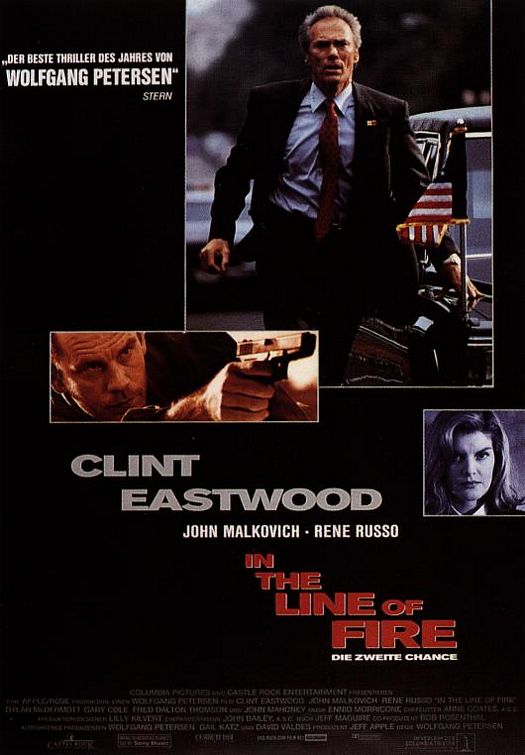
In the Line of Fire

Today is President’s Day and I will review an amazing movie, “In the Line of Fire,” released in 1993. Thrillers are as good as their villains, and “In the Line of Fire” has a great one – a clever, slick jerk who dangerously lairs his way into the mind of the hero, a veteran Secret Service agent named Horrigan, played by Clint Eastwood. The jerk, who likes to play mind games with his opponents, makes a series of phone calls threatening to murder the President. He picks Horrigan because he knows the agent still feels guilty about not being able to save John F. Kennedy’s life 30 years ago.

The would-be killer has an all-American name, Mitch, played by over the top actor John Malkovich as an intelligent, twisted man who uses disguises, fake ID and an interesting way to get close to the President. He more or less tells Horrigan what his plan is, and when, but Horrigan has his hands tied. The president is running for re-election, and his chief of staff, played by Fred Dalton Thompson, doesn’t want him to look like a coward. After Horrigan gives off a couple of false alarms, he’s taken off the White House detail, and has to break the rules so he can stay on Mitch’s trail.

In its large outlines, “In the Line of Fire” has a story similar to many of Eastwood’s “Dirty Harry” movies, where a mental killer plays games with a cop, who is ordered off the case and then continues as a free-lance, helped by a loyal partner. The movie even gives a typical Eastwood sidekick, a female agent played by Rene Russo, who is tough and capable, and able to fall in love.

Roger Ebert mentioned in his review, “Despite the familiar plot elements, however, "In the Line of Fire" is not a retread but a smart, tense, well-made thriller - Eastwood's best in the genre since "Tightrope" (1984). The director is Wolfgang Petersen ("Das Boot"), who is able to unwind the plot like clockwork while at the same time establishing the characters as surprisingly sympathetic.”

Horrigan, the Secret Service agent, still blames himself for Kennedy’s assassination. He feels he could have made some sort of a difference. Mitch has done his research, knows all about Horrigan, and dangerously slips into his minds with words aimed like painful darts. Soon the assassination attempt becomes a two-handed game, in which Horrigan is as much of an outsider as Mitch, and must protect the President almost against his will – and the will of his politically determined staff.

Russo, as Lily, another agent, finds an interesting difference on the role of associate and love. Ebert commented, “Her relationship with Horrigan begins on a rocky note, when he drops a couple of sexist statements, essentially accusing the Service of tokenism for hiring women. Well, OK, he's an unreconstructed chauvinist pig, but eventually their respect for each other grows, and there is a wonderfully played moment when they concede they are attracted to one another.”

Meanwhile, the plot moves forward insistently. Ebert remarked, “After seeing "The Firm," which was good but needlessly labyrinthine, it was a pleasure to follow the twists and turns of Jeff Maguire's screenplay for "In the Line of Fire." It doesn't waste a line.” Horrigan takes clues that Mitch gives him, uses sixth sense and experience, breaks agency policy when needed, and eventually finds himself testing the enthusiasm that all Secret Serviceman are supposed to have – to take a bullet in place of the President.

Eastwood is perfect for this role, as a man of a lot of experience and deep feelings. He is set off by an inspired performance by Malkovich, who is quiet and careful and very clever, and plans a sneaky plan to work his close to the President with an original murder weapon. The movie’s climax is exciting not only because of its action, but also because of its perfect logic.

What’s surprising is how much time the movie finds for small touches of realistic detail and emotion. The conversations between Eastwood and Russo – about work, jazz, strategy and romance – sound as if they’re taking place between real people. The locations look convincing, especially Air Force One and some shots apparently inside the White House. The special effects are good at interesting a young Eastwood into 1963 footage of Kennedy; setting up the character’s need to stop the new assassination he feels is going to happen. And the direction of the last scenes is as amazing as it is clever.

Yes, it’s doubtful that Mitch the killer would jump into the elevator (Ebert comments, “it's an example, in fact, of the Fallacy of the Climbing Killer, in which villains always make the mistake of heading for a high place”). But it allows for an earlier situation to come back again as a marvelous payoff. Most thrillers these days are about stunts and action. “In the Line of Fire” has a mind.

Definitely see this movie because it is worth checking out. I hope that everyone does watch this because it’s great to see Eastwood and Malkovich together, whether they are talking on the phone, or when they finally meet in person. Their scenes are just phenomenal together.

Stay tuned this Friday for the third entry in Black History Month Movie Reviews.

Monday, February 17, 2014

Lincoln

Happy President’s Day everyone! Today, I would like to honor my personal favorite president, Abraham Lincoln. And what better way to do that then by taking a look at Steven Spielberg’s 2012 historically accurate masterpiece, “Lincoln.”

The late Roger Ebert said, “I've rarely been more aware than during Steven Spielberg's "Lincoln" that Abraham Lincoln was a plain-spoken, practical, down-to-earth man from the farmlands of Kentucky, Indiana and Illinois. He had less than a year of formal education and taught himself through his hungry reading of great books. I still recall from a childhood book the image of him taking a piece of charcoal and working out mathematics by writing on the back of a shovel.”

Lincoln lacked social polish but he had a vast amount of knowledge on human nature and was smart in that area. The trademark of this great President, played so powerfully by the great Daniel Day-Lewis, is calm self-confidence, patience and an eagerness to play politics in a realistic way. The film looks at the final months of Lincoln’s life, including the passage of the 13th Amendment that ended slavery, the surrender of the Confederacy and his assassination. Rarely has a film focused really carefully to the details on the politics.

Lincoln believed that slavery was morally wrong, but he also thought the 13th Amendment was an effort in cutting away the financial establishments of the Confederacy. In this film, the passage from the 13th Amendment is guided by William Seward, played by David Strathairn, his secretary of state, and by Rep. Thaddeus Stevens, played by Tommy Lee Jones, the most powerful abolitionist in the House. Any performance in this movie does not depend on self-conscious histrionics. Particularly, Jones plays a crafty weirdo with some secret hiding areas in his heart.

The capital city of Washington is portrayed in this film as a vicious gathering of politicians on the make. The images by Janusz Kaminski, Spielberg’s frequent cinematographer, use earth tones and muted indoor lighting. Ebert mentioned, “The White House is less a temple of state than a gathering place for wheelers and dealers. This ambience reflects the descriptions in Gore Vidal's historical novel "Lincoln," although the political and personal details in Tony Kushner's concise, revealing dialogue is based on "Team of Rivals: The Political Genius of Abraham Lincoln" by Doris Kearns Goodwin. The book is well-titled.” The film is not about an icon of history, but about a President who was disrespected by some of his political opponents as (Ebert puts it) “just a hayseed from the backwoods.”

Ebert says, “Lincoln is not above political vote buying. He offers jobs, promotions, titles and pork barrel spending.” He isn’t even slightly unenthusiastic to spend the low-handed strategies of his chief negotiators (Tim Blake Nelson, James Spader, and John Hawkes). That’s how the game is played, and indeed we may be reminded of the arm-bending used to pass the civil rights legislation by Lyndon B. Johnson, the subject of another biography by Goodwin.

Daniel Day-Lewis, who has a fix on an Oscar nomination, changes Lincoln. He is soft-spoken, a little bent, tired after the years of war, concerned about having anymore soldiers die. He communicates through stories and tales. At his side is his wife, Mary Todd Lincoln, played by the very lovely Sally Field (typically sturdy and spunky), who is sometimes seen as a social climber but here is focused as wife and mother. She has already lost one son in the war and is afraid of losing another. Their other son, Robert Todd Lincoln, played by Joseph Gordon-Levitt, refuses the benefits of the family.

There are some battlefields in “Lincoln” but the only battle scene is at the opening, when the words of the Gettysburg Address are spoken with the greatest possible impact, and not by Lincoln. Kushner also smoothly merges the wording of the 13th Amendment into the film without making it sound like a mandatory history lesson.

The film ends soon after Lincoln’s assassination. I would assume that audiences would want that in the movie. There is an earlier shot, when it could have ended, of President Lincoln walking away from the camera after his amendment had been passed. The rest belongs to history.

In the end, go see the movie, it’s a fantastic movie. You will love Spielberg for getting this film very accurate, and it’s appropriate for today. I hope you enjoyed my review and stay tuned for this Friday for the third entry of my “Black History Month Movie Reviews.”