Friday, October 6, 2017

Halloween: The Curse of Michael Myers

“Halloween: The Curse of Michael Myers,” released in 1995, is a mess in storytelling, but director Joe Chappelle does do an agreeable fall savoring to this otherwise ordinary fifth sequel. Set six years after “Halloween 5: The Revenge of Michael Myers,” 15-year-old Jamie Lloyd, now played by J.C. Brandy, has disappeared, having been scared off by Michael Myers (George P. Wilbur) and his friend, the mysterious Man in Black (Mitchell Ryan). After giving birth, Jamie runs outside in a rainy night (it’s Halloween night, obviously) with her newborn, succeeding in secretly hiding him away after getting impaled on a farm tool. Having heard Jamie’s voice on the radio begging for help, an adult Tommy Doyle, played by Paul Rudd, locates the baby at the Haddonfield bus stop the next morning. In a sudden twist (or just poor writing), Tommy coincidentally lives across the street from the Myers house, now housed by the dysfunctional Strode family, relatives of Laurie’s parents. Despite everything, single mother Kara (Marianne Hagan) and six-year-old Danny (Devin Gardner) – not to mention Kara’s mother (Kim Darby), father (Bradford English) and brother Tim (Keith Bogart) – have no idea of their home’s dark history. Dustin Putman stated, “Did I mention Haddonfield is gearing up to celebrate Halloween for the first time in over half a decade?” “Halloween: The Curse of Michael Myers” pays respectful honor to the original the entire time – Danny, like Tommy, drops a pumpkin as he walks home from school. Kara and Danny run across the street and start knocking on the door to be allowed inside as Michael is closing in behind them – but the film is taken down by a ridiculous planning involving warlocks, druids and Thorn that don’t even belong in a movie about a villain who is supposed to be “purely and simply evil.” Donald Pleasence, in his final screen role before he passed, reprises one last time as Dr. Sam Loomis, but gets a disrespectful send-off in the movie’s final act.

Here’s a special note Putman put at the end of his review, “A controversial Producer's Cut (or P-Cut, as it's called by those in the know) of "Halloween: The Curse of Michael Myers" has been bootlegged around for years. This was to be the released version until the powers-that-be chopped it all up. Having seen the P-Cut myself, I can say that it is no better than the theatrical version, with a much-changed climax that nonetheless is still a disaster of story holes and asinine writing. If anything, the theatrical cut is slightly better, with a cool, moody rock-tinged music score of the well-known original themes and peppier pacing. Both, however, leave a lot to be desired.”

I have heard about the Producer’s Cut when I saw James Rolfe’s review on this film a few years back. I have only seen the Theatrical Version, so I have no idea what goes on in the Producer’s Cut. Although I do hear that it’s probably worse than the Theatrical Version, so I think I might be better off not knowing what goes on when watching the Producer’s Cut, even though certain questions are answered, but more are asked.

Anyway you look at it, “Halloween: The Curse of Michael Myers” is a mess. This, in my opinion, started the downhill slope when it came to the franchise. People like to call this the “Thorn Trilogy,” which it can be, but I also like to call this the “Jamie Trilogy,” because it focuses on her. However, this is first in the series that I say to skip because you will not like this one at all. You will instead be asking what you’re watching and ashamed that they made the series go this bad.

Well everyone, just look out tomorrow when I look at the installment that came out on the 20th Anniversary of the first film that actually would have been nice if they left it off there in the continuation of “Halloween-a-thon” in this year’s “Halloween Month.”

Thursday, October 5, 2017

The LEGO Movie

Any film allowing a toy product in its title, and occupied by brand-name toys, is going to fall under thought as nothing more than something that is just wanting to have people buy their products from toy stores.

Then let’s take a look at the surprising success of directors and co-writers Phil Lord and Christopher Miller (“Cloudy With a Chance of Meatballs”). With their animated 3D adventure film, “The LEGO Movie,” released by Warner Bros in 2014, they not only give a switching hilarity for both adults and children, they also manage to include a surprisingly critical spoof of traditional consumerism into the events.

An everyday person of that modern style, ordinary construction worker Emmet, voiced by Chris Pratt, just goes along with the people in his boring hometown of Bricksburg. He buys expensive coffee, laughs at the right moment at a mindless, one-joke show called “Where Are My Pants?” and loves the same upbeat catchy pop song – Everything Is Awesome – like everyone else.

Emmet also trusts totally in the local expert of weakness, creativity-hating CEO President Business, voiced by Will Ferrell.

John Mulderig stated in his review, “Two closely related events are destined to rock Emmet's contentedly brain-dead world, however. One is his accidental acquisition of a fabled building block called the Piece of Resistance.” The other is his run-in with touch but attractive underground protester Wyldstyle, voiced by Elizabeth Banks, a rebel average excellence who he immediately falls in love with.

Based on him holding the Piece of Resistance, that she has been looking for, Wyldstyle is sure that Emmet is a prophesied hero called The Special. According to the legend, he is the one to lead a team against President Business. Mulderig said, “Unbeknownst to the public, behind the scenes this evil would-be tyrant prefers the title Lord Business, and he has a scheme on foot to control the world, and purge it of all originality, using a secret weapon.”

He’s sure that a mistake has been made – his total lack of the needed requirements soon has Wyldstyle herself showing doubts about him – Emmet sort of unwillingly agrees to do his best.

Joining Emmet and Wyldstyle in their journey to take down the aspiring dictator is an oddball team of fighters that includes Wyldstyle’s narcissistic boyfriend, Batman (Will Arnett), and Vitruvius (Morgan Freeman), the pixilated wise man who predicted The Special was coming in the first place.

The person who is trying to stop them is Lord Business’ right-hand man, Bad Cop-Good Cop, voiced by Liam Neeson. Just like his name says, this police officer is both hilariously schizophrenic and legitimately facing between the positive and negative sides of his own personality.

Mulderig said, “Colorful and fast-paced, "The LEGO Movie" sails along toward a format-shifting conclusion that adds another asset to the rich mix: a touching sequence promoting family bonds over selfishness.”

As the movie runs, confusing use is made of the phrase, “the man upstairs.” Some may think this repeated reference as guessing that God himself – or maybe religion – is just another source of forced order against what the characters are rebelling. Mulderig ended his review by saying, “But those disposed to resist such a reading are given an out when the words receive a quite literal fulfillment close to the movie's wrap-up.”

If you haven’t seen this movie, why read this review? Go out and see it if you haven’t. It’s definitely one of the funniest kid’s movies you will have ever seen. You will be laughing from first minute to last and will have a great time with it. After seeing it, the song Everything Is Awesome will continuously play in your head to a point where you buy that song off of iTunes.

That would be the end, but we have two spin-off movies to talk about, so let’s jump into the first one.

Peter Travers started his review out by saying, “Is it possible that every movie would be better with Legos? Suicide Squad, for sure. And, of course, Batman v Superman: Dawn of Justice. How do I know?” Because “The LEGO Batman Movie,” released back in February, animated with love and insanity, is the funniest Batman movie ever made. Will Arnett may have found the role of his career as the voice of the raspy superhero as a delusional, ego-maniac Batman wanting and willing to get laughs out of his own obsession, Hollywood’s dark soul of every Bruce Wayne/Batman from the late Adam West to Ben Affleck. Travers stated, “The kids are gonna love it, even if the inside jokes, Freudian subtext and subversive jabs at corporate America sail right over their towheads. As for the, grown-ups, they'll eat up the antics of this newly lighthearted DC vigilante. "I have aged phenomenally," he beams. And for the under-10 crowd – pampered with poopy-level sight gags and "wanna-get-nuts" action – everything is PG awesome.”

If any film is at the top of the business, it’s “The LEGO Movie,” which was made first and was a huge hit in the crazily creative minds of co-directors/co-writers Phil Lord and Christopher Miller. That team is now off to make the Han Solo “Star Wars” spin-off, and their mischievous disrespect is really missed in Gotham City. However, Chris McKay steps right up to bat, and since he was animation director and editor on “The LEGO Movie,” he already knows what to do.

Travers said, “It begins in the dark: "All important movies start with a black screen," explains Arnett's Batman, satirizing the comic-book universe in one fell voiceover swoop. (Funny idea. It would have been funnier if Deadpool hadn't beaten it to the punch, but still.)” The story, which has so many writers that you have to look up and see, starts as Batman the loner is fighting the Joker, voiced by Zach Galifianakis, the surprisingly sensitive villain who wants Batman to admit that they “complete” each other. Startled, Batman sends the Joker into the Phantom Zone, a somewhat alternate dimension for arch-villains (including Sauron (Jemaine Clement), King Kong (Seth Green), the Wicked Witch, Dracula, Godzilla, Lord Voldemort and Agent Smith from “The Matrix”). Eventually, there’s a breakout, thanks to The Riddler (former writer on SNL and “The Simpsons,” former host of “The Late Night” and “The Tonight Show” and current host of “Conan,” Conan O’Brien), Harley Quinn (Jenny Slate) and Two-Face (Billy Dee Williams) teaming up. Can this orphan superhero, who can’t forget the murder of his parents, beat them alone? Are you kidding? Travers stated, “How long do you think this dude can sit alone in his Lego Batcave eating microwaved Lego lobster thermidor before he realizes he needs a surrogate family to help him?”

That’s where Alfred (Ralph Fiennes), Wayne’s butler and other father figure, and Dick Grayson (Michael Cera), the adopted son who’s soon has his own superhero suit and calls himself Robin comes in. “He’s not my son,” insists Batman. “It’s even weirder if he’s not,” says new police commissioner Barbara Gordan, voiced by Rosario Dawson, also champions the sass area. He wants to call her Batgirl. “How about I call you Batboy?” she replies.

As the trouble increases, the movie goes completely insane in ways the first Lego movie did not. It’s easy to get distracted with everything going around and never really connecting into a main story. Travers said, “My advice? Don't obsess over the rough edges. The Lego Batman Movie rises on its own goofball spirits. Wanna get nuts and shake your sillies out? This is the place to do it.”

This is not as funny as the first movie, but it’s still almost as funny and worth seeing. If you like to see a good spoof on Batman, this is the movie for you. It’s good for adults and children again, and it’s fast-paced that you won’t be able to catch up with every joke, which is good.

Now it’s time to come to the latest spin-off, “The LEGO Ninjago Movie,” which came out two weeks ago.

In Ninjago, every day is the perfect day for the evil Garmadon, voiced by Justin Theroux, to attack with his mechanized shark-dressed minions to try and take over and rule the city. Fighting against him each and every time are a team of mechanized Ninjas, all given codenames representing the Earth’s elemental powers like Water, Earth, Lightning, Ice and Fire. What Garmadon doesn’t know is that his own teenage son Lloyd (James Franco’s youngest brother, Dave Franco), aka Green Ninja, is the leader of the team, his best friends from High School, in actuality his only friends thanks to being the son of the “Worst Guy in the World,” Cole (Fred Armisen), Jay (star of the HBO series “Silicon Valley,” Kumail Nanjiani), Kai (Michael Peña), Nya (star of “Broad City,” the hot Abbi Jacobson) and Zane (Zach Woods) the other members of the team. Is anyone else thinking Power Rangers?

Going against the teachings of the group’s wise teacher Master Wu, voiced by Jackie Chan, and tired that his dad, as evil as he is, refuses to recognize him as anything other than a thing from the past and rarely as his son, Lloyd hits him with the Ultimate Weapon. Unfortunately, that brings the giant cat Meowthra to Ninjago, destroying everything in its path with it paws. Now, forced to team up with Garmadon, Master Wu and the kids have to walk into the forbidden forest in order to find the Ultimate Ultimate Weapon, needed to get this cat threat out of their peaceful city. As they make this dangerous walk, every one of them learn things about one another they never knew beforehand, while Lloyd and his evil father make a family bond that very well could change both of their lives forever.

After the huge success of “The LEGO Movie” in 2014, it’s no surprise that Warner Bros was going to do everything in their power to make more box office money as often and frequently as they could. Back in February they made the successful “The LEGO Batman Movie,” that animated comedy getting positive reviews and audience love in basically equal ways. Sara Michelle Fetters stated in her review, “Now comes The LEGO Ninjago Movie, inspired by the long-running “Ninjago” animated television series, and from my understanding far more comedic and ridiculous than the show is.” It’s going to be a really huge hit, just like the past entries. More importantly, it’s actually also really amazing.

Giving us a story and script credited to nine different writers, asking for any type of narrative structure here isn’t a good idea. Fetters said, “Same time, like a great piece of sketch comedy, all of the numerous vignettes feeding the central storyline are so consistently amusing the fact all of this goes way beyond nonsensical into the realm of outright absurdity isn’t as big a problem as it might otherwise have been.” The jokes go by really quick, both verbal and visual (there’s even a Locke joke), and it will probably need multiple viewings to even start to notice so many of them. Fetters said, “I admit to having a giant grin on my face all the way through, even during the live-action prologue featuring Chan as a kindly shopkeeper telling a tale of heroism, sacrifice and forgiveness to a wide-eyed youngster, played by Kaan Guldur. The movie is just a heck of a lot of fun, and to my mind is an even more successful piece of family-friendly pop entertainment than The LEGO Batman Movie ended up proving to be.”

Fetters goes on to say, “I love the vocal cast, especially Chan, Franco and Theroux.” Everyone looks like they are having so much fun voicing these characters into life.  Better, their energy and excitement jumps off the screen. Particularly, Theroux is completely loony. Fetters noted, “The stuff he says (as well as the way he says it) is consistently hysterical, some of his off-the-cuff asides worthy of a gigantic belly laugh all by themselves.” However, the whole cast has their moments, especially Jacobsen and Nanjiani, while Oliva Munn has an enjoyable time voicing Lloyd’s cheerful overprotective mother Koko, a confidently determined woman with a samurai past of her own.

Everything is obviously funny, and some of the extended jokes don’t have as much hits as the film goes on, most notably a joke where Garmadon’s never-ending series of generals getting shot out of a volcano for not coming up with good ideas for dominating Ninjago. Fetters said, “But visually there’s so much going on there was always something that drew my attention in a positive way, and I honestly feel like this latest LEGO offering is the most fantastically and imaginatively animated one yet. The LEGO Ninjago Movie made me giggle, start to finish, and to my mind saying anything more than that just isn’t necessary.”

I noticed that this movie isn’t really getting as good reviews as the past two, but my brother and I saw it this morning and we thought it was a fine, funny kid’s film. I personally think this is good and has the right amount of jokes that is hard to keep up with, so if you liked the first two LEGO movies, then definitely see this one, especially if you have children, they will love it.

Alright everyone, now that I have done “The LEGO Trilogy,” there will be a sequel next year, stay tuned tomorrow for the continuation of “Halloween Month.”

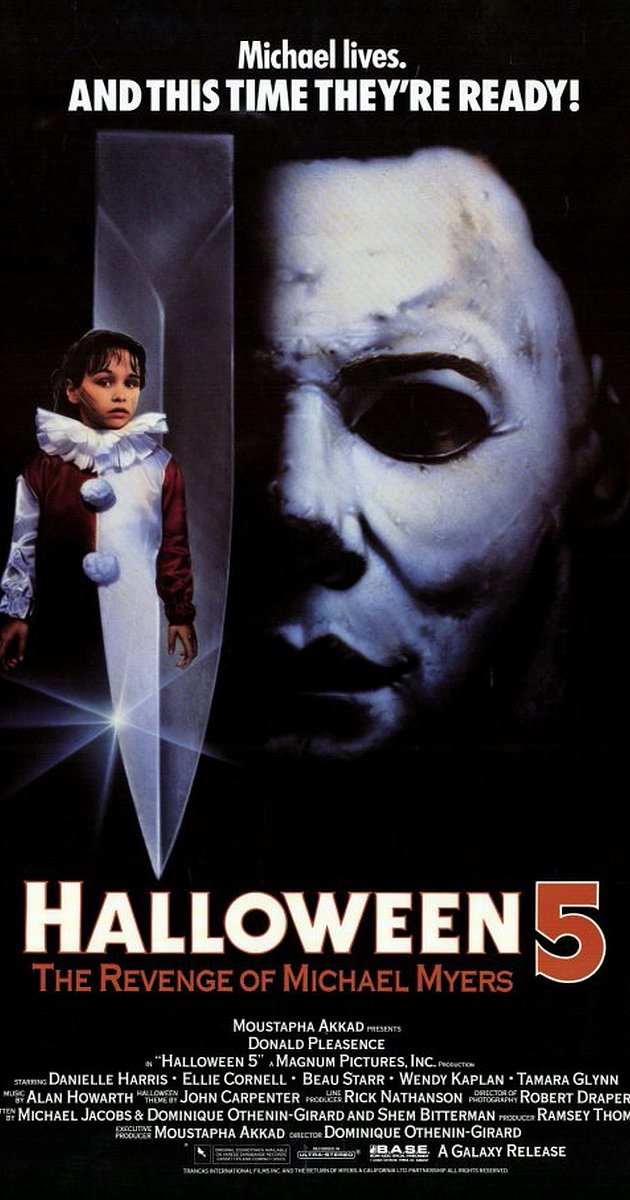
Halloween 5: The Revenge of Michael Myers

Assumed to be dead after getting showered with bullets by the Haddonfield police, Michael Myers, played by Don Shanks, is secretly taken care of – and returns a year later to start back with his murder. He once again goes after his young niece, Jamie, who’s recovering in the local children’s hospital after attacking her stepmother, played by Karen Alston, and losing her voice. Jamie’s mental link with Michael may be the key to continuing the family trait.

The residents of Haddonfield, Illinois now have to go up against the revenge of Michael Myers. Doing exactly the same thing “Halloween II” did, this installment picks up exactly where “Halloween 4” left off. “Halloween 5: The Revenge of Michael Myers,” released in 1989, exactly one year after the last one, with many characters return in here as well. Dr. Loomis returns along with Ellie Cornelle, Danielle Harris and Tina Williams (Wendy Kaplan).

After the traumatizing events of “Halloween 4,” Jamie is now in a children’s clinic being watched by Dr. Loomis. This nightmare was evidently a lot for the 9-year-old to take in, so she has not spoken a word. Michael, assumed dead after being blown by dynamite in a mine shaft, has been in a coma for an entire year while being taken care of by a hermit, played by Harper Roisman, on the edge of town. (Apparently the Haddonfield police department did not go for a good search in the town.) To continue with the Myers’ story and to make another sequel, Michael awakens on Halloween Eve, kills the hermit, and then goes to find his nice. Only this time Jamie can feel what killings her uncle is doing.

Jamie’s mental connection with Michael gives the story an interesting twist, and is not a complete redoing of the “good overcome with evil” trait. Her stepsister Rachel is back, but only for a short time. Michael ends up killing her in the first 20 minutes. Austin Hinderliter stated in his review, “Can you say BIG mistake? After the release the producers acknowledged their error by killing off Cornelle’s character. Hey, at least they admitted a fault. But it was nevertheless sad to see such a beloved character go.” Now that Rachel has bought the farm, we see her friends for the rest of the film: the 80’s icon Tina, the airhead Samantha (Tamara Glynn) and their boyfriends Michael (Jonathan Chapin) and Spitz (Matthew Walker). Hinderliter said, “For the first time in a Halloween movie, the characters are all cardboard cutouts.” The only thing they want to do is get drunk and make out. Somehow everything still seems to work. That might be because every character is surpassed by the amazing performances from Pleasence and Harris.

Continuing the story, “Halloween 5” is also famous for bringing a new character – the mysterious “Man in Black,” also played by Shanks. He has a Celtic symbol tattooed on his wrist, which looks exactly like the one Michael has on. (I think that was seen in the later sequels.) Nobody, even the crew during production, knew what his reason was. This character would be responsible for leaving the ending with questions for a sequel. Many say this subplot ruins this film. I agree with Hinderliter when he said, “But the “Man In Black” does not bother me, in fact I think he works to Halloween 5’s advantage.” The movie has a mysterious theme in it anyway, and this just does that.

In between the “Man in Black” walking through the streets of Haddonfield, Michael edges toward Jamie. She continues to feel he’s there throughout the film and with the help of a friend, Billy Hill, played by Jeffrey Landman, tries really hard to save Tina and her friends from being murdered by Michael. With most franchises, “Halloween 5” tries to give Michael some human feelings. Hinderliter said, “I find it to be effective here, because we as the audience feel the family connection between Jamie and Michael. Family is forever after all. Although I am not too fond of Michael being unmasked.” The final scene has a three-way fight between Jamie, Michael and Dr. Loomis in the old Myers’ house that is sure to please any fans of the Halloween franchise.

Hinderliter stated, “Now, let me enumerate the flaws of the film. Bottom line, it feels rushed. Going into preproduction directly after the release of Halloween 4, there was not much time to get the script perfected. And sadly it shows. The pacing is irregular at times, and some mistakes in continuity and editing are strikingly obvious. At times the words do not match up with the actors mouth even. Apart for the sparse Halloween decorations the movie doesn’t have much of a seasonal theme. Even though the film is set in October, the leaves are all green. But they were the same in the original, so I’m willing to overlook that. Overall though, this was a solid and grounded film.”

There are obvious errors in continuity connecting this with the fourth movie. The major one being Michael’s mask, because they change it from film to film. Hinderliter said, “I actually favor the mask in this entry over the lackluster one in H4. Another drastic difference is the Myers’ house, which has been transformed from a humble two story house into a multiple story Gothic mansion with wrap around porches and towers. Again, a change I do not have a problem with. The sequence with Dr. Loomis exploring the mansion is a personal favorite of mine.” Let’s not forget about the famous laundry chute part. That is suspenseful, claustrophobic and undeniably one of the more edge-of-your-seat scary moments in the series. Could all of that worked in the small house they made in the original? Most likely it would not have.

“Halloween 5” separates itself from the franchise when it comes to atmosphere and story. In all honesty, this actually works very well. Hinderliter said, “Girard brings a European feel to make this film stand out from the rest.” Let’s not forget the interesting opening credits, with the severe carving of a pumpkin with a butcher knife. That is, hands down, the strongest credit sequence in the franchise. Hazy lighting, Gothic houses, dropping shadows, and creaking barns give “Halloween 5” a stylish and successful sequel in this ongoing horror series.

I know that people didn’t like this film, but I personally thought this was better than the fourth. I do acknowledge the faults, like throwing away the idea of how the fourth film ended. However, I think the makers thought that they would be repeating the same plot threads if they made Jamie go down the same path as Michael. With her not speaking for the first 45 minutes, I thought was really effective. I actually feared for her throughout the film, and I liked the connection she tried to make with Michael in order to make him human. I do get that he should look more burnt and zombie like, but I don’t know why they made his face look normal. Plus, I think he was trying to be human, especially since he didn’t really hurt Jamie, seeing how it was his niece, so he was being like Two-Face that was fighting his split personality. Goes with the Thorn symbol they were doing. Definitely see this one and give it a chance.

Well, I’m sad to say it’s all downhill from here. If you want to know what I mean, check in tomorrow for the continuation of “Halloween-a-thon” in this year’s “Halloween Month.” Also, review to come later today since my brother and I went to see a movie that is based on our favorite toy product.

Wednesday, October 4, 2017

Halloween 4: The Return of Michael Myers

After the wrongfully hated “Season of the Witch,” Moustapha Akkad and crew simply restarted the Halloween storyline by completely remaking the first film. While it does add some new stuff, “Halloween 4: The Return of Michael Myers,” released in 1988, is half restart and half remake. It’s also the start of another story arc about Michael and his evil mark of Thorn. After Michael was burnt in the second movie, Michael has been in a coma for a decade and is kept under high supervision in a hospital. During a transfer, Michael, played by Tom Morga in this scene, is now conscious and kills every guard that gets in his way. Dr. Loomis returns and looks into the ambulance crash Michael was in. While the police are sure Michael died in the crash, Loomis is determined that Michael is still alive and is out in the public.

We see young Jamie Lloyd, an adopted and disturbed little girl with a weak personality who is close to her foster sister Rachel, played by Ellie Cornell. Continuously haunted with nightmares and visions of Michael Myers, she wants to forget her problems with Halloween preparations, as Rachel also has relationship problems with her boyfriend, played by Sasha Jesnon. Jamie is an interesting and very convincing character with a nice back story that makes her the perfect follow-up to Laurie Strode. That is because we find out she’s Laurie’s daughter.

Danielle Harris (who was very adorable in this movie) gives a very realistic and brave performance as young Jamie who has trouble with the scary dreams of Michael, while giving one of the greatest screams in horror movie history. Harris manages to turn Jamie into a heroine we can cheer for and sympathize with, and she successfully puts the viewers in her trouble. Like Laurie, Michael, now played mostly by George P. Wilbur, is sadly the person she has to fight alone. He’s quickly traveling all the way to Haddonfield once again. For some reason, Haddonfield is still just a quiet town and has done nothing to recover the Myers curse at all. The residents are still wearing his mask during Halloween. You would think the town would not allow the mask after what Michael has done.

Felix Vasquez stated in his review, “Nonetheless, director Dwight H. Little manages to evoke some sense of tension every so often, with Loomis’ attempts to warn police about Myers re-entering Haddonfield, while Jamie and Rachel become victim to Michael’s murderous rampage. Once again under Akkad’s presence, Michael becomes another routine masked slasher who has a knack for doling out some painful murders, and “The Return” is changes its narrative mid-way from a stalk and slash to a suspenseful mission involving Rachel’s efforts to keep Jamie alive.” Even though this is not the best in the franchise, it’s an enjoyable slasher film with a very good final scene that takes the cake compared to the other titles in the franchise.

Despite this was a superfluous entry in the franchise, it’s actually not a bad film. It’s good, and if you were one of those people that wanted Michael Myers back after the third movie, your wish has been granted. So if you didn’t like the third one, you’ll like this one. I personally think the third one was a good movie that was wrongfully hated, but I think this one is better.

Check in tomorrow when we look at another wrongfully hated entry in my “Halloween-a-thon” in this year’s “Halloween Month.”

Tuesday, October 3, 2017

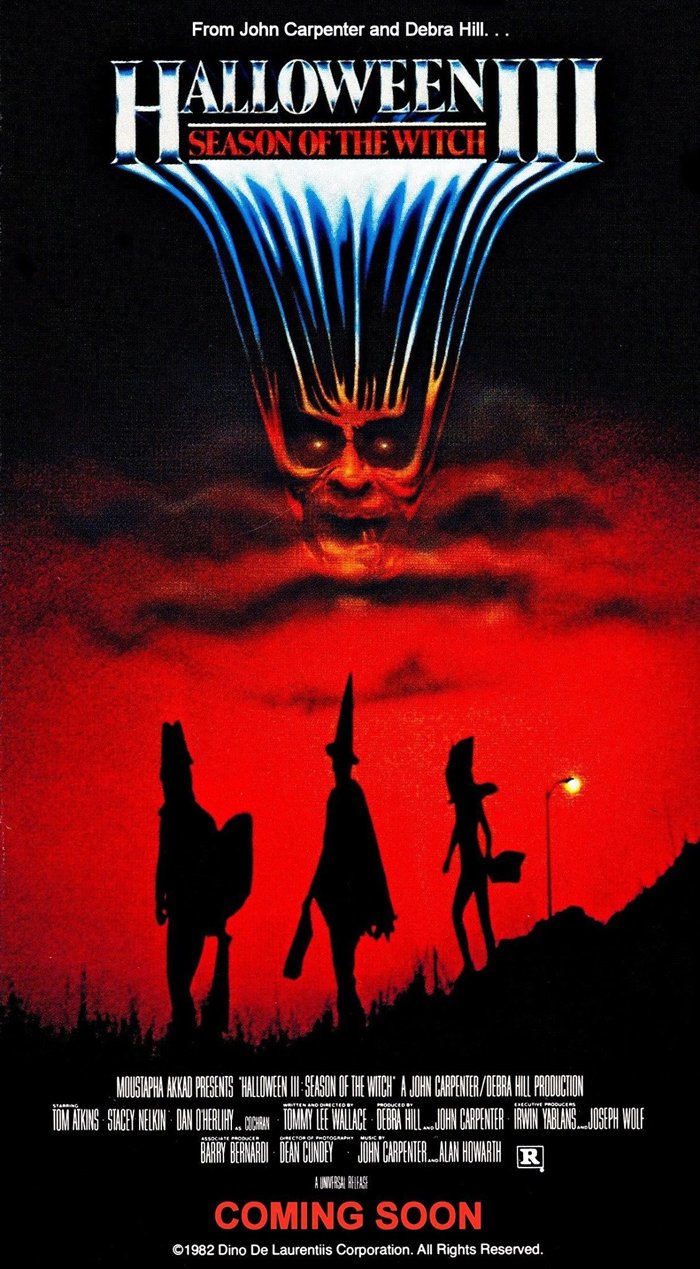
Halloween III: Season of the Witch

“Halloween 3: Season of the Witch,” released in 1982, is one of the perfect examples of expectations being beaten. Jeffrey M. Anderson stated in his review, “By that, I mean that audiences were disappointed by what they didn't see rather than what they did see; and in their disappointment, they failed to register what it was they actually saw.” This happens quite often in movies, especially in sequels and remakes. Basically, filmmakers had the idea that in this movie they didn’t want to create new Michael Myers stories, and decided to start a new series of Halloween-themed movies that told different, new stories, each year. That idea was discarded after this movie because irritated fans saw that Michael Myers wasn’t in here.

It wasn’t the fact that this movie was filled with hilariously bizarre ideas, some really dark, horrific stuff, and some completely insane stuff. Tom Atkins plays Dr. Daniel Challis, a divorced dad who spends more time at work flirting with nurses and drinking beer than he does with his kids (Joshua John Miller and Michelle Walker). A strange man, played by Al Berry, checks himself into the hospital holding a rubber Halloween mask. Before long a strange man in a suit, played by Dick Warlock, kills him and then goes kills himself in his car. The dead man’s daughter, Ellie, played by Stacey Nelkin, arrives and decides to look into the creater of the mask. Her father ran a store that sold the masks. For some reason, Dr. Challis goes with her.

They arrive at the factory, located in a small town and the boss is Conal Cochran, played by Dan O’Herlihy. They sleep in the hotel room and then take a tour of the factory. Clearly Cochran has some secrets. What’s really happening is that he has stolen so much of Stonehenge, and is using parts of it inside a computer chip attached to each mask. Then he airs a dangerous television commercial with a catchy jingle. When the children wear the masks and watch the commercial on Halloween night, their faces will melt and (weirdly enough) roaches and bugs will come crawling out from under their masks. The man in the suit earlier apparently was really a robot and Cochran has made an army of them.

What’s odd is that the movie looks like John Carpenter made this. Director Tommy Lee Wallace had been a production designer and editor on the original “Halloween,” and Carpenter was around on this installment as a producer, an uncredited co-writer, and as a co-composer for the scary, synth soundtrack (co-composed by Alan Howarth). Anderson noted, “Wallace uses the widescreen similarly to Carpenter, the wide composition creating a sense of false security, with threats hiding just outside of frame.”

The real deal to this movie is its strange depiction, combining all those dark, different scares, and building up to a really dark ending as Dr. Challis tries to get every TV channel to stop airing the commercial before it’s too late. Anderson said it best, “The movie isn't exactly scary, or even gory, but it's rather unsettling, and it's rooted in that old standby that evil corporations are out to get you, at any cost.” However, after thirty years of bashing, “Halloween 3: Season of the Witch” is starting to gain the status of a cult film from slasher fans.

I agree with James Rolfe when he stated that this film isn’t as bad as everyone said it was. I understand that people were mad because Michael Myers wasn’t in it, but I actually would have accepted the idea of the filmmakers going off on an anthology and telling separate stories about people returning Halloween to its sacrificial origins. Imagine all the horrible stuff that can happen on Halloween night? Why did fans want more of Michael Myers, especially when the final act of “Halloween 2” felt like it ended it off perfectly right there? Maybe because they loved slasher villains so much that they wanted more of that. Well, jokes on them because the series really started to go off in a bad direction from here.

If you want to know what I mean, you’ll have to wait until tomorrow to find out. In the mean time, definitely watch “Halloween 3” and give it a chance because this film has been, like the second one, wrongfully hated and shouldn’t be. Instead, try and accept it for at least trying something new, like I did. When you watch the film, you won't stop singing the jingle Happy, Happy Halloween, Silver Shamrock.

For those who are probably wondering what I mean by bringing back Michael Myers in the next sequels, stay tuned tomorrow to find out what I mean in "Halloween Month."

Monday, October 2, 2017

Halloween II (1981)

When “Halloween” became the highest-grossing independent film of all time when it came out in 1978, it was given a sequel that wouldn’t be long from then. Still, how could a sequel even try to meet the success of the previous film, a horror masterpiece that helped heavily in the creation of the slasher genre? Well, it doesn’t. “Halloween II,” released in 1981, is great for many reasons; the first of it being its frightening visuals, but it’s not “Halloween.” However, the first two films in the series are about the same feel, pace, tone, atmosphere, and look, which is all the more useful seeing how they take place on the same night. Dustin Putman stated in his review, “Viewers could edit "Halloween" and "Halloween II" into one three-hour epic, the latter picking up immediately where the former left off, and the transition between pictures would be nearly seamless.”

When Michael Myers disappeared after Sam Loomis shot him six times off the Doyles’ balcony, Loomis runs from the house to try and catch up to his escaped patient’s path. As Michael silently makes his way through the neighboring houses, stealing a knife from the old, sandwich-making Elrods, and killing another victim in the home-alone Alice, played by Anne Bruner, a wounded and frightened Laurie Strode is taken by ambulance to Haddonfield Memorial Hospital. Putman said, “It isn't long before Myers has reached the medical center himself, determined to find Laurie even as he paints the staff red.”

Directing from a screenplay by John Carpenter and Debra Hill, Rick Rosenthall masterfully has tried to copy the at purpose but fascinating pacing and overall feel of “Halloween.” Supposedly, it wasn’t Rosenthall but Carpenter who did the post-production reshoots to add more violence and gore effects in the film. Of course, this is one of the problems of “Halloween II” that separates it from the original, not having the control and doing everything in showing people being burnt alive or having too much oxygen inserted in their head. Putman said, “Even as Carpenter misguidedly tried to compete with the most graphic "Friday the 13th"-style movies of the era, he could not destroy the classiness with which Rosenthal mounted the majority of the picture.” Whatever happened to Rosenthal in the short-term is beyond people. He came back for the horrendous “Halloween: Resurrection,” which is what everyone says is the worst in the series, but we’ll get to that soon enough.

Now about this madman who just is targeting three teenage girls, “Halloween II” happens to give him a certain objective and a more thorough back-story. As such, as Laurie is put under anesthesia and scarily tosses and turns in her hospital bed, she dreams of a childhood that shows she is Michael’s kid sister, adopted by the Strodes’ not long after Michael killed Judith and only knowing him through short visits to the mental asylum as a little girl. Putman said it best, “This certainly lends weight to the relationship between Michael and Laurie during the taut climax—a scene where Laurie waits for elevator doors to open as Michael approaches steadily from behind her is especially suspenseful—even as this plot hook was solely created for the sequel.” Until the final act, Laurie has little to do but be in a hospital bed and wake up for a short period before passing out again. Jamie Lee Curtis (by 1981 a complete scream queen wanting to come out to the mainstream) comes back in her role and is amazing when her character is awake. There is also a cleverly threatening story point, several times said, where head nurse Mrs. Alves, played by Gloria Gifford, tries to call Laurie’s parents to tell them what happened. Mrs. Alves is not able to call them – this is really suspicious as the night gets really late – and it doesn’t take long in the film or any later sequel what it is said what happened to them. Putman said it best, “It is just as well; the act of not knowing and imagining the worst is far creepier than the alternatives.”

With Laurie not being in the film that long and Loomis, along with nurse Marion, played by Nancy Stephens, try to find the links connected between Michael’s behavior and Halloween, a lot of the movie focuses on the hospital setting of doctors, nurses and candy-lovers working on Halloween. As they say jokes, fights, flirt, take care of patients (there are very few seen, except for a little boy who is one of the victims of the old razorblades-in-the-apple trick), and sneak out for some love, Michael Myers sneaks through the hallways, selecting his latest victims as he moves closer to Laurie. Putman stated, “The palpable air of October 31st is all over these almost observational scenes, with jack-o'-lanterns and decorations throughout, a few scenes in town featuring passersby in costumes” – one which has Ben Tramer (Jack Verbois), Laurie’s apparent crush from the first movie, and another where nurse Karen (Pamela Susan Shoop) late for her shift and having to drop off her friend Darcy (Anne-Marie Martin) off on her way to work – and a synthesizer-heavy music score by Alan Howarth (based on John Carpenter’s themes) that basically displays horror with a look of autumn.

Putman said, “"Halloween II" holds some sloppy holes in its script that the first movie did not, such as the way the hospital seemingly becomes deserted the further the film presses on, and the fact that the electricity goes out without much mind paid to it (this played a larger part in the director's cut, which occasionally airs on AMC). If one can overlook these logistical and editorial mishaps, the film is otherwise a well-made thriller, exquisitely photographed by the returning Dean Cundey and mostly respectful to the style of the original.” Just because Michael Myers is not in the front of a camera does not really mean he isn’t there, and director Rick Rosenthal is smart in not giving these scary moments by obvious hat-tipping, but letting viewers figure it out themselves. The long third act, where Laurie is chased by Michael and sees she is weak and helpless in the parking lot of the hospital, trying to get Loomis’ help but unable to scream when the car he is in arrives at the front door, is pitch perfect in building the nervousness and pending danger.

Finishing off with a three-person fight between Michael, Laurie and Loomis (Pleasance played this role with splendid willpower) that would look like the franchise had completed if it wasn’t for money, “Halloween II” is a more than solid if obviously weaker sequel. Even with its added violence afterwards, the film still has the same basic story, with masterful builded tension the main purpose was just to put together a body count. Putman said, “For Laurie Strode, her character arc is completed here (well, until 1998's "Halloween: H20"), encapsulated in the part-quixotic, part-eerie ending credits music cue of The Chordettes' "Mr. Sandman."” She may have started “Halloween” as a weak, soft, kind of innocent teenage girl, but she brought a start of a new era as a stronger, but also more tired and scarred young woman. In the last shot of “Halloween II,” Michael’s body and mask aren’t the only things being burnt, so is Laurie’s innocence.

If you saw the first movie and loved it, you should definitely check this one out. It feels like the only one that is about as good as the first one, and it felt like it was needed, even if it felt superfluous. This is a good sequel, and I recommend this to everyone, as if felt like the definitive cap and the right ending for the franchise. Please give it a chance and I’m sure all of you will like it. Yes, this is my 600th movie review, which is hard to believe.

Check in tomorrow for an underrated and wrongfully hated entry in the “Halloween-a-thon” reviews in this year’s “Halloween Month.”

Sunday, October 1, 2017

Halloween (1978)

Welcome everyone to the fifth annual “Halloween Month,” where this month I will be talking about the top three slasher franchises. Let’s get started with the first one, the 1978 classic, and one of the best, “Halloween.”

One of the more successful independent films in the slasher/horror film genre, it has become a yearly tradition to watch this film, and is a cult film. This was written and directed by John Carpenter, who also created the bone-chilling music, and was made on a low budget of $300,000. This is considered to be the archetype of the recent franchises of slasher films, while the others look like pale copies and lacks in comparison. “Halloween” gives the slasher series a better name than it probably got. This scary flick is well-made, and the gore is well-visualized and made second in its suspense. Another aspect is how it intelligently lets its forceful spark be shown in a frightening way against the background of the small town of Haddonfield. Dennis Schwartz stated in his review, “In a more amateurish and gruffer way it brings about the same tension that Hitchcock's "Psycho" did, though it's not up there in that film's stratosphere of greatness. What I appreciate most about this Carpenter flick, is that he goes for the suspense while showing as little blood as possible as he casually lets the viewer observe and even relate to the threatened teenagers without making a moral statement about their questionable behavior or trying to explain the enigmatic psycho on the loose except by borrowing from the manufactured Halloween tradition that he's the Boogie Man.” Carpenter definitely shows this, even if he doesn’t mean it to be looked at in this way, the film looks at the more middle-class America by having the one innocent teenager live through the Halloween massacre while every one of the girls desperate to be in bed with their boyfriends are the violent victims.

The film starts in the small town of Haddonfield, Illinois, as Judith Myers (Sandy Johnson) just finishes making love to her boyfriend (David Kyle) in her family house and when he leaves, she’s stabbed to death by her 6-year-old masked brother, Michael (Will Sandin) for no reason. The film jumps 15 years later to 1978 in an asylum in another small Illinois town, where the 21-year-old escapes (Nick Castle) by stealing the psychiatrist’s car who is treating him, Dr. Sam Loomis (the late Donald Pleasence).

The confused Loomis arrives in Haddonfield with a gun on Halloween night to warn Sheriff Brackett, played by Charles Cyphers, about the escape and the trouble the town will be in. Loomis has taken care of Michael since he was arrested 15 years ago and believes he’s finishing off some psychotic business and does not speak a word since his imprisonment and has a deadly stare like he can look through walls in a warning way. Schwartz said, “For a reason I don't quite get, except I think the shrink might be incompetent, he gets the only seen cop in town to keep it a secret about the escape, and he plans to hide in the bushes by the abandoned Myers house and thereby trap the killer when he returns.” Loomis becomes a saving person, maybe because he feels guilty that Michael was able to escape so easily from his captivity when he was watching him.

Janet Leigh’s daughter, “Scream Queen” Jamie Lee Curtis makes her fortunate film debut as she plays Laurie Strode, the protagonist who is, as Schwartz describes, “the good virgin girl who is too socially backward and too smart for the boys in town and therefore has no dates.” She’s a great baby-sitter because of her patience around children, and babysits little Tommy Doyle, played by Brian Andrews, on Halloween. While her more desperate school friend Annie Brackett (Nancy Loomis), the daughter of the sheriff, will babysit three houses down for Lindsey Wallace (Kyle Richards). She’s only disappointed that her boyfriend (John Carpenter) got grounded by his parents for throwing eggs as a prank and can’t be with her while she babysits. Laurie’s other friend is the obnoxious but beautiful popular cheerleader Lynda (P.J. Soles) who starts every sentence with “Totally” and plans to be with her boyfriend Bob (John Michael Graham) on Halloween night and to join Annie later on where she’s babysitting for the little girl who is watching “The Thing” on TV.

The suspense builds as Michael becomes a shadowy figure seen for a moment in town by Laurie and then Tommy, but soon disappears into the night leaving Laurie uncertain if she really saw something and Tommy is not believed when he says he saw the Boogie Man. This leaves Laurie crying and going up against Michael alone. Nick Castle plays Michael and he is credited as “the Shape.” Schwartz describes, “He's viewed as an inhuman, zombie-like embodiment of evil who wears a painted white Captain Kirk mask that hides his features as he slowly kills without emotion and in silence, and with only the glint of his huge knife seen in the semi-darkness.” “Halloween” is definitely a good scary film to watch, if you like this somewhat pointless film. Schwartz ended his review by saying, “This genre always seems to be popular with movie-goers, and when this film got noticed by a film critic from the Village Voice it finally got a wide release and received some good box office (once in a while someone listens to a film critic).”

If you haven’t seen this film, it’s a must. You have to see it, especially if you’re a fan of slasher films. This is one of the best of the genre, and the first of the slasher villains. I can say that I was definitely scared by it, and if I ever got the chance to watch this again, I would, especially since I like how Michael is very “ninja like” with his murders.

Seeing how the first film was a success, check in tomorrow for how good the sequel is in my “Halloween-a-thon” for this year’s “Halloween Month.”