Monday, January 19, 2015

Donnie Brasco

Now we get to a 1997 movie that is based on a true story, “Donnie Brasco.” Roger Ebert started his review by saying, “Norman Mailer told us tough guys don't dance, but in the movies, it's mostly tough guys who do dance.” We’re so doubtful of close emotional relationship between men that the movies are only comfortable showing them if the guys are cops, jocks, soldiers or mobsters. Underneath all of that, “Donnie Brasco” is the story of two men who learn to love one another, within the structure of a teacher-student relationship. It’s not about love, it’s about need.

The movie opens in New York coffee shop that’s a regular place for the gang. A young man named Donnie (Johnny Depp) comes in and talks disrespectfully to an older man named Lefty (Al Pacino). Lefty can’t believe what he just heard: “You're calling me a dumbski? You know who you're talkin' to? Lefty from Mulberry Street!” If what he said actually means anything.

However, this actually means a lot to Donnie Brasco, whose real name is Joe Pistone, and who is an undercover agent for the FBI. He eventually earns Lefty’s trust, and it becomes clear that Lefty desperately needs someone to trust. He has cancer, his son is a junkie, and his mob career is not excelling. Donnie is a good looking boy who is an excellent listener, and Lefty is in dire need to be a mentor. Ebert comments, “In another world, he would have been your favorite high school teacher.”

“If I say you’re a friend of mine, that means you’re connected,” Lefty explains to Donnie. “If I say you’re a friend of ours, that means you’re a made guy. If I introduce you, I’m responsible for you. Anything wrong with you, I go down.” The movie is based on a 1978 book inspired by the real “Donnie Brasco” case (its author is still alive in the government witness program). The story plays like a friend to “GoodFellas,” with the same tradition, the same violent Mafia code, the same wavering between sudden violence and strange comedy. (At one point, Lefty is called to a meeting with his boss and expects to be murdered. Instead, he’s given a present - a lion, because he likes to watch wild animals on videos.) Ebert said in his review, “he British director Mike Newell, whose biggest hit was "Four Weddings And A Funeral" might seem like a strange choice for this material, but he's the right one, because the movie is not really about violence or action, it's about friendship.” We can see right away why Lefty is drawn to Donnie, but it takes a little longer to see why Donnie begins to like Lefty. After all, a guy risks his life because he trusts you. You can’t help feeling like a rat if you’re double-crossing him.

Michael Madsen plays the boss Lefty reports to. He’s tall, tough, harsh – a scared too, because when he gets taken up a notch, the job includes a $50,000 monthly payment to the guy above him. A lot of the time these guys spend hanging around their social club, playing cards and complaining that business is bad. In the movie, Mafia guys don’t get away with anything: With them, it’s work, work, work, just like how it is with everyone you see.

Donnie has some ideas for them, which includes a club in Florida that he thinks might make them some money. But opening night there is a mishap, and although they believe there is a betrayer with them, what they do not suspect is that an opponent mob section was responsible. Ebert mentioned, “Every time I see a Mafia movie, I wonder how any Mafiosi can still be alive, given the rate of sudden, violent attrition and the willingness to shoot first and find out the rest of the facts later.”

The Florida project and the other jobs are a setting for the relationship between Donnie and Lefty, which is complicated because the FBI agent has a wife (Anne Heche) and kids (Delanie Fitzpatrick and Katie Sagona) hidden away in the suburbs, who go for weeks at a time without seeing him. He can’t even tell them what he does (nor would they believe him). “I pretend I’m a widow,” his wife tells him.

Eventually all of the pieces, personal and criminal, come down at one moment when Lefty will either will or will not act on what he knows, or thinks he knows. As the two men face their moment of truth, we are reminded what great acting the movie contains. We expect it from Pacino, who is on ground he knows well, and is sad and gentle as a man who is “just a spoke in the wheel,” a loyal soldier who lives and dies by the rules. For Johnny Depp, “Donnie Brasco” breaks new ground. He looks a little older here, a little sleepier, and he makes the transition from betrayer to friend one faint step at a time.

The violence in this movie is horrible (a scene involving the removal of bodies is mostly graphic). However, the movie has many human qualities and contains what will be remembered as one of Pacino’s memorable scenes. At an important moment in his life, he puts some things in a drawer. He starts to leave, then thinks again, turns back and leaves the drawer partly open. What this implies and how it plays creates the perfect ending for the film, which fades to black – only to start up again with unnecessary footnotes. Doesn’t matter, it’s still a great scene.

Another thing that made this film memorable is the quote, “Forget about it.” This is another amazing Mafia movie, which is also another one of my favorites. Definitely see this movie if you haven’t because you will love it, I promise you.

Stay tuned Wednesday to see what will be the next entry in “Al Pacino Month.”

Friday, January 16, 2015

Heat

There is a part at the middle of Michael Mann’s 1995 movie, “Heat,” that light up the movie’s real subject. As it starts, a Los Angeles police detective named Hanna (Al Pacino) has been finding a high-level crook named McCauley (Robert De Niro) for days. McCauley is smart and cautious and seems impossible to catch. So, one evening, tailing McCauley’s car, Hanna turns on the flashers and pulls him over.

McCauley carefully hides the loaded gun he is loading. He waits in the car. Hanna comes up to him and says, “What do you say I buy you a cup of coffee?” McCauley says that sounds like a good idea.

The two men sit across from one another at a Formica table in a diner: Middle-aged, tired, with too much experience in their areas of work, they know exactly what they represent to one another, but for this moment of peace they drink coffee.

McCauley is a professional thief, skilled and gifted. When Hanna cleverly suggests otherwise, he says, “You see me doing thrill-seeker liquor store holdups with a ‘Born to Lose’ tattoo on my chest?” No, says the cop, he doesn’t. The conversation comes to end. The cop says, “I don’t know how to do anything else.” The thief says, “Neither do I.” The scene focuses on the truth of “Heat,” which is that these cops and robbers need each other: They occupy the same area, sealed off from the mainstream of society, defined by its own rules.

They are enemies, but in a sense they are more personal, more involved with each other than with those who are supposed to be their friends – their women, for example.

The movie’s other topic is the women. Two of the main players in “Heat” have wives, and in the runtime of the movie, McCauley will fall in love, which is against his policy. Hanna is working on his third marriage, with a woman named Justice, played by Diane Venora, who is sour because his job obsesses him: “You live among the remains of dead people.” One of McCauley’s crime partners is a thief named Shiherlis (Val Kilmer), whose wife is Charlene (Ashley Judd).

McCauley’s own policy is never to get involved in anything that he can’t lean-to in about 30 seconds. One day in a restaurant he gets into a conversation with Eady, played by Amy Brenneman, who asks him a lot of questions. “Lady,” he says to her, “why are you so interested in what I do?” She is lonely. “I am alone,” he tells her. “I am not lonely.” He is actually the loneliest man in the world, and soon figures out that he needs her.

This is what Roger Ebert said in his review: “This is the age-old conflict in American action pictures, between the man with "man's work" and the female principal, the woman who wants to tame him, wants him to stay at home. "Heat," with an uncommonly literate screenplay by Mann, handles it with insight. The men in his movie are addicted to their lives. There is a scene where the thieves essentially have all the money they need. They can retire. McCauley even has a place picked out in New Zealand. But another job presents itself, and they cannot resist it: "It's the juice. It's the action." The movie intercuts these introspective scenes with big, bravura sequences of heists and shoot-outs. It opens with a complicated armored car robbery involving stolen semis and tow trucks. It continues with a meticulously conceived bank robbery.”

McCauley is a mastermind. Hanna is the guy assigned to guess his next motive.

The cops keep McCauley and his crew under 24-hour surveillance, and one day follow him to a lonely warehouse area, where the thieves stand in the middle of a gigantic space and McCauley summarizes some plan to them. Later, the cops stand in the same area, trying to figure out what plan the thieves could possibly be thinking of. No target is anywhere in sight. Suddenly Hanna figures it out: “You know what they’re looking at? They’re looking at us – the LAPD. We just got made.” He is correct. McCauley is now on the roof looking at them through the lens, having succeeded in tricking them.

De Niro and Pacino, veterans of a handful of amazing movies in the crime genre, have by now spent more time playing cops and thieves that most cops and thieves have. There is always talk about how actors study people to model their characters on. At this point in their careers, if Pacino and De Niro go out to study a cop or a thief, it’s likely their subject will be created themselves on their performances in old movies. There is absolute accuracy of effect here, the feeling of roles assumed automatically.

Ebert mentioned this about the women: “What is interesting is the way Mann tests these roles with the women. The wives and girlfriends in this movie are always, in a sense, standing at the kitchen door, calling to the boys to come in from their play. Pacino's wife, played by Venora with a smart bitterness, is the most unforgiving: She is married to a man who brings corpses into bed with him in his dreams. Her daughter (Natalie Portman), rebellious and screwed up, is getting no fathering from him. Their marriage is a joke, and when he catches her with another man, she accurately says he forced her to demean herself.”

Ebert goes on to say: “The other women, played by Judd and Brenneman, are not quite so insightful. They still have some delusions, although Brenneman, who plays a graphic artist, balks as any modern woman would when this strange, secretive man expects her to leave her drawing boards and her computer and follow him to uncertainty in New Zealand.”

Michael Mann’s writing and direction raise this material.

It’s not just an action movie. Above everything else, the dialogue is complex enough to let the characters to say what they’re thinking: They are expressive, insightful, fanciful, and poetic when necessary. They’re not stuck with clichés. Of the many imprisonments possible in this world, one of the worst must be to be hesitant – to be unable to tell another person what you really feel. These characters can do that. Not that it saves them.

This is one of the greatest movies ever made, and easily another one of my favorites. If you haven’t seen it, you need to. It’s just great to see these two powerhouses in this movie finally together. Definitely check it out because you will love it, I promise you. Stay tuned on Monday to see the next installment in “Al Pacino Month.”

Wednesday, January 14, 2015

Scent of a Woman

It’s time to talk about one of the greatest films ever made, “Scent of a Woman,” released in 1992, which had the famous, “Hoo-ah!” quote.

The colonel sits alone in his room, drinking and nursing his self-pity. He is a mean, angry, sarcastic person. We get the feeling he has always been lonely, but not as lonely as he is now, when he is stuck inside being blind. He lost his ability to see late in his life, through his own lack of common sense, and now he gets intoxicated and waits for victims. However, a ray of hope arrives because two fugitive threads in his personality: He is a romantic and also has a grudging sense of humor.

The colonel is named Slade but does not like to be called “Sir,” and is played by Al Pacino in one of his best and riskiest performances. This is risky because at first the character is so rough we can’t stand him, and only slowly do we begin to understand how he works and why he isn’t as miserable as he looks.

He definitely looks like a sad, sorry jerk that first day when Charlie goes to housesit for him. Charlie, played by Chris O’Donnell (pre-Schumacher Batman movies, which destroyed his career), is a student at the exclusive local prep school. He’s a scholarship student who originates from the West who doesn’t have money to waste and is happy to have a weekend job, watching over the old guy. Charlie is in a lot of trouble at school. There’s going to be a penalizing hearing on Monday about whose idea was the prank to damage the headmaster’s, played by James Rebhorn, new Jaguar, and Charlie, who knows who it was, doesn’t want to be a snitch. He could get expelled for that.

Roger Ebert said in his review, “Martin Brest's "Scent of a Woman" takes Charlie and the colonel and places them in a combination of two reliable genres. There's the coming-of-age formula, in which an older man teaches a younger one the ropes. It's crossed here with the prep school movie, which from "A Separate Peace" through "If," "Taps," "Dead Poets Society" and "True Colors," has always involved a misfit who learns to stand up for what he believes in.”

The two genres make a good combination in “Scent of a Woman,” maybe because the one thing Charlie needs in school is a role model, and the one thing the colonel has always known how to do is provide one.

The screenplay is by Bo Goldman, who is more interested in the people than the plot.

Charlie thinks the weekend will be spent in the colonel’s depressing little cottage, watching the old guy drink and hearing his insults. The colonel has other ideas – more than Charlie can even begin to guess. He buys them a couple of tickets to New York and says that they are going to party in the big city. Particularly, he wants to instruct this young boy with his ideas about women and how they are the most wonderful beings in all of God’s creation.

Ebert mentions, “The colonel's ideas are not Politically Correct. On the other hand, he is not a sexist animal, either; he has an old-fashioned regard for women, mixed with yearning and fascination, and the respect of a gentleman who has lived his life in the military and never known a woman very well. He almost believes he can inhale a woman's scent and tell you all about her - what color her hair is, or her eyes, and whether she has a merry light in her eyes.”

All of this is done against the backdrop of very serious drinking, which Charlie sees with astonishing alarm. The movie does not make the mistake of making the colonel and the student friends with instant companionship. Charlie stays far away. He is a little scared of the colonel, and very afraid of what might happen to him.

They rent a limousine. They purchase a suite at the Waldorf. They talk. The colonel lectures. Charlie, who distrusts him, answers politely, and remains cautious. The colonel does not notice.

They drink. They go to the hotel ballroom, where Charlie sees a beautiful young woman, played by Gabrielle Anwar, and the Colonel insists her in conversation and talks her into dancing the tango with him. He’s a pretty good dancer. Ebert describes him as, “He is even better as an old smoothie.”

There is something so moving about him. His entire life, he tells to Charlie, he has dreamed of waking up next to a good and beautiful woman. The limo driver takes them to the address of a highly recommended call girl. Charlie waits in the car. The movie could have spoiled everything by going inside with the colonel, but it stays outside with Charlie, and when the colonel comes out again he says very little, but in it we can guess that he regards woman as the undiscovered country of everything good and encouragement, a country he will never live in.

They arrive at a disaster, and Pacino and O’Donnell take on something that is just as powerful as the showdown between Jack Nicholson and Tom Cruise in “A Few Good Man.” It’s the best scene – the real conclusion of the movie, however Charlie’s story still has to find its own conclusion, when they both go back to the prep school. By the end of “Scent of a Woman,” we have come to the usual conclusion of the prep school movie. However, rarely have we been taken there with this much intelligence and skill.

If you haven't seen this movie yet, you are definitely missing out on it. Check it out because it's one of the greatest movies ever made, and another one of my favorite movies. Stay tuned this Friday for the next installment in "Al Pacino Month."

Monday, January 12, 2015

Dick Tracy

For over a decade (actually, ever since “Star Wars”) American movies have been getting closer and closer to comic books. I guess it wouldn’t be a surprise that Warren Beatty’s attempt to win the summer-movie sweepstakes finally takes us all the way. More than “Batman” or “Superman,” “Popeye” or “Flash Gordan,” “Dick Tracy,” released in 1990, has been stylized into a live-action comic strip – Owen Gleiberman describes it as “a lavishly eye-popping Day-Glo gangster movie.” The film’s light pleasures include insanely color-coordinates sets. Stylizes close-ups taken straight from the Sunday papers, villains who look like mutants (Dustin Hoffman as Mumbles and William Forsythe as Flattop keep putting their spongy, alien mugs into the camera), and a hero whose most distinguishing feature is his yellow trench coat that looks like a banana peel.

Beatty and 80s pop singer Madonna are at the top of the actors list, but they aren’t the stars of “Dick Tracy.” The color format is. From first shot to last, the movie is a tender rainbow of the primary colors red and blue, bright greens and pinks and oranges, and (obviously) raincoat yellow.  Gleiberman says, “The whole film looks good enough to eat.” Plenty of the action is wrapped in velvet shadow, but that just makes you notice more of how Tracy’s coat matches the yellow trashcan in an alleyway, or how the impossibly tall big-city buildings seem to shine from within, or how the streetlights and fairy-tale moonbeams bounce affectionately off rain-swept streets. It’s like if the 30s underworld melodrama has been colorized by Andy Warhol.

Beatty and his team of colleagues have sharp the brilliantly cheap urban night world of Chester Gould’s classic comic strip. Gleiberman points out, “Indeed, there's something almost fetishistic about Dick Tracy's gorgeous visual design. The movie is like one of those aestheticized yuppie diners that serve white wine with meat loaf.” As an exercise in American pop surrealism, the picture succeeds brilliantly, yet it also feels weak and distanced.  “Dick Tracy” is less a movie than an incredible slide show. What’s missing is the passing vulgarity that gave the original Tracy comic strip its rude, no-nonsense thrust.

As the story develops, the troublemaker gangster Big Boy Caprice (Al Pacino) has deep-sixed his enemy, Lips Manlis (Paul Sorvino), and calls himself king of the local mob. Who can save the city? Tracy can! But can the lone-wolf detective save himself from the bad-girl maneuverings of Breathless Mahoney, played by Madonna when she was still hot, a beautiful torch singer desperate to be searched by our hero?

Gleiberman says, “The plot would have been more involving had someone put a kinkier spin on the '30s melodramatics. The screenplay team of Jim Cash and Jack Epps Jr. (Top Gun, Legal Eagles) has come up with another of their perfunctory, freeze-dried jobs. These guys are outline writers posing as scriptwriters. They know how to pile up scenes (the movie is all transitions), but they haven't figured out a way of making anything matter.”

Beatty looks like as if he’s still hiding from Barbara Walters. Here he is, controlling the most high-profile movie of the year, and he plays Tracy as a charming, polite nobody, a Clark Kent with no Superman inside him. The idea behind the casting seems to have been Warren Beatty = Superstud = Storybook All-American Hero. But if Dick Tracy is anything, he’s an extreme customer with roaring resolution. Beatty’s plead has always been his gentleness, his half-drowned helplessness. He’s such a gentle actor that he just disappears inside the trench coat.

Madonna does better. Gleiberman notes, “Her rendition of Stephen Sondheim's acridly sexy ''I Always Get My Man'' gives the picture some atmosphere, and when Breathless has to coo sweet nothings at Tracy, Madonna's eyes speak sleazy volumes.” However, she’s not on screen that much.

Other than Tracy, the main character is Big Boy Caprice. Gleiberman describes, “As Pacino plays him, hunched and beady-eyed, he's a ghoulish vulgarian, like someone running a deli counter inside a morgue. Pacino's abrasive scenery chewing certainly gives the picture a jolt of energy.” Still, there’s not that much charm to this ranting performance.

Since Big Boy is strictly business (he takes no vicious pleasure in evil), Pacino can’t give the picture a smirking, wicked center, the way Robert De Niro did in “The Untouchables” or Jack Nicholson did in his amazing one-man parody of evil in “Batman.” Gleiberman says, “When comic-strip movies become too literal-minded, they deny their characters any human shadings.” After all, actors aren’t the same as drawings on a newspaper page. All the visual stylization in the world can’t make them so. “Dick Tracy” is an honest effort but finally a bit of silliness. It could have been used a little less color and a little more flesh and blood.

Hope everyone liked today’s review. Stay tuned on Wednesday for the next installment on “Al Pacino Month.”

Friday, January 9, 2015

Scarface (1983 film)

Brian De Palma’s 1983 movie, “Scarface,” has become such a classic film over time and the protagonist, Al Pacino as Tony Montana, is such an iconic pop cultural figure that few people would believe that he was actually nominated for a Razzie as the Worst Director in 1984. “Scarface” is yet another film that was maybe misunderstood when it was released, but has made such a solid cult following over time (it influenced a lot of rappers and hip-hop artists during the 90s) and is recognized by IMDB as one of the top 250 films. When we look at all the gangster films, this may not be as good compared to “The Godfather Part 1 and 2” or “Goodfellas,” but it still is up there with the top 10 of its genre and has become immensely popular over time. Esteban Gonzalez said in his review, “Despite having never seen the film in its entirety before, I was familiar with the ending.” Everyone knows the famous line “Say hello to my little friend” from this film even though there are those people who have never seen this movie before because the ending to “Scarface” is hands down one of the most famous ending scenes in cinema history.  “Scarface” has so many memorable lines that it’s downright impossible to choose one, and that is because the script was written by Oliver Stone who loosely adapted it from a previous movie. This is such a memorable film thanks mostly to Al Pacino’s masterful performance as Tony Montana. Gonzalez admits, “He has made so many great films in his career, but I think this character will always stand out a bit above the rest. For some critics, his performance may be over the top, but I think he nailed it and that is why Montana has become such an iconic figure over time.” There is something about him that has exceeded time and cultures. It is an epic and ultimately violent stylized film and that is why Al Pacino’s over-the-top and loud performances are done so well. “Scarface” has a runtime of 170 minutes but it never fails to entertain you for a second.

During the Mariel harbor opening in Cuba, more than 100,000 Cuban refugees were sent to the United States, one of them happening to be a communist-hating ex-military, Tony Montana. He has huge dreams and large ambitions that when he arrives, he has to start off at the low like everyone does when they first start a job. He and his friend, Manny (Steven Bauer) begin washing dishes when they are approached by Omar Suarez (Murray Abraham) to make a business deal with some dangerous Colombians involving some drugs and money. Tony and Manny survive their mission and Omar introduces them to his boss, Frank Lopez, played by Robert Loggia, a drug kingpin in Miami, who hires them on the spot. Frank has everything: a big mansion, nice cars, and a beautiful wife named Elvira, played by Michelle Pfeiffer. Everything that Tony dreams of having when he arrives in the United States. Tony is determined to never stop until he gets everything that he wants and in doing so helps his sister Gina, played by Mary Elizabeth Mastrantonio, who he has been separated from when he was in his prison time in Cuba. The only problem is that he will have to make a lot of enemies when he is climbing the ladder.

Gonzalez mentioned, “I really don't know what DePalma's true intentions were for Scarface. I don't believe he was trying to glorify Scarface because he was portrayed in a dark and negative light, but over time he has become sort of a role model for some people.” Perhaps Al Pacino’s performance was so powerful that it made it easy for audiences to relate to this ambitious character. De Palma was able to make the audience care for this unbalanced and explosive character. On one hand, he refused to kill women and children, but on the other hand, he was able to kill his best friend without hesitating. “Scarface” looks like it walks on the fine line between glorifying the character and showing how dangerous ambition and excesses can be. This depressing mood set in the film can be seen through Elvira, someone who has it all but seems completely unhappy with her life. Even when Tony seems to lose himself completely by this unrestrained behavior once he gets everything he wanted. He hates seeing Gina with other men involved in the same business because he knows how dangerous this life is. Gonzalez says, “That is why I think DePalma was never trying to portray Scarface in a glorifying light, but over time his character has become admired by worldwide audiences.” The film has a lot to say about ambition, loyalty, and betrayal, but above all, it is a stylized mega-violent film that doesn’t have the technical achievements that “The Godfather” had. It still stays as one of the best gangster and immigrant films of the 80s, and one of my all-time favorite films.

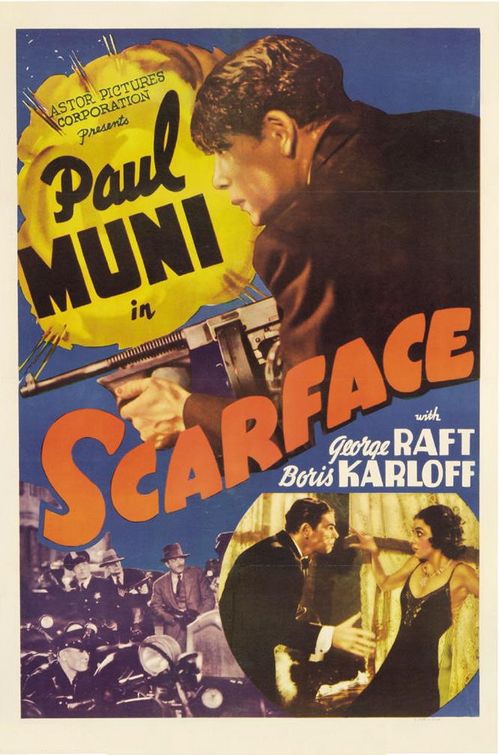
Pacino said that one day he was walking down Sunset Boulevard and saw the original “Scarface” from the 30s, saying that this is a picture and a movie, even admitting that Paul Muni is one of the greatest actors he had ever seen. Pacino then called producer Martin Bregman up and told him about the original movie, and Bregman then made the remake. Pacino had to work with Bauer on the Cuban accent. During Pfeiffer’s screen test, she had to do the scene where she threw dishes, and when the test was over, they looked around and saw blood everywhere. People were checking to see if Pfeiffer hadn’t cut herself, but she looked over at Pacino and saw his hand was bleeding. After cutting Pacino in her screen test, he started to like Pfeiffer.

In the end, I will have to tell you that if you haven’t seen this film, what are you doing reading this review then? Go out and see this film because it is one of the best films you will ever see. I promise you this. This movie gets a high recommendation from me, as it does deserve.

Watch out for next Monday to see what I will put as the next entry in “Al Pacino Month.”

Wednesday, January 7, 2015

Scarface (1932)

If you were to hear Scarface, you would immediately think of the classic Al Pacino movie as merciless Tony Montana who says so many F bombs in that movie. Matt’s Movie Reviews said, “Yet after watching the Howard Hughes produced, Howard Hawks directed 1932 gangster morality play original, Pacino et al. will become a faded memory when compared to this originator of violent gangster pictures, which has inspired crime illuminati’s Martin Scorsese, Francis Ford Coppola, and of course, Brian De Palma, who directed the 1983 remake.”

Loosely based on the abuses of famous gangster Al Capone, who was the king of the main streets of Chicago during the prevention era of the 1920’s, “Scarface” focuses on the rise and fall of vicious criminal Tony Camonte, a new class of gun-yielding gangster who lives by the faith “Do it first, do it yourself, and keep on doing it.”

Camonte was played by celebrated 1930’s character actor Paul Muni, with the entire splendor he could gather together. This was to be expected. Matt stated, “With such a flashy character, an equally flashy performance is needed, and Muni provides an exceptional example on how to play over the top without losing his characters emotional grounding.” Strangely enough, the only actor that could pull this off as well as Muni would be Pacino.

The beginning of this film has Camonte playing hitman for mob boss Johnny Lovo, played by Oswood Perkins. However, his superior goals for power quickly see him climb to the top of the Chicago mafia, taking out Lovo and stealing his girlfriend, played by Karen Morley, at the same time. However, his brutal love for his sister Cesca (Ann Dvorak) puts everything on the line when she falls in love with Camonte’s right hand man, Rinaldo (George Raft).

When watching “Scarface,” you must understand that this film is a product of its time. It’s illustrations of Italian American’s in particular relies strongly on stereotype, even in its use of speech, with “eh?” put at the end of each sentence. For instance, “I gotta do this; I gotta do that, eh?”

Matt stated, “Also, while the films violence is tame compared to the intense standards of today’s cinema, one must also appreciate that Scarface circa 1932 was a very violent film for its time, which brought on the wrath on censors and saw producer Howard Hughes battling the Hays Office and regional censor boards, delaying the films release for up to a year. So viewing the film in a historical context is a must.”

However, this does not discourage from the fact that “Scarface” is a largely entertaining film because of its daring, over-spending, gripping plot developments, and strong emotional centre, mainly the relationship between Camonte and his sister, which is developed further in the 1983 remake.

When you look outside of Muni’s performance, the most memorable element of “Scarface” has to be Howard Hawks’ brilliant direction and use of visual symbolic touches: a dead body bent on the corner of Under and Taker Streets. The use of the letter “X” as a visionary about death. The use of shadow (thanks to cinematographers Lee Garmes and L. William O’Connell).

Matt ends his review by saying, “A trend setter and instigator, dated in some parts, ageless in many others, Scarface is essential viewing not only for lovers of crime movies, but for lovers of cinema.”

In the end, see this movie because it’s one of the best. It’s a classic 1930s movie that you should definitely check out when you have the chance. Do you want to know what I thought of the famous 1983 remake? Stay tuned this Friday to find out.

Monday, January 5, 2015

...And Justice For All

Welcome back to “Al Pacino Month,” where we are going to look at another one of my favorites of all time, “…And Justice For All,” released in 1979. This couldn’t be a more sarcastic title, perfectly criticizing the violence and lack of justice shown in this excitingly brilliant courtroom drama. Mike Massie stated in his review, “With phenomenal dialogue and character development that recent films somehow forget to include, and with an Academy Award nominated performance by the wondrous Al Pacino, “…And Justice for All” is a must-see film, eloquently released on DVD to outshine it’s most recent emulator, Michael Clayton.”

Famous for his high regards for truth and real justice, Baltimore lawyer Arthur Kirkland (Al Pacino) is assigned to defend Judge Fleming (John Forsythe) in a lawsuit. The thing is that Kirkland hates the judge, who has an unusually malevolent love of statuses that frequently hurt Arthur’s clients. In a political move to discourage the idea that hidden deals and negotiations might take place to clear Fleming, Kirkland is blackmailed into defending him in the caste of viciously attacking and raping a young woman. To add even more bad stuff onto this situation, Arthur opening attacks the Judge’s honesty and is confident that he is guilty. His partner Jay Porter, played by television actor Jeffrey Tambor (who you might remember from "The Ropers," "Hill Street Blues," "The Larry Sanders Show," "Arrested Development," and now "WordGirl" and "Transparent") is quickly going insane, and Arthur’s clients are submitting to tragic fates during unfair imprisonment.

Massie says, “From the jazzy and upbeat intro music (gaily carried on throughout much of the film) to the final sarcastic scene on the steps of the courthouse, “…And Justice for All” makes no mistakes cynically battering and brutalizing the legal system. Corruption runs rampant amongst the colorful characters frequenting the courts, and the last thing anyone actually receives is justice.” Judges shoot guns to get order in the courtroom, committees investigate every wrong lawyer, and deals are struck and traded similarly with the stock market. However, past simplay making fun of right and wrong and whether they have anything to do with determining innocence and guilt, the film amazingly builds up characters that are outstandingly brilliant and memorable.

Pacino perfectly plays Kirkland, a skilled lawyer who struggles with his old grandfather (director and acting teacher, the great and memorable Lee Strasberg), saying on the good side of the suicidal Judge Rayford (Jack Warden), keeping a relationship with his girlfriend (Christine Lahti) who sits on a committee that unsuccessfully investigates corruption, and giving accidentally false hopes to his clients that perish in prison. He stays the underdog throughout the film, being stepped on by Fleming, falling victim to regrettable timing, and even being shorter than his fighting girlfriend. Massie admits, “Even our first impression of Arthur is witnessing him in a jail cell after being held in contempt of court for assaulting a judge; these devices allow the contrastingly thrilling climax to be even more powerful and poignant.” “Being honest doesn’t have much to do with being a lawyer,” Arthur says during a conversation with his grandfather.

One of the things “…And Justice For All” does better than most is to connect the audience with hilarious, steel-humored dialogue and plenty of deep emotions and events that combine within the plot. While the main storyline is not completely complex, the several subplots that come in and out and support the main theme give the film a feeling of completeness – not a moment is wasted (despite scenes that don’t move the film forward) and the pacing is accurate. As the plot thickens, we become absorbed in the tragic and absorbing story of a man finding truths and justice in a world overrun with corruption and lies. Massie ends his review by saying, “It’s as thrilling as a ride in a helicopter with insufficient fuel – and when you watch this Norman Jewison masterpiece, you’ll know what I mean.”

Probably the most memorable scene is at the end of the movie when Arthur snaps during the case and says, “You’re out of order! You’re out of order! This entire trial is out of order! They’re out of order!” With a great buildup to that line, it’s definitely worth the wait when he says that at the end. If you love courtroom movies, then this is right up your alley, especially if you’re a Pacino fan. Check this one out because you are missing an amazing film.

Stay tuned for Wednesday for the next installment in “Al Pacino Month.”