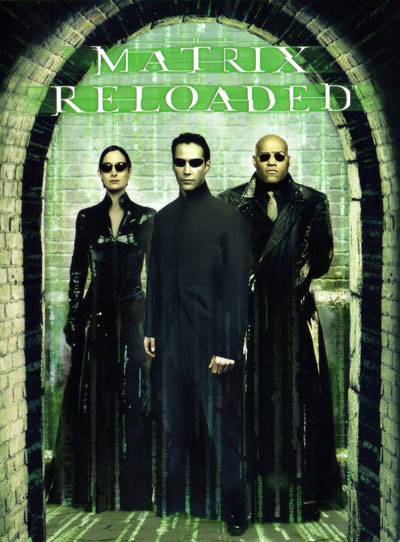
Friday, May 27, 2016

The Matrix Revolutions

The first “Matrix” movie may have been clichéd, but it took old elements and redid them in a great flick focused by an essentially interesting concept and good story subtleties. “The Matrix Reloaded” had its moments of excellence, but to get to them you had to go through many boring fights and endless monologues about choosing from choice and fate. It was a very different film and an overall disappointment. Those who hoped for answers in “The Matrix Revolutions,” also released in 2003, or at least a worthy sequel to the original film, are going to sadly be left with about nothing again.

If this movie came out sooner that year, maybe in July, it could have been in better hands because what you see here is a summer blockbuster – and a very average one to say. Garth Franklin mentioned in his review, “The money is all onscreen, the FX from a technical point of view are utterly tremendous and visually it can't be faulted.” However, the script & dialogues are terrible, the action scenes go on way past the point of dull and the principal flow of the whole movie is that by the end, the audience is left feeling very ripped off. Franklin mentioned that, “Take away the pretty pictures and you have a film as equally problematic as other bad sequels this year ala "Bad Boys" and "Charlie's Angels" but without the playful sense of fun.”

Franklin goes on to say, “For all the complaints about 'Reloaded' being too high brow, the opposite is true with 'Revolutions' - there's almost no depth here.” The first half hour is also the worst. If you haven’t seen the first two films, then don’t even try to understand. If you haven’t seen “The Matrix Reloaded” before this, it’s still going to be tough to sit through the beginning. Franklin mentions, “From a family of programs in a train station limbo, to a new Oracle (Mary Alice) who gives her role dignity but lacks the quirky sense of humour so signature of her predecessor - its a class in exposition 101 with endless talking albeit very little said.”

When the movie gets to Mega City’s Club Hel (an interesting, but desperately theatrical club), we once again meet the Merovingian (Lambert Wilson). Franklin brings up that, “Gone is the dangerous man with a taste of eccentricity, replaced by a Bond-esque olive-sucking baddie complete with trophy wife with just one line” (however, the hot Italian actress and fashion model, Monica Bellucci’s shot of her chest in here is the most impressive FX shot of the whole movie). After that point, the film starts to deteriorate. The one that is the most notable is the main actors of the movie are missing.

Franklin speculates, “Maybe we've been spoiled by TV or films like "Return of the Jedi" or "LOTR: The Two Towers" where there's constant cutting between 2-3 separate subplots but its an effective storytelling method which helps keep the pace moving and add tension.” For an hour or so in the middle of the movie, we see the defense of Zion and that’s it. Franklin says, “Sure Morpheus' head appears at times and Jada Pinkett Smith puts in a far better turn this time out, but they're the B-story to what is one of the longest non-stop action sequences on film.”

Franklin goes on to say, “Yes its random faces (such as the overly eager kid (Clayton Watson) and the old warhorse general (Nathaniel Lees)) in CG tonka toy gun suits shooting non-stop at squids.” It’s fierce and furious to be sure, and impressive but also tiring and insistent to the point it becomes tiresome. Zee (Nona Gaye) and her masculine army friend (Laurence Fishburne’s wife, Gina Torres) (Franklin calls her “a Vasquez wannabe”) fire rockets and more rockets, the council contemplates, the shooting continues, some gets killed by Sentinels, something random crashes and falls over, etc.

Eventually, we get a breath of fresh air from this and return to Neo, Trinity, the machine world and, obviously, the much commercialized fight of Smith and Neo in the rain. The outsides of the machine world look great, likewise there’s a nice moment in here when Trinity sees a natural beauty for the first time in her life and comments on it before it disappears. Yet, it also leads a moment of the film that was designed to be emotional is actually ends up being laughable in the extreme for both what is said and how long it bores you.

Even though the Neo/Smith fight again looks visually great, it’s also completely flat. These two can’t hurt each other, but they keep going on and on in different ways to the point where you are saying, “Finish the fight, guys.” Franklin mentions, “Indeed if there's one thing this whole sequence does well is that it inspires you to think about possibilities - not about what's happening on-screen but rather how cool would a Superman movie be using the filmmaking techniques used here. The ending I'm not going to even comment on, suffice it to say it renders the point of pretty much everything before it moot and cheats the audience - its a stop gap measure at best and leaves open way too many sequel possibilities for a film that it was claimed would always be "the last".”

Is this movie worth seeing? Maybe for the fans. Even though the action felt like something you would see in a cartoon in the second film, it does have more weight here and by having things take place in the real world, it does give it a bit more brutality and a real sense of desperation at times, it’s interesting to see a movie where the idea of people praying for a better tomorrow comes off sincere (for the most part, at least).

Bruce Spence has a nice little turn as a wild-eyed traveler program named the Train Man, and Hugo Weaving does quite the best antagonist work ever as Smith. The main convincing reason though is eye candy – this is what $200 million and a boatload of CG machines can buy and filming techniques give in these scenes will probably never be used again. For cinematographers and filmmakers of different skill who have a liking for visuals, this movie is for you.

Sadly, it’s just flat for the rest of the audience. Those who found “The Matrix Reloaded” not “sci-fi action worthy” enough for them will get into this more. Yes, it’s designed as more of a crowd pleasing film than the last. I agree with Franklin when he says, “Yet I honestly prefer "Reloaded" myself and think with the failure of many of this years bad sequels its been shown that people are getting tired of these bloated blockbusters with little or no point.” Don’t believe any of the talk from the producers that “this is actually the second half of one big movie,” saying and look smartly this feels very different to the other two, Franklin says, “far more glossier and vapid best sums it up.” A nice empty ending to a film series which should’ve just ended at the first movie.

My brother was the only one who went and saw this in the theaters. My sister and I didn’t see this until I got it from the library, I say when I was in late high school, early college. You can believe we fast forwarded through a good majority of this movie since it was just boring us to death with so much dialogue and what action there was, it felt flat. Undeniably, this is the worst one of the three. If you want to see this, go ahead, but I say you should just watch the first one and “The Animatrix,” and that’s it. However, Nostalgia Critic is right when he says that none of these movies, even this one, is god-awful. All of them are still watchable and I credit them for at least making an impact in cinema.

So that ends “The Matrix Month.” I hope I gave you good recommendations, although I think anyone could tell you that it was obvious that they should have left the series off at the first movie and not continue it on. Look out next month to see what else I have in store for everyone.

Friday, May 20, 2016

The Animatrix

There’s been plenty of hype around the Matrix in the Year of the Architect, 2003. While “The Animatrix” was mainly a marketing gig targeted to increase the hype fans, some of its parts are bright and magnificent examples of animation. Brian McKay said in his review, “Unfortunately, like the average music CD, for every great track there's usually a "filler" song.”

This isn’t going to be a review, but nine individual reviews with the verdict being hinted at towards the end. Without anymore digressing…. 

1.      Final Flight of the Osiris: The absolute best of the segments. The characters, even though they are short, are interesting (and beautiful – especially Jue, voiced by Pamela Adlon, who also did the voice of Bobby Hill on "King of the Hill," Ashley in "Recess," Sam in the "Pajama Sam" PC games, Moose on "Pepper Ann," Otto Osworth on "Time Squad," Derek Generic on "Bobby's World" and Rusty on "The Big Guy and Rusty the Boy Robot"). The action scenes are as exciting as anything in the chapters, and the animation is close to flawless. Several moments look complete lifelike. This one almost makes the film worth buying on Blu-Ray. Strange that it’s the first chapter in this film. You would think that they would make this last since it’s the best. 

2.      Second Renaissance Part 1: Visually, it doesn’t hold a candle to the universe of “The Matrix” in any way. However, it is a breathtaking part of animation with a fairly thoughtful and, sometimes, instinctively disturbing story. You may feel a type of chill go down your back as a bunch of humans destroy a female robot to death, when she is screaming, “Please, I’m real!” (Think of “Short Circuit,” did you?), and McKay said, “The ‘Schindler's List’ holocaust theme of humans persecuting millions of sentient machines is handled very well.” 

3.      Second Renaissance Part 2: The conclusion that shows us how man eventually was the reason for his own mistake by making machines more powerful than them. Not quite as fascinating as part 1, and McKay admitted, “some of the music video battle sequences were a little over the top and reminded me of the campy animation style of Heavy Metal.” Still, it’s an interesting follow up. 

4.      Program: A standard Samurai-theme training simulation goes completely haywire, and a soldier of Zion, voiced by Hedy Burress (who also voiced Yuna in Final Fantasy X and X-2), has both her ability and her loyalty put to the ultimate test. Again, the visual style doesn’t quite fit together, and the result is a bit of a way around. Not bad, but pretty forgettable. 

5.      World Record: An athlete, voiced by Victor Williams, pushes himself too far, and begins to see beyond the mask of the Matrix when his adrenaline reaches the maximum levels. Interesting idea, but not well executed, and while most of these segments can be blamed of having a visual style that doesn’t really fit the Matrix universe, this one brightly fights with it. McKay mentions, “Too many hard lines and square features make the characters look unappealing, the athlete's Slim Shady wannabe sidekick, voiced by Alex Fernandez, is annoying, and what is up with the agents in this one?” The way they dress and wear their hair, they look more like the Joker’s minions from a mediocre Batman cartoon. This is one you can pass. 

6.      Beyond: Taken place in an unnamed city that McKay describes, “looks like a hybrid of Tokyo and Los Angeles,” a teenage girl named Yoko, voiced by Hedy Burress, loss her cat. A trio of neighborhood kids, voiced by Jack and Julie Fletcher, Dwight Schultz (Captain H.M. "Howling Mad" Murdock from "The A-Team) and Jill Talley, think they saw it wandering into the neighborhood “haunted house” – which, unbeknownst to them, is a faulting segment of the Matrix. Once inside, they can bend the laws of gravity and physics, and program failures clear themselves as strange and indistinct visions. A pretty cool idea, with some cute characters, but it does drag in places. Not a bad segment. 

7.      Kid’s story: McKay said, “Why the tagalong kid in Matrix Reloaded got as much screen time as he did is a mystery to me. Not only was the kid annoying, but his character made no sense to viewers because his back story hadn't even been released yet.” Surprisingly, though, “Kid’s Story” is a pretty decent animated cartoon. When a teenager, played by Clayton Watson, begins to sense that his “real world” may not be so real after all, he begins to hunt chat rooms looking for the answer. However, when he gets a phone call from Neo, voiced by Keanu Reeves, in the middle of class, and suddenly finds his school surrounded by agents, voiced by James Arnold Taylor – well, what can he do but make some kind of escape on his skateboard? While the story isn’t really interesting, the animation is mesmerizing – especially the skateboarding parts with lots of unclear lines to emphasize motion and speed. 

8.      Detective Story: Apparently, part of the Matrix is an anachronistic world of 1940s clothing styles and architecture, combined with computers and hacking. When a private detective (James Arnold Taylor) is hired to track down a hacker named “Trinity” (Carrie-Anne Moss), his investigation takes him all over the city trying to pick up “his” trail. “A case to end all cases,” he calls it. Don’t try to over-exaggerate this. Again, we have an interesting story, and watching a fedora-wearing detective meet Trinity in her attire of black leather is kind of cool. McKay pointed out, “Also, the scenes of a snowy New York City with towering skyscrapers that look more like something out of Metropolis is a nice touch. But the story just didn't quite convince me, the ending was a bit flat, and all the anachronisms just didn't quite fit.” This gets credit for trying something different, but in the end you can say this was a “nice try.” 

9.      Matriculated: Since they put the best part on the movie first, it makes sense that they put the worst last. McKay said, “I couldn't even tell you what the story is really about, as convoluted as it was. From what I could gather, some people from Zion capture a machine and jack into a simulation program with it, hoping to convert it to their human way of thinking.” This plan backfires, but who really cares? Again, the animation doesn’t really look anything like from “The Matrix,” and while it is evidently busy and eye-candy, it can’t hide the fact that the story is boring and clumsily told. McKay asks, “And what is up with these new "sentinels" that chirp and walk around with big antennae and look about as menacing as a cybernetic Jiminy Cricket?” Once you get through the eighth segment, you can turn the movie off.

In the end, when you really look at it, this is a nicely solid anthology, with some strong ideas and excellent animation, and they transferred even the weakest stories. “The Animatrix” is pretty average. You can see this movie, and if you would like, you can copy the good segments onto your files, then return it. I saw this movie about 3-4 years ago when my brother rented it from the library, and I thought it was nice and I'm glad I saw it.

Now hold on to your vomit bags everyone because next week we will be finishing off “The Matrix Month” with the absolute worst in the series.

Friday, May 13, 2016

The Matrix Reloaded

This is the really fast review of “The Matrix Reloaded,” released in 2003: One incredibly cool, gravity-resisting, CGI-helped, spinning-camera kung-fu fight; one jaw-dropping, 100 MPH, against-traffic freeway chase; and too much long-winded, expository, circular, self-important, pseudo-philosophical talk.

Rob Blackwelder stated in his review, “Writing-directing brothers Larry and Andy Wachowski saddle their cast with endless equivocal prattle while toiling to buttress the complex plot and metaphysical undertone of this picture's uber-stylish 1999 predecessor, which saw what we think is the real world exposed as an elaborate virtual reality prison for the minds of all humanity.” Mankind’s suspended bodies give a power source for a tribe of machines, which a small group of escapees want to destroy in the post-apocalyptic world outside the Matrix.

“We can never see past the choices we don’t understand,” wise but vague computer-prophet The Oracle says secretly to Neo, the computer-Messianic hero whose realization that physical laws don’t apply in the Matrix which was mentioned in the first film’s groundbreaking wire-work martial arts fights and bullet-dodging slow-motion stunts.

In another scene, Neo says to a slippery, French-accented villain, “You know why we’re here.” This man, played by Lambert Wilson, replies, “Yes, but do you? You think you do, but you do not.”

This type of boredom drags on for three to four minutes at a time, in scene after scene, throughout the movie – which comes to feel empty and meaningless in the end. Blackwelder admitted, “Sometimes it was all I could do to keep from going cross-eyed and zoning out.”

Even when this movie takes a break from all this sleepy talk, the Wachowskis give only two action scenes that are on the same level as the breathtaking standard made in the first movie. The first is when Neo (who can now “see” in flowing green computer code made into the tech world) fighting a countless amount of Agent Smith, the slippery responsive computer program in a Secret Service suit who was the first film’s antagonist and now has gone rouge inside the Matrix, like a virus.

Blackwelder mentioned, “The scene is choreographed and computer-enhanced within an inch of its highly-stylized life, with Neo knocking Smiths across courtyards and up several floors into the sides of adjacent buildings while the camera circles around him wildly, using the Wachowskis' trademark of speed-up-slow-down trick photography. This fight doesn't have the "wow" factor that such moments did in 1999, but it's the first time "Reloaded" really comes to life (even if it is inundated with a cheesy, over-orchestrated, metal-guitars-and-angel-choruses musical score).”

The second adrenaline-rushing action scene is the freeway chase that sees seriously spiritual leader Morpheus fighting another Agent (Daniel Bernhardt) on top of a speeding 18-wheeler while the eye-candy that looks super-hot in leather heroine Trinity outruns cops, Agents (David A. Kilde and Matt McColm) and the Frenchman’s henchmen (two indestructible, ghost-looking albino twins in white suits and dreadlocks (Neil and Adrian Rayment)) by speeding in and out of head-on traffic on a Ducati motorcycle. Along with its countless amazing slow-motion crashes and explosions, this scene is the movie’s only real showstopper.

A good amount of the story takes place in Zion, the deep-underground last fortress of mankind in the real world. Blackwelder said, “The place looks like a sci-fi version of a 1950s biblical epic -- complete with wide-eyed worshipers, women carrying bread baskets to lay at Neo's feet and men in military tunics, many of whom are doubters in the prophecy of Neo as their savior.” (One of the clichéd people says, “Morpheus, I don’t care about Oracles or prophecies or Messiahs! I only care about saving our city!”)

Zion is preparing for an attack by 250,000 sentinels (the scary, giant-squid-like robots from the first film) that are digging toward the city, and it looks like the only hope is for Neo to fulfill his destiny by sneaking through digital “back doors” in the Matrix program and attacking the system’s mainframe. Once he is there, he will have to face a complete surprise and what might look like an impossible choice – if only the scene didn’t have another five minutes of tedious, tightly packed dialogue.

Blackwelder is right when he says, “Often hard to follow (one character with less than four minutes of screen time turns out to be pivotal -- if you can remember what he looks like), "The Matrix Reloaded" is further burdened by the franchise's monotoned acting style, by atmospheric scenes that serve no purpose (Neo and Trinity make love during a Burning Man-styled rave in Zion) and by effects sequences that have so many layers of soft-focus CGI they look more like a videogame than a movie.”

Aside from that, is it worth actually watching for the action alone? For fans, yes but just barely. Blackwelder suggested at the time this was released, “But if you're anywhere near an IMAX theater, you might want to wait until June when the film will be released in large-format -- and mercifully 20 minutes shorter because IMAX projectors can only run films under two hours.” However, I would not recommend anyone to watch this movie at all because you will hate it so much and be bored by it easily. If you do, just watch it for the action.

If you do succumb to the torture of this film, be sure to fast forward through the unresolved ending and closing credits for a preview of the last in this trilogy, “The Matrix Revolutions.”

I saw this in the theaters when I was 13, after only seeing parts of the first movie. At the time, I liked it since, like Nostalgia Critic stated, this was a “No Holds Barred Movie” with being over-the top. My siblings didn’t like it, and after I saw the first movie the whole way through months later, I didn’t quite understand the horrendousness of this movie until I was older and thought about it more. I never saw the movie again, and watching the Nostalgia Critic’s review, I started to notice all the problems that people talked about with it. Except for those two action scenes, the rest of this movie is not even worth checking out with its long-winded, boring philosophical talks. Even though there were problems like that in the first film, at least that movie kept a central focus, unlike this one where all the problems that were in the first film just escalated more and more.

Before I get to the third in this “Shameful Trilogy that didn’t need to be made into a trilogy,” there is an animated movie that came out a month after this one that I would like to talk about. Is it any good compared to how good the first one was and how horrible this movie turned out to be? Find out next week in my continuation of “The Matrix Month.”

Saturday, May 7, 2016

Captain America: Civil War

Today I got a chance to see “Captain America: Civil War,” which was released yesterday. In 2014’s “Captain America: The Winder Soldier,” directors Anthony and Joe Russo, and writers Christopher Markus and Stephen McFeely, gave a first-rate political thriller in the Marvel Cinematic Universe. The same directing/writing team is back to start Phase Three of the Marvel Cinematic Universe with “Captain America: Civil War,” and they don’t disappoint.

The film takes place one year after what happened in “Avengers: Age of Ultron,” and opens with a split of the Avengers – Steve Rogers/Captain America (Chris Evans), Sam Wilson/The Falcon (Anthony Mackie), Natasha Romanoff/Black Widow (Scarlett Johansson), and Wanda Maximoff/Scarlet Witch (Elizabeth Olsen) – on a mission in Africa to stop a group of terrorists, and it doesn’t end well. On the side, Tony Stark/Iron Man (Robert Downey, Jr.) has a guilt trip (not underserved!) put on him by the grieving mother of an American (Alfre Woodard) caught in the battle during “Avengers: Age of the Ultron’s” climactic Battle of Sokovia.

Stark brings in the man who wants the Hulk, General Thaddeus “Thunderbolt” Ross, played by William Hurt, now the US Secretary of State, to the Avengers headquarters’ to tell his soldiers about the threatening “Sokovia Accords,” which will turn over regulation and control of “enhanced” individuals to a United Nations committee. Allan Bourdius said in his review, “As if the United Nations (in our own real world knowledge) has ever shown itself capable of anything productive.”

The sides quickly head up with the most uncontrolled, Stark, leading the case to have the Avengers put under international control. He immediately has his friend James Rhodes/War Machine (Don Cheadle) and the Vision (Paul Bettany), who’s basically a Stark creation as well.

How many times can you recall hearing Stark’s argument when it comes to expanding government in our lifetime? Acquiesce a little, so you don’t give up a lot – except the acquiescing never is so miniscule. Captain America is firm that he won’t sign on, and The Falcon and Scarlet Witch are on his side, the latter ending up on effective house arrest in the Avengers’ headquarters.

As the Sokovia Accords are about to be approved during the UN session in Vienna, Austria, a bomb goes off killing a handful at the conference including King T’Chaka of Wakanda, played by John Kani, who was the main international shot of the Accords (Bourdius mentioned, “Wakanda is the nation which is the sole source of the fictional “vibranium”, of which Cap’s shield is made”). The attack is blamed on the Winter Soldier, better known as Cap’s friend James “Bucky” Barnes, played by Sebastian Stan. Cap decides to kidnap Bucky, which starts some issues between Team Iron Man and Team Captain America.

As the between the Avengers starts, we also get introduced to Black Panther (Chadwick Boseman) and Peter Parker/Spider-Man (Tom Holland), as well as seeing once again Clint Barton/Hawkeye (Jeremy Renner) and Scott Lang/Ant-Man (Paul Rudd).

Bourdius admitted, “Unfortunately, I can’t really give much more detail without spoilers. Suffice to say that the story arcs presupposed from watching the trailers aren’t exactly correct, so there are plenty of twists and turns in the plot to keep everyone interested. Civil War is the longest MCU film to date (2:26), but it never drags.”

“Captain America: The Winter Soldier’s” themes of absolute power damaging absolutely and some distrust of power can be fine are continued by “Captain America: Civil War,” and adds in the rights of the individual to make choices for themselves being higher to the needs of authority to control those choices. One character says, “Compromise where you can, but where you can’t: don’t.”

That’s a feeling many of us will be thinking about in our politics as we are getting closer to November’s election. I agree with Bourdius when he says, “Civil War earns its place among libertarian-leaning cultural offerings that “our side” would be well to use in bringing people towards a limited government/limited authority viewpoint. A government with the power to protect you absolutely is also powerful enough to deprive you of everything that makes life worth living.”

Bourdius goes on to say, “And it’s a film like CA:CW which shows how conservatives and libertarians regularly fail cultural tests. I can envision conservatives of several different stripes discarding the film simply because it has a character named “Black Panther” (“Oh! This must be a racial justice effort!”), and that’s a total shame. As in our own lives, politics, and cultural interactions, lines do get blurred in the movie, but in the end, inalienable truths on life and liberty turn out to be, well, inalienable.” There will be people who don’t like the message the film delivers, particularly those who think picking the side that isn’t as evil is a continued path to success.

In the end, all of us have choices to make, and we can break down this year’s election to, “Are you ‘Team Captain America,’ or are you ‘Team Iron Man’?” Are you for everyone as individuals, or for authority? I know for sure that I will always be Team Captain America.

Spoiler Alert: in the post-credits scene, Parker is recovering from injuries, with his Aunt May, played by Marisa Tomei, giving him an ice-pack, when his web-shooters project a Spider-Man symbol on his ceiling.

You have to go see this movie in the theater, if you are Marvel fan, an Avengers fan, and/or a Captain America or Iron Man fan. As a sequel to “Winter Soldier” and “Age of Ultron,” this movie succeeded on every level. This is the best of the “Captain America” movies, and is by far, the best superhero movie this year. I consider this another one of my favorites. Phase 3 is off to an excellent start and I’m looking forward to the other movies in the Marvel Cinematic Universe. Hope Davis and John Slattery are in here playing Iron Man's parents and Emily VanCamp reprises her role as Sharon Carter.

Stay tuned next Friday when I continue “The Matrix Month.”

Friday, May 6, 2016

The Matrix

For the month of May, I will be looking at a series that looked like it had some potential with the first movie, but the sequels were really poor. You might be thinking, “That could be a number of franchises.” True, but I’m talking about a series that Nostalgia Critic already covered last year. In case you don’t know, I’m talking about “The Matrix series.” That’s right, May will be “Matrix Month” on this blog. Let’s get started with the 1999 adrenaline-rushing action flick “The Matrix.”

Thomas Anderson, played by Keanu Reeves, is a computer programmer by day and a hacker by night, called Neo in the cyber world. His employer, played by David Aston, notices that he has a problem with authority. Neo is trying to find Morpheus, a legendary hacker who knows the answer to the question he keeps thinking: What is the Matrix? There is a lot of talk about it in the cyber world but no one knows the answer.

Trinity, played by the hot Carrie-Anne Moss, calls Neo to a dance club and warns him that he is being hunted by the authorities who believe Morpheus is the most dangerous man alive. Neo is not able to escape these three Secret Service looking agents, Neo is captured and interrogated by the evil Agent Smith, played by Hugo Weaving. Smith and his two men, played by Paul Goddard and Robert Taylor, put a centipede-looking tracking device in his body and Trinity later removes it while she is driving him to meet Morpheus.

Neo has two options to choose from. Morpheus, played by Laurence Fishburne, gives him two pills. The blue pill will let him stay in his current life while the red pill lets him enter the Matrix where he will be able to learn about it. He chooses the red pill, and the truth is almost more than he can comprehend. The reality he thought was real is actually created and run by advanced machines who get their powers from hibernating womb pods that have sleeping humans. People are nothing to these machines other than batteries. The everyday world of modern buildings, busy streets, work places, and dance clubs are a computer-generated dream world, “a neural-interactive simulation.” However, Morpheus is a free human and with a small team of compatriots, he wants to protect the secret location of Zion, a human monopoly, and work to free their people.

Frederic and Mary Ann Brussat said in their review, “This super-duper science fiction film, winner of four Academy Awards, is a pop postmodern treasure-trove of images and references from literature, religion, other movies, mythology, science, and technology. Directors Larry and Andy Wachowski, who also wrote the screenplay, have designed it so you can pick and choose your own thematic entry points and re-experience the drama again and again.” You could look at this film as an exploration of the fight between machines and human beings. Look at the speech by Agent Smith, one of the highly intelligent cyber-human, to his sworn enemy, Morpheus: “There is another organism on this planet that follows the same pattern [as humanity]: a virus. Human beings are a disease, a cancer on this planet. You are the plague, and we are the cure.”

This movie will be of special interest to Christians as the approach to this film calls Neo a Christ figure. At the beginning of the movie, a hacker arrives at Neo’s door with some money to buy mescaline and says, “Hallelujah! You’re my savior, man, my own personal Jesus Christ.” After he meets Morpheus, Neo is told he is “The One” (Neo is an anagram for One) they have been waiting for to free humans from their captivity. In one of the most interesting scenes in the film, he meets the Oracle, played by Gloria Foster, an African American in her kitchen. She tells him words of wisdom as well as freshly baked cookies. The Oracle has been in the resistance movement from the start and has predicted the arrival of the One who will bring freedom to the people. The Oracle tells Neo, “You’ve got the gift but it looks like you’re waiting for something.”

She’s right. Neo must first go under more training in the Matrix. He fights with Cypher, played by the great Joe Pantoliano, a traitor inside the resistance movement, and fails a leap of faith jump. Brussat said, “The filmmakers swerve away from the essence of the Christian Gospel when they make this Christ figure into a liberator who uses excessive violence to achieve his goals. Like so many others, the Wachowski brothers can't get beyond the myth of redemptive violence, the traditional linchpin of American cultural history and a central message of many Hollywood movies. The life-restoring kiss that Trinity gives to the dead Neo is a touching image of love as resurrection but not even that healing scene can wipe away the disappointment we feel that blazing guns are proffered as the inevitable way to fight the evil ones in power.”

Brussat goes on to say, “Some viewers have identified Gnostic and Buddhist references in The Matrix, and this is another way to enter this story.” Here, Neo is a good-hearted man on the path to enlightenment who finds out that the suffering of the world is because of ignorance, greed, craving, and attachment. The tests and trials he endures in his martial arts training with Morpheus makes him see the power of the mind to change conditions and bring the change. A young boy, played by Rowan Witt, waiting to meet the Oracle shows this ability to think outside of the box.

In the climactic fight with Agent Smith, Neo’s imagination and instinct makes him bend and break the rules which the cyber-humans are not able to do. Brussat credited, “This scene holds the key to what makes The Matrix such an enthralling adventure on so many different levels. The vast and untapped potential of imagination is the force that can save the human race and release us from enslavement to ignorance and the follies of craving and attachment.” In the opening scene, the film sums up what everything is. Neo is asleep in front of his computer and his monitor says, “Wake up, Neo.”

This is actually a good movie that everyone should check out. If you haven’t seen it yet, see it now. This is a must. It’s not like one of the greatest movies ever made, but it’s still a good movie that is worth seeing. I had only seen parts of this movie when I was a teenager. When I was 14, I was sleeping over my aunt's house and I finally watched the whole movie there since my cousin had borrowed it from another one of our cousins. It wasn't until I was in college that I saw the movie again since I was taking a class where I studied the English Bible as a piece of literature (which shocked me when I saw that as the title of the class). I was working with another one of my classmates on a project where we were assigned to watch this movie and talk about the Christian symbolism in it, which it's filled with. Just see the movie to find out. 

Bear in mind that this is the only movie in the series that has a re-watch value, which I will go into further when I review the sequels.

What can be said about the sequels? Those who have seen the sequels already know what to say about them, but I will let you know my thoughts next week in the second installment of “The Matrix Month.”

Friday, April 29, 2016

The Karate Kid (2010)

If you’ve seen the 1984 “The Karate Kid,” the memories will come back while watching the 2010 remake. That’s a compliment. The original story was long-lasting to make three sequels, and now we have an entertaining remake made mostly on location in China, with Jackie Chan as this film’s Mr. Miyagi.

The original was one of the best movies of 1984. The 2010 remake lacks the perfect freshness of the original. There aren’t many surprises, as it follows the 1984 original almost verbatim. However, here is a nice and well-made film that stands on its own feet. The Chinese locations add visual beauty, there are parts of brilliance in mountains and on the Great Wall, and the characters are once again engaging.

The original film’s strongest part was the Oscar-nominated performance by Pat Morita as Mr. Miyagi. Jackie Chan is so famous that it will not come as a surprise in his role of Mr. Han, a solitary janitor, when he tells a hidden secret for the martial arts. Roger Ebert noted, “But Chan has never been a strutting, macho fighter onscreen; his charm comes from a self-kidding quality. Here he does a good job of cooling down his usual cheerfulness and keeping his cards hidden.”

In the role of his student, Jaden Smith, son of Will and Jada Pinkett Smith, has a natural screen presence. Dre Parker is calmer than Daniel, but so much smaller than his opponents that we can completely buy his fear of a bully at school. When that happens, we can forget about going crazy over the 1984 film and enjoy this one. That was then, this is now.

The story once again tells about a kid being dragged with his divorced mom, played by Taraji P. Henson, as they leave his hometown and friends and move far away – from Detroit to Beijing, this time. He hates it. Then a cute young violinist named Meiying (Han Wenwen) smiles at him, and things start to look better – if it weren’t for the school bully Cheng (Wang Zhenwei). This kid is so hateful and vicious, it’s hard to explain, until we meet his evil Kung Fu coach, Master Li (Yu Rongguang). Ebert is right when he says, “The monstrous Li teaches a new form of child abuse: Kids beating up on each other.”

The story continues, as it should, with Dre slowly making Mr. Han come out, who saves him from a beating by Cheng and agrees to teach Dre Kung Fu. His training goes well, and Dre and Meiying make an agreement to attend each other’s important days: his Kung Fu tournament, her recital. Just like in the original movie, her parents, played by Zhensu Wu and Zhiheng Wang, disapprove of Dre. Why in the world would the parents of a great violinist disapprove of a Kung Fu student from Detroit who doesn’t speak Chinese?

Luckily for Dre and the movie, everyone in China who needs to speak English can do so, even his bully Cheng. Ebert noted, “Many Americans not only have little interest in learning another language, they have little interest in reading subtitles of their own. We believe, as Mark Twain put it in The Innocents Abroad, that any foreigner can understand English if it is only spoken slowly enough and loudly enough.”

It is pretty obvious that the entire film leads up to the climatic Kung Fu tournament, and that Dre is going to fight Cheng for the championship. The descent of the film is separated. The 1984 original was directed by John Avildsen, the same director of “Rocky.” This film’s climax is oddly well-handled. The tension is made in a careful way, the characters are developed, and the use of a scoreboard makes it look orderly, not rushed. Ebert admitted, “It's one of the better obligatory fight climaxes I've seen.”

Ebert goes on to admit, “The director, Harald Zwart, has not been one of my favorites; he made last year's "The Pink Panther 2." But here, with a robust script by Christopher Murphey and cinematography by Roger Pratt (who filmed two "Harry Potters"), he makes a handsome, absorbing movie.” It runs a little long, but during the championship, that’s the last thing you’re thinking of.

As much as the remake can be good, I can’t help but think how similar this one is to the original movie. Once again, it’s a repeat of the same formula, which at this point has become stale and repetitive. Still, I can say check this out, but you may not like it. If you don’t, I know exactly how you feel. I’m not saying that I didn’t like it or hate it, I thought it was nice, but it might have been better if they didn’t remake the movie.

For years I have been hearing of the possibilities of them making a sequel to this movie, but it’s been six years and nothing has been confirmed. We’ll see if there will be a sequel to this movie and if they plan to do something different, but it may not happen. Jaden Smith is getting older now and it may be difficult to make a movie with him as a young adult.

Well, that completes “The Karate Kid Month.” I hope all of you enjoyed my reviews, and hopefully I gave all of you good recommendations. You should check this series out if you haven’t because this is a beloved franchise that holds up to this day.

Check in next month to see what series I will look at next.

Friday, April 22, 2016

The Next Karate Kid

I can’t believe that director Christopher Cain, who replaced John G. Avildsen, thought that there was potential to make one more Karate Kid sequel. What story did he see that could have been made into another sequel? He should have just left it at three movies, especially since the third one was negatively received. I thought the story arc of these movies ended with the third movie.

When I rented the DVD from the library, the cover said both “The Karate Kid, Part III” and “The Next Karate Kid.” At first I thought it was a select screen to choose which one you wanted to watch, since DVD’s have that feature. It wasn’t until I figured out that I had to flip the disc to the other side in order to watch “The Next Karate Kid.” Was the film really that bad that it didn’t get its own DVD, but instead had to be put on the back of the other sequel that many people didn’t like?

Even Ralph Macchio didn’t reprise his main role in this one, which I feel glad that he didn’t. However, the bad part about it is that there isn’t really much of a follow up made to his character anywhere in this movie. There’s just a passing mention of him, and that’s about it.

As much as I don’t want to review this horrific sequel, I think I should just get it over with, so I will not delay this any longer. This is the 1994 sequel, which is also the worst sequel in this series and one of the worst sequels ever, “The Next Karate Kid.”

The movie opens in Boston, where Mr. Miyagi is attending a commendation for the 442nd Regiment in World War II. There, he meets the widow of his commanding officer, Louisa Pierce, played by Constance Towers. She invites him over to her house, where Mr. Miyagi meets Louisa’s granddaughter, Julie Pierce, played by Hilary Swank in one of her first roles. She apparently is a very uptight high school teen since her parents died in a car accident, and her relationship with Louisa is not so strong. Mr. Miyagi tries to solve this by sending Louisa back to his house in California to take care of his bonsai trees, while he stays in Boston to take care of Julie and her aggressive behavior.

At school, Julie is hiding a hawk named Angel, voiced by Frank Welker, who has an injured wing, and is constantly harassed by the head of her school’s security called Alpha Elite, Ned, played by Michael Cavalieri. I really hate this character since he is such a snotty-nose brat. Alpha Elite is led by a man named Colonel Dugan, played by Michael Ironside. You know that he is the villain, but how come he always likes to play that? Is it because his eyebrows easily give it away? Also, if you thought John Kreese from Cobra Kai was insane, this guy takes it to the nth degree. I feel like the school didn’t do a background check on him. What he teaches his comrades are just odd and cruel. One of the members that doesn’t make the team is Julie’s crush named Eric McGowen, played by Chris Conrad.

One of the biggest problems with this movie is that they changed the character of Mr. Miyagi a little bit. In the first “The Karate Kid” movie, Mr. Miyagi clearly said to Daniel that he never taught anyone karate. However, when Julie said to Mr. Miyagi that her father taught her karate, who was taught by Julie’s grandfather, Mr. Miyagi tells Julie that he taught Julie’s grandfather karate as a way of thanking him for saving Mr. Miyagi’s life during WWII. WHY DID YOU DO THAT!?!?!?!? IT MAKES NO SENSE!!!!!

Julie is such a jerk to Mr. Miyagi where she is telling him that she doesn’t need any work from school to know where she is going with her life, since she already has that part planned out. What direction are you going in, down on the streets where you have no life!? Additionally, how dare she insult Mr. Miyagi by saying he can’t speak English!!!! You do not disrespect Mr. Miyagi!!! She also says to Mr. Miyagi that he doesn’t know anything about girls, and he admits that he needs to learn a lot about girls while also saying that boys are easier. I agree with him since Daniel never gave him this hard of a time.

Julie gets suspended from school for a few weeks because she gets caught sneaking in to school to take care of Angel, so Mr. Miyagi takes her to a Monastery to teach her karate, and she is so impatient on not being able to learn it quickly. Once again, Daniel didn’t understand Mr. Miyagi’s way of teaching, but he never gave Mr. Miyagi this much disrespect and impatience to not being able to learn anything right away! The Grand Abbot, played by Arsenio ‘Sonny’ Trinidad, saves an insect from being squashed by Julie’s shoe, and she thinks it’s stupid that nothing is killed in a Monastery. What is this girl’s problem? Does she not have any respect for anyone or anything! Because I clearly think she doesn’t!!

Mr. Miyagi wants Julie and Eric to go to the prom together, but how does Mr. Miyagi guess her dress size at the store? He just gives some vague descriptions, so how is the tailor able to guess the right dress size for Julie? At the prom, why does one of the Alpha Elite members decide to bungee jump from the ceiling of the gymnasium and into the table? Ned claims that his comrade was brave to try it, but HE BROKE HIS ARM YOU IDIOT!!!! Are you saying that he was brave to try acting like a moron!?!?!?

Throughout the movie, Ned keeps talking about the docks and we don’t get to see them until the final act. One thing I don’t understand is: what is up with Alpha Elite!?!?!? They “do not” qualify as high school security. They are a gang! Why is that? They blew up Eric’s car then gang up and beat him down! Colonel Dugan says to finish him off since he was training them, for what I can think is, murder. THIS IS SCHOOL SECURITY!!! WHERE IN THE JOB DESCRIPTION DOES IT SAY THAT MURDERING IS A PART OF THE JOB!?!?!? SCHOOL SECURITY WRITE HALL PASSES AND SEND STUDENTS TO THE CAFETERIA FOR LUNCH!!!!

Colonel Dugan says that the war isn’t over because one battle is lost, which I don’t get what war he is talking about. WHO ON EARTH IS THIS GUY!?!?! WHERE DID THEY FIND HIM!?!?! Whoever hired this guy didn’t carefully evaluate him before giving him the job.

How come Mr. Miyagi claims that he always tries to look for ways to not fight, but always ends up in fights? He fights in every movie.

In the end, this movie is really bad, but I do give credit to Hilary Swank for making her character grow throughout the movie. She does end up being likable, but she can’t save this sequel at all by making her character become likable. My advice is to never bother with this movie because you will not like it at all. I know that the only female characters that little girls could look up to at the time were the Power Rangers girls from the shows, but they should have done a better job in this movie to portray a good, strong female role model for little girls. Even though Julie did grow and got better throughout the duration of the movie, she didn't come off as a good female role model for little girls. If you didn’t like “The Karate Kid, Part III,” you will definitely not like this one at all. Instead, you will wish that the series just stayed as a trilogy. So don't torture yourself by watching this cinematic garbage with "The Karate Kid" name on it.

Oh boy, that was a relief. I was happy that they never made another sequel, but I do know there was the cartoon that I never heard of or watched until The Nostalgia Critic and James Rolfe mentioned it briefly in their videos. However, they did make a remake to “The Karate Kid,” which I will look at next week in the finale to “The Karate Kid Month.”