Monday, January 20, 2014

Cape Fear (1962)

Since I had given away what I was going to review this week, I thought that I would first review the original version of the film released in 1962, “Cape Fear.” This unpleasant but suspenseful film noir is controlled with a steady hand by J. Lee Thompson and is based on the novel The Executioners by John D. MacDonald. James R. Webb was responsible for the chillingly tight screenplay that plays on the terror a family man faces while trying to not only protect himself, but his family as well.
After he has served his eight-year term in a Baltimore prison for a vicious rape and assault, psychopath Max Cady, played by Robert Mitchum, is set free, clearly without parole (which messes up your head), and goes straight to the rural small-town in Georgia (filmed near Savannah) to confront and make a nightmare for the family man and famous lawyer Sam Bowden (the late Gregory Peck), his wife Peggy (Polly Bergen), and his teenage daughter Nancy (Lori Martin). Max is out for revenge on Sam because he was a key witness at the trial that sent him to prison.
Once Max has stalked them and has been harassed by strong-armed methods by the police under Sam’s good friend, the chief of police, Mark Dutton, played by Martin Balsam, the court interferes on the side of the stalker and Sam finds out that his establishment records can’t stop Max from contacting him until he breaks the law – just being intimidating and sinister won’t be enough for causing the authorities to jump on quickly. For further protection Sam hires private detective Charles Sievers, played by Detective Kojak himself, Telly Savalas. However, that does not stop Max because he poisons Sam’s dog and makes gestures towards Nancy. When Sam can’t get Max to leave town, especially by bribing him with $20,000, he decides to take action by trapping this ex-con man by hiding Peggy and Nancy in his river houseboat in Cape Fear. He imagines that Max will come after them, hence getting this ex-con caught in the act of breaking the law; Sam will send Max back to prison for life.
This film shows flaws with the judicial system exposing how such a threat to the people has the ability to avoid the law and use it to make life unbearable for the good citizen. It shockingly shows how tolerable the law is and that the citizen has been brought to a point that violence is the only way he can protect his very own family.
Bernard Herrmann handled his scary score which effectively sets the mood, which is tensing. Mitchum’s arrogant life of an evil role, a put back from his role in “Night of the Hunter,” plays well as a balance to the scared but strong Peck role as the protector of his family by any means necessary – implying at its most insignificant the good bourgeois thinking.
In the end, I would say this film does show the effort, and is bone-chilling. I would rate this film with an 8. Check in for Friday when I review the 1991 Scorsese remake.

Friday, January 17, 2014

Goodfellas

Sorry about doing this late, I got hung up with a few things that I completely forgot about today’s review. No, it will not be “The King of Comedy,” because I have not seen that. Let’s just skip to 1990 with one of the best gangster movies ever made, “Goodfellas.” In this film, director Martin Scorsese does something simple and risky. He takes the guilt out of organized crime. The movie, a brutally open, part-comic epic about life in the mob, follows the path of Henry Hill, played by the great but creepy-looking Ray Liotta, an Irish-Sicilian Brooklyn kid who suggests himself into the local section of the Mafia and grows up to become a clever and devoted “wise guy.” Henry’s reasons for getting himself into the Mafia could not have been made any clearer. The local gangsters get whatever they want – money, women, respect. They wear great clothes, are treated like kings in the nightclubs, and spend most of their time in an independent dreamworld of pleasure and animal nature. Why shouldn’t Henry want to join?
Most movies about criminal figures have a serious arc. We watch the hero rise and fall, a victim of his own environment. Scorsese has brought off the rare act of making a legitimately dishonorable film. “Goodfellas” is 2 hours and 15 minutes long, yet it’s little more than a successful series of incidents. We watch the charming, know-how Henry persuade his moneymaking methods (most of them involve stealing huge loads of merchandise), marry a beautiful Long Island Jewish girl, played by Lorraine Bracco, who’s turned on by his criminal behavior, mess around to his heart’s content, assist in vicious executions, do time in an extremely comfortable jail, get hooked on drugs, fall into a final feudal war focusing on his trusted partner Jimmy Conway, played by Robert De Niro. Throughout, Scorsese maintains a tone of bright, driving objectivity. That is the film’s strength and its limitation.
Scene for scene, “Goodfellas” is often exciting. Scorsese, adapting from Nicholas Pileggi’s 1986 novel Wiseguy (the two of them worked together on the screenplay), draws us into the natural excitement of Henry’s world even as he shows us the shocking bursts of violence that push it. It shows a mob family, headed by Paul Cicero, played by Paul Sorvino. At one point, Henry is hanging out with the boys at the local bar when his gang, the slithering, bullying Tommy DeVito, played by Joe Pesci, decides to cause a little trouble. Pesci gives a masterful performance as a vulgarly fearless, paranoid shrimp that’s constantly in need of demonstrating his own power. Scorsese is better than any other director in bringing out the casual unreasonableness of those who live by violence. As Pesci beats a perfectly innocent restaurant owner the moment increases into brutal, slapstick humor. Pesci is also famous in this movie for tricking Liotta in the famous "How am I funny? You mean I'm funny like a clown? I amuse you, I make you laugh? Is that what I'm here to do?"
Owen Gleiberman said in his review, “Yet even as I was caught up in scenes like this, something stuck in my craw.” Liotta’s smiling; diplomatic Henry is presented as a smooth operator, a basically good guy who’s in love with crime because he wants to live high. A movie devoted to the pleasure-seeking tempt of criminality is all well and good (in a sense, anything else would be hypocritical), yet it’s essential that we understand how Henry reduces himself – to feel the price he pays.
Indeed, Scorsese takes the easy way out. It’s not just Henry who’s made inactive; the whole movie is made inactive. It shows us people being killed in bloody, awful ways, yet we’re never asked to respond to victims as human beings (as we were in “The Godfather”). In this sense, we’re “inside” the consciousness of a mobster only in a clinical, abstract way.
Scorsese got deep inside the vicious antiheroes of “Taxi Driver” and “Raging Bull.” Here, it’s almost as if he is inventing a schoolboy fantasy of ruthless evil. “GoodFellas” is brilliant surface moviemaking, but it’s hollow at the center. The trouble with the movie is that Liotta’s Henry has no inner life as a character. Scorsese borrows a great deal of narration for Pileggi’s book (in the final section, it sounds like the book is being read aloud), yet that’s not the same as performing your hero’s soul. “Goodfellas” yearns to be another great Scorsese film. What’s missing is Scorsese’s humanity.
With all this said, I would definitely give “Goodfellas” another 10, as it is another one of my favorites. Stay tuned next week for both the original version and Scorsese remake of “Cape Fear.” That’s going to be enjoyable to review.

Friday, January 10, 2014

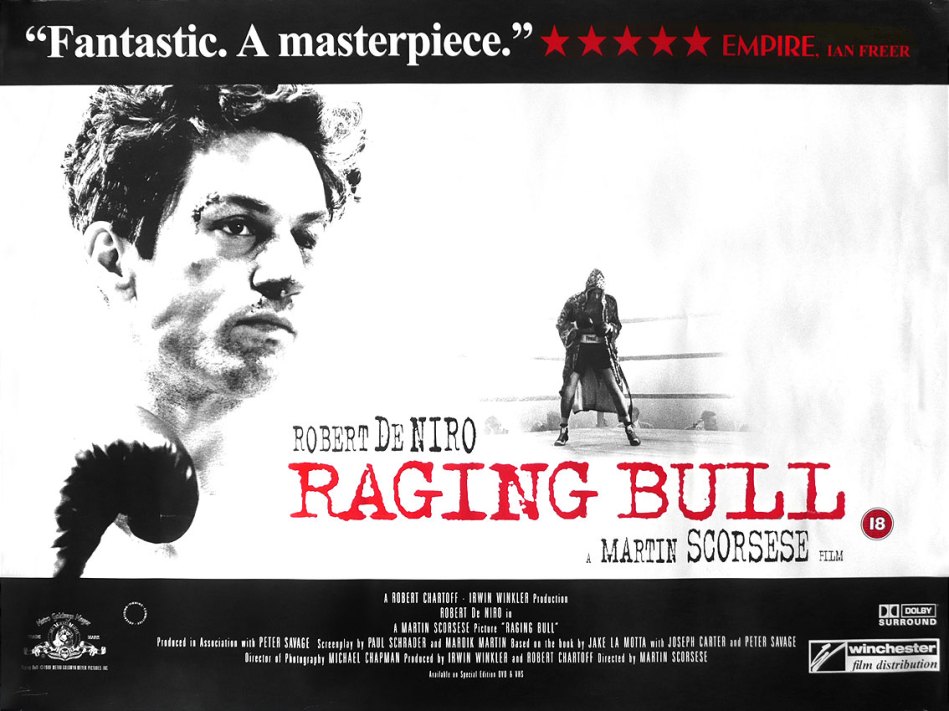
Raging Bull

Now we come to the second entry of Scorsese/De Niro month, the 1980 boxing epic, “Raging Bull.” I bet you all were expecting “New York, New York,” but I haven’t seen that one. So let’s get started with “Raging Bull,” which is another one of my absolute favorites.
He is as tough as nails in 1941, a real comer in boxing. But no one wants to fight him. This is none other than The Bronx Bull himself, Jake La Motta, played by Robert De Niro. His brother Joey, played by Joe Pesci, is his manger, who takes all of the insults, moods, and rages. The Mob wants a piece of that action but La Motta insists on being his own man. He is addicted by wanting to be middleweight champion of the world. The Bull snorts. The Mob perseveres. Once La Motta tells one of the Mob members, Salvy Batts, played by Frank Vincent, the will throw a fight to get a shot at the title, the Mob becomes happy. In 1948, La Motta wins the title.
In the ring he takes all of the punches and returns them twofold. People call him a cruel fighter. His first wife cannot take this violent man. La Motta falls in love with a 15-year-old girl named Vickie, played by Cathy Moriarty. Vickie is a blond beauty that men desire to be with and speak in hushed tones about her behind her back. Both of them marry and have a family, giving La Motta the power of being seen with a classy woman. However, that recognition isn’t enough, since he becomes jealous. He constantly is abusing her verbally and physically that she is sleeping around with other men behind his back. When Joey tries to reason with Jake, Jake turns against his brother, and their relationship is tarnished over this anger.
Frederic and Mary Ann Brussat stated in their review of this film, “Anger is a fury that is hard to extinguish once it is loose. Jealousy is a worm that eats away at the innards.” “Raging Bull” is more than a screen biography of Jake La Motta, more than an intense look at the sport of boxing, more than a sociological inspection of the Italian Catholic setting of the Bronx. The screenplay by Paul Schrader and Mardik Martin is about a giant passion – the complex, wild, crazy ones which bring a person to discover the worst that is in them.
Once La Motta climbs to the top, he loses it all. Sugar Ray Robinson, an opponent and enemy of his that he has boxed before, played by Johnny Barns, beats him positively. La Motta then quits boxing and becomes the manager of a shady nightclub in Miami. Vickie leaves him and he gets thrown in jail for moral charges. He is finally caged, deserted by everyone. All alone with his own self, self-destructed, he bangs his head up against the wall crying, “Why? Why? I’m not an animal!”
Jake then gives himself a rebirth, going beyond his own death. In a closing scene, he is now some sort of a philosopher, preparing for a 1964 appearance at the Barbizon Plaza Hotel Theatre where he does passages from Chayefsky, Schulberg, Shakespeare, and others. This is also where De Niro quotes Brando from “On the Waterfront.”
“Raging Bull” is not an easy film to watch with its bloody fight sequences, rough martial arguments, and quiet environments. It doesn’t give you that good feeling that “Rocky” did. Actually, it’s pretty much the polar opposite of “Rocky” when you think about it. However, the performance of De Niro deserves an Academy Award. He really knows how to dig deep into the elemental strength of an unlikable character and carries the audience up to the point where the unwilling respect for the man’s determined spirit is given. Scorsese has given another award winning quality performance from Joe Pesci as the brother. He also deserves credit for making Cathy Moriarty’s acting debut a positive one. “Raging Bull” also deserves a 10+.
Check in next week for the third entry of this month.

Monday, January 6, 2014

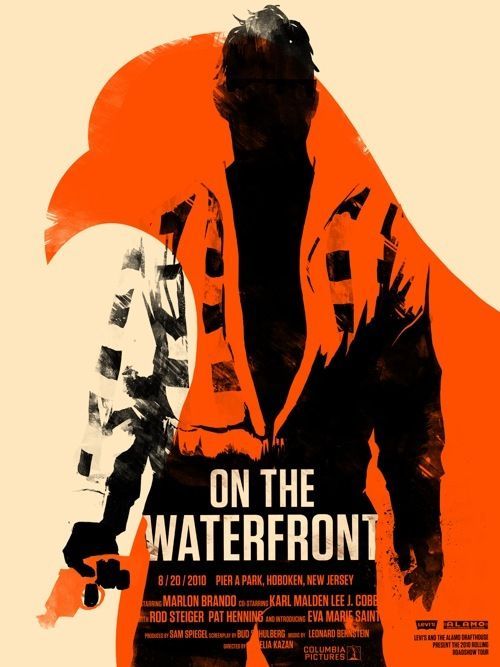
On the Waterfront

Today I am going to look at a very classic film from 1954. It’s one of the best films ever made and is also another one of my favorites. I’m talking about none other than the magnificent “On the Waterfront.”
Marlon Brando, who I have to say, was the best actor for his time, plays Terry Malloy, an ex-Prize Fighter who is fighting with his conscience and bumped off one of his co-workers, played by Ben Wagner, for the union boss Johnny Friendly, played by the great Lee J. Cobb. Malloy is a slight mess of half-formed emotions.
His strange love moments with Eva Marie Saint, who plays his co-worker’s sister, Edie, show, as described by Empire, “the new-fangled Method acting at its most controlled and poetic.” The famous scene when Terry is in the cab with his brother Charlie, played by Rod Steiger, is the highlight of the movie. This is the famous scene where Brando says to Steiger, “I could have been a contender, I could have been somebody, instead of just a bum, which is what I am.” Hats off to screenwriter Budd Schulberg, and his speech for the priest, played by Karl Malden, in the loading bay is still moving.
Once you add the acting/writing epics, Leonard Bernstein’s calm score, and a striking, dark look by cinematographer Boris Kaufman, you have a sad picture of labor relations that crawls into your skin and feels like it’s chewing you alive. You will still feel that after the 60 years this film was released.
Empire feels that “It's hard to like it that much, however, when you realize director Elia Kazan and writer Budd Schulberg made it after they ratted on their pals to the McCarthy commission and needed to do a picture about how informers were noble, brave souls facing up to oppression rather than sneaky squealers saving their careers.” I still feel that this film holds up very well today and is a classic that should be seen by everyone. It’s one of Brando’s finest performances he has ever done, and you should see it if you know or don’t know about Brando.
In the end, I give this film a solid 10. You’re probably wondering why I reviewed this film today. It’s very similar to the film that I will review this Friday, and you may already know which film I am talking about. Stay tuned this Friday to find out (if you don’t know what I will review).

Friday, January 3, 2014

Taxi Driver

Happy New Year everyone! Let’s kick off the year with a month review of the two greatest powerhouses who come together and make great films. I’m talking about none other than one of the best directors, Martin Scorsese, and one of the best actors, Robert De Niro. Now bear in mind that this will be films that I have seen, since I have not seen all eight films they collaborated on. With that said, I haven’t seen “Mean Streets,” so I will instead skip to the 1976 amazing film, and one of my favorites, “Taxi Driver.”
The steam flying up around the manhole in the street is a dead giveaway. Manhattan is a thin cement lid over the entrance to Satan's home, which is also full of cracks. Hookers, hustlers, pimps, pushers, frauds, and freaks – they’re all at their peak. They form a busy, faceless, shameless society that knows a secret list. On a hot summer night that cement lid becomes an uncontrollable rant written in neon: walk, stop, go, come, drink, eat, try, enjoy. Wait a minute…enjoy? That’s not likely. Only the faceless ones who you look at as utter filth could enjoy it.
This is what Travis Bickle, played by Robert De Niro, might write in his diary. Travis, a lonely man who comes from another place, drives a Manhattan cab at night. By day he sleeps a little, takes pills to calm himself down, drinks peach brandy, which he sometimes pours on his breakfast cereal, and goes to adult films to relax. At a certain time he is aware that his headaches are worse and he speculates that he may have stomach cancer.
Travis Bickle is the hero in “Taxi Driver.” He’s as crazy as they are, a psychotic, but played by De Niro as a fascinating character residing in a place that’s his creation as much as he is the creation of it.
Vincent Canby of the New York Times said, “Taxi Driver is in many ways a much more polished film than Mr. Scorsese's other major Manhattan movie, Mean Streets, but its polish is what ultimately makes it seem less than the sum of its parts.” The original screenplay was done by Paul Schrader, who was new at the time, and he enforces a smart plan on Travis’s story that finally makes it too simple. It steals the mystery from the film. Canby says, “At the end you may feel a bit cheated, as you do when the solution of a whodunit fails to match the grandeur of the crime.”
Until that last moment “Taxi Driver” is a vivid, electrifying portrait of a character so particular that you will be surprised that he makes constant dramatic sense. Canby comments, “Psychotics are usually too different, too unreliable, to be dramatically useful except as exotic decor.”
Travis Bickle – a character designed by the actor, writer, and director – remains one of the greatest characters ever portrayed from beginning to end, probably because he is more of a character who is crazy. He is the person who shows us our nightmares of urban isolation, treated in a performance that is effective as much for what De Niro does to this character. This kind of acting is rarely seen. This is talent, which one gets in theater, as well as from behavior, which is what movies normally give the viewers.
If De Niro was not so good of an actor, Travis would be your usually sideshow freak. The screenplay gives him plenty of time to work with the character, thankfully. Until the final moments, “Taxi Driver” has a type of hyper lack of direction that is a direct reflection of Travis’s mind, capable of eruptions of common sense and discipline that are separated when he is confused. Travis writes in his diary, “I don’t believe that one should devote his life to morbid self-attention,” and then sets out to make a name for him by plotting a murder of a politician.
Travis is a buildup of self-destruct instruments. He befriends a pretty, smart campaign worker, played by Cybill Shepherd (who Canby says “recoups the reputation lost in At Long Last Love”), but wonders why she is appalled when he takes her to see one of his favorite adult films. Canby describes Travis’s mind as “full of crossed wires and short circuits.”
There is a point in the film (which I will not say or else I will give away the plot) where is questionable, but the rest of the film works. The supporting cast, which is always seen in Scorcese movies, is just great. They include Jodie Foster as a teenage hustler, Harvey Keitel as her pimp, and Peter Boyle as a confused Manhattan cab driver.
You may want to argue with “Taxi Driver” at the end, and with good reasons, but you won’t waste your time with it. Go see the film if you haven’t, you will love it. Especially since this film has the famous De Niro line where he looks in his mirror and says, “You talkin’ to me?” This film deserves a solid 10.
I hope you enjoyed the first entry to Scorcese/De Niro month. Stay tuned next week when I review the next film of these two juggernauts.

Friday, December 27, 2013

Willow

I guess I must be feeling the post-Christmas blues. I was contemplating heavily on what to review today. It couldn’t be that I ran out of movies to review because there are so many out there to review. To end the year, I couldn’t think of anything else besides the 1988 fantasy movie, “Willow.”
“Willow” is the much-heralded elfin epic directed by Opie from “The Andy Griffith Show” and Richie Cunningham from “Happy Days,” Ron Howard, but it’s clearly the idea of executive producer George Lucas. Here he shaved one of the Ewoks from “Return of the Jedi” to make a Nelwyn, the Hobbit-sized hero in the title role.
Rita Kempley of the Washington Post commented on her review, “If "magic is the bloodstream of the universe," as "Willow" tells us, Lucas needs gamma goblin. There's little of magic in this anemic, high-tech fantasy, no matter how well-dressed the sets or how splendidly scenic the locale. The big budget can't conceal the fact that this fiction is fallow, more rootbound than spellbound.”
It’s déjà voodoo. Not only does Lucas rework his own mythology but others as well. He borrows from Oz, “Masters of the Universe,” and even the Bible. You heard right. Baby Moses meets the Munchkins meets the medieval Star Wars. Kempley said, “The gnomenclature changes, but the creatures remain the same as a war rages between good and evil.”
Queen Bavmorda, played by Jean Marsh, has ordered that all pregnant women be put behind bars and any child who has “the mark” killed. One midwife saves her daughter Elora (Kate and Ruth Greenfield/Rebecca Bearman) from being killed because Elora has the mark, by putting her in a reed basket and making her sail to the land of the Daikini. Elora washes up on shore in Nelwyn, where she is rescued by a farmer named Willow.
Warwick Davis, a 3-foot-4 actor who played a Ewok, plays Willow who is married to Julie Peters and has two kids with her. Willow, like all fantasy heroes, has this drive for adventure and dreams of becoming a great wizard. It will prove a growth step if only in the emotional sense. Even though he has the powers, he lacks the confidence to try them.
Elora is actually a princess who has her destiny written to overthrow Bavmorda, and Willow and his wife, Kaiya, take her in. Then the village is attacked by Bavmorda’s army, killing a nursing mother in the process. The High Wizard, played by Billy Barty, tells Willow that he should travel to Daikini and give the child to the first big person that he sets eyes on. That person is Madmartigan, played by Val Kilmer, an irresponsible traveler – not the type who would want a baby with him.
After a series of accidents, the two team up to take Elora to the kingdom of Tir Asleen. They are hunted on the way by General Kael, played by Pat Roach, and an army of creatures that look like a mix between “junkyard standard poodles and wart hogs,” according to Kempley. They are aided by Fin Raziel, played by Patricia Hayes. Raziel is a witch who was turned into a possum by Bavmorda. Along the way, they meet a fairy queen, played by Maria Holvöe, who tells two of her Brownies (Kevin Pollak and Rick Overton) to guide them along the way. Now we have four men and a baby.
Kempley describes Elora as “a bonny, burping girl who can melt hearts right through chain mail.” She’s red-headed, and the Greenfield twins who portray her are as cute as the Pound Puppies. Elora isn’t the show-stealer in this film, the Brownies are. Always underfoot or falling into ale buckets, these two are the equivalent of R2D2 and C-3P0. Without their arguments and sass and the hesitant daring-do of Madmartigan, the movie is only in monotone.
Lucas’ story, helped by the dialogue of Bob Dolman’s screenplay, focuses on the coming of age of the title character. He is played by a teenage Davis with dignity, not charisma. Madmartigan is like Inigo Montoya from “The Princess Bride,” the character we want more of, but we don’t get.
He looks like an Arthurian samurai, with his black hair in braids, his swordplay and arrogant stance. Kempley comments, “He is nevertheless in chivalric shell shock, spiritually beaten by the war with Bavmorda.” Mardmartigan changes thanks to Willow’s courage and a love potion which makes him crazy for Bavmorda’s daughter, Sorsha, played by Joanne Whalley.
Kilmer is one of America’s great screen secrets, covered by Tom Cruise in “Top Gun” and Ralph Macchio in “The Karate Kid.” With this performance, a feverishly silly mix of Toshiro Mifune and Harrison Ford, he promises to get himself in the same place as the pantheon of Spunky Guys to Die For.
With ease he walks that hairline between mumbo and jumbo, between child’s epic hero and man-size dilemma. It’s the same line that Han Solo and Indiana Jones walked on, which is also known to other characters like Alice, Babar and Bilbo Baggins alike. T.H. White, Jonathan Swift, Lewis Carroll and Lucas himself have called themselves both the adult and the child. But “Willow” is an empty tale. All of the nice costumes and special effects from Narnia to Oz can’t hide that fact. We are always aware of the man behind the curtain.
In the end, I have to rate this film with a 5. It’s not good, but it’s nowhere near terrible or god-awful. There are far worse films than this. “Willow” just is an adequate film.
Well that ends the year. Hope everyone closes out 2013 positively and here’s hoping for another great year in 2014 for blogging. I will see you all then.

Wednesday, December 25, 2013

A Charlie Brown Christmas/Charlie Brown's Christmas Tales

For the finale of my 25 film review countdown to Christmas marathon, I thought that I would end off with another beloved classic. Hey, it’s Christmas, so why not? Today, let’s cap this marathon off with the 1965 “A Charlie Brown Christmas.”
This special finds the always insecure Charlie Brown, voiced by Peter Robbins, unhappy that it’s Christmastime again. You might be thinking, “Why would he be unhappy? Christmas is everyone’s favorite holiday.” Well, Charlie Brown has not received any Christmas cards. Lucy, voiced by Tracy Stratford, tries to cheer him up by getting him involved in the annual Christmas play by asking him to be the director. Charlie Brown takes on the position with his usual intrusiveness, and everyone thinks the play will fail.
The filmmakers, especially Bill Melendez and Charles Schultz, keep the story innocent and charismatic, which helps children to love this special, but bringing in jazz artist Vince Guaraldi to do the music, they capture the adults’ attention as well. The combination is mouth-watering, and music from the episode went on to become the best-selling soundtrack. Playing that CD of Guaraldi’s music every Christmas should bring holiday cheer in your house.
Lucy thinks the play needs a modern spirit of Christmas and sends out Charlie Brown with the duty to find an aluminum Christmas tree. Instead, Charlie Brown ignores Lucy’s orders and goes out and buys a real Christmas tree instead. The result is emotional and provides an interesting lesson about the true meaning of Christmas. This got the “Peanuts” shows off to a very special start and it holds up to this very day.
Hands down, this special will get a 10+. It’s another one of my absolute favorite Christmas specials ever.

We're not done yet folks, because we are going to look at another Peanuts Christmas Special titled "Charlie Brown's Christmas Tales," released in 2002. This one is about a series of Christmastime vignettes with different Peanuts characters: Snoopy, Linus, Sally, Lucy, and Charlie Brown. Snoopy (Bill Melendez) is having difficulty trying to forge a Christmas song with the vicious cat next door and wants to ice skate with Lucy (Serena Berman), but she doesn't want to do anything with Snoopy. Linus (Corey Padnos) works on his letter to Santa and tries to figure out the girl in his class sitting behind him who always changes her name. Sally (Megan Taylor Harvey) writes a letter to "Samantha Claus" and mortifies herself in class, Lucy tries to be nice to her brothers, and Charlie Brown (Wesley Singerman) tires to prepare for Christmas.

In each of the small stories, you get a vision of what's going on in the characters' heads. Even though this special is inferior compared to "A Charlie Brown Christmas," I believe that "Charlie Brown's Christmas Tales" might be a yearly tradition of Christmas specials to watch around the holiday times. In the end, I would probably give this film an 8.

Thanks for joining in on my 25 film reviews of Christmas specials; Merry Christmas, Happy Holidays, and Peace to everyone. Stay tuned this Friday when I start back up on my regular Friday reviews.