Saturday, December 7, 2013

It's a Wonderful Life

I had a long day today, which is the reason why I am posting this review late. Since I didn’t have the time to watch the fifth Home Alone movie, I thought that maybe I will review a little classic that came out in 1946, “It’s a Wonderful Life.”
Bosley Crowther of the New York Times said in his review of this film, “For a turkey dinner, with Christmas trimmings, is precisely what's cooking at the end of this quaint and engaging modern parable on virtue being its own reward.” This town’s characters that go through a lot in the running time of this film are waiting around to feast on this turkey. Or, they at least watch James Stewart eat it. Stewart is the main character in this beloved Christmas special, and by the end of this film, you see that he does most of the turkey stuffing and he deserves the white meat and stuffing.
Reason behind this: director Frank Capra, who had came back from the war, had resumed with a will in his previous manifest fondness for depicting people of simple, unpleasant worth. In this film, Stewart plays George Bailey, who wants to get away from his small-town life and duties but is never able to do so because slowly they close in on him. Capra shows in this film that it is really a family, friends and honest hard work that make “a wonderful life.”
George Bailey is a friendly guy who wants to travel and do big things but unfortunately he keeps finding himself running a building-and-loan association in a small town, married, and caged in a constant fight with the greedy old banker of the town, Mr. Potter, played by Lionel Barrymore. When it finally looks that the banker has won the fight, he does a hasty attempt to take (what he thinks) his horrible life. This calls on his guardian angel, played by Henry Travers, who grants him his wish and shows him what the town would have turned out if he never existed. When George looks around and sees this, he gets upset that he returns back to his life with such elation, and thanks to the help of all his friends, battles the financial crisis he is in.
In making this moralistic tale, Capra and his writers have put in a lot of everyday occurrences and emotional complications just for comedic timing, which works. The boyhood of his hero, the play at a high school dance, the clumsy hunt of a romance – all are shown in a humorous way, despite the too frequent tendencies of every one to act childish and shy. The heavier parts of the drama are handled in a tense, sudden style.
As the main character, James Stewart does a warmly interesting job, showing that he has grown spiritually as well as in talent during the years he was in the war. Donna Reed is remarkably balanced and polite as George Bailey’s sweet-heart wife. Thomas Mitchell, Beulah Bondi, H.B. Warner and Samuel S. Hinds stand out among the cast of assorted small-town characters who give this film variety and energy. Lionel Barrymore can be compared to Ebenezer Scrooge, and Henry Travers as the angel is “a little too sticky for our taste,” according to Crowther.
Crowther also says, “Indeed, the weakness of this picture, from this reviewer's point of view, is the sentimentality of it—its illusory concept of life.” The people Capra depicts are charming, nice people, his small town is quite an attractive place and his pattern for solving those problems is optimistic and superficial. Somehow they resemble theatrical attitudes rather than average realities. Crowther ends his review by saying, “And Mr. Capra's "turkey dinners" philosophy, while emotionally gratifying, doesn't fill the hungry paunch.”
In the end, I would give “It’s a Wonderful Life” a solid 10. This is also one of my favorite Christmas specials, and I think you should all make it a tradition to watch this film every year around this time. Hold on to your vomit bags tomorrow because I will finish off the “Home Alone” reviews.

Friday, December 6, 2013

Home Alone 4: Taking Back the House

“Home Alone 4” might be the strangest movie yet to have been filmed in Capetown, South Africa. I’m not joking here. The budget to this film was apparently so low that the only place that they could find to film was in South Africa. You might be watching this film and continuously find yourself looking in the background to see if there is anything that gives it away that this is in South Africa. This is an effort to find anything on a plot from a plot that is sick, pompous and silly.

I know that I considered “Home Alone 3” an average sequel, seeing how there were good things in it, but acknowledging that it is flawed. That is nothing compared to what “Home Alone 4” has to deal with. “Home Alone 3” focused on a completely different family in a similar looking Chicago suburb (probably trying to make this family the main focus), this one brings us back to Kevin and his family, who strangely is the same age as the first movie. In this 2002 TV movie, Kevin is played by Mark Weinberg, who doesn’t have the same charm that Culkin had. He’s actually somewhat creepy. He talks all of the time, and his dialogue is nothing more than those tacky kid lines like, “I knew this was gonna be the best Christmas ever.” He’s not a good child actor in Hollywood.
The plot involves Kevin spending his Christmas Eve with his dad’s girlfriend Natalie, played by Joanna Going. His parents (Jason Beghe and Clare Carey) are separated, which leads to a sub-plot that has some cliché about the importance of your family. That’s when Kevin isn’t setting up traps for the burglars. Not satisfied with the family plot, there has to be (again) a series of jokes of the burglars and the kid has to stop them by setting up traps that could only be done with the help of the special effects people.
The burglars this time are Marv and his wife Vera. Marv was well-known to be played by Daniel Stern, and he was offered to reprise the role, but he refused because he called this “an insult, total garbage.” Who is his replacement in this film? How about the cast member from the sitcom “3rd Rock from the Sun,” French Stewart. I’m going to be honest, French Stewart doesn’t get good roles and he is a pain to sit through. Especially in this film because he just does a bad impression of Daniel Stern. There are some acts you can’t get, and others you just don’t want to. Like I said, French Stewart just hurts you throughout this film. What you are watching is a good comedian trying to imitate another good comedian. Stewart twists and turns his voice and body language in such a weird and disgusting way that you sit there wondering about the man’s condition. Then you realize this is his performance.
Marv wants to kidnap Kevin for reasons I don’t think they ever made clear. He and Vera, played by Missi Pyle, break into Natalie’s house, which is a house that you could see in “The Jetsons” cartoon because everything is voice activated. It’s not much of a stretch of how the third act is set – lots of hits to the head and that weird pratfall where people slip, fly up in the air, and land on their backs. Were they trying to pull a “Peanuts” stunt here? Jerry Roberts said in his review, “Knowing that this movie takes place in Chicago, but filmed in South Africa, I kept hoping that the SAP would bust down the door and drag the crooks off to who-knows-where.”
Now the first “Home Alone” was one of the best comedies and beloved Christmas specials, which is also one of my favorites. Because of Culkin, it became really successful, but this isn’t an idea that anyone could really build on. The sequels based on that idea seemed more like a spoof and an imitation.
Overall, I rate this film with a 1. Stay tuned tomorrow when I finish off my reviews of the “Home Alone franchise” when I talk about last year’s made-for-television sequel, which will hopefully be the last. Then, I can get back to reviewing probably some classics in my 25 days of Christmas reviews.

Thursday, December 5, 2013

Home Alone 3

This may come across as strange, but I actually would like to recommend the 1997 sequel, “Home Alone 3,” although not to grownups unless they are in a silly mood. Yes, I know, it does follow the same formula as the first two, but it’s still funny and gentle, has a real charmer as our main character, and provides impressive wish fulfillment and entertainment for kids in the lower grades in Elementary school.

There is even a better reason as to why the child is left home alone. Played by a newcomer named Alex D. Linz, and Roger Ebert says, “Who seems almost too small for a middle initial” and he gets the chickenpox. His dad, played by Kevin Kilner, is out of town on business, his mom, played by Haviland Morris, has a serious urgency at her office, and his brother and sister (played by Seth Smith and Scarlett Johansson) are at school. That is why Alex is left home alone with a beeper number, fax number, cell phone number, and the number of Mrs. Hess across the street, played by Marian Seldes, and dialing 911 as a fallback position.
The subplot has already been set into play. A spy ring has stolen a computer chip, and because of confusion at the airport baggage claim with identical bags, the toy truck that has the chip ends up at Mrs. Hess’ house. Four spies (Olek Krupa, Rya Kihlstedt, Lenny Von Dohlen, and David Thornton) fly to Chicago on the same plane as Mrs. Hess and have four hours to board to find the bag, but being the stupid spies that they are, they fail to find it and end up deciding to break into every house in the same neighborhood as Alex.
This means a lot of more trouble on the way. They use walkie-talkies, computer programs, surveillance vans, a fake baby buggy and other props in order to be wasteful and noticeable as possible, and of course Alex, using his telescope from his attic window, spots them. Don’t even think about asking why the four spies never spot him up there. After he calls the cops twice but they escape before the cops get there, Alex decides to handle the spies himself. He sets up intricate traps, just like in the first two, and the last 45 minutes consist of nonstop wreck as the bad guys fall for every trap. Ebert says about these traps, “these are the kinds of traps that any 8-year-old could devise, if he had a budget of tens of thousands of dollars and the assistance of a crew of movie special-effects people.” It’s still funny though.
Ebert says, “So, OK. I know the formula, and so does the movie (written, like the first two, by John Hughes). Forewarned and forearmed as I was, why did I actually like “Home Alone 3”? It was partly because of little Alex Linz, who has a genuinely sweet smile on his face as he watches his traps demolish the bad guys. I don't know if he'll have a career like his predecessor, Macaulay Culkin (for his sake I sort of hope not), but he has the same glint in his eye.”
Also, the booby traps, even though they are painful, are funnier this time. Sure, people do fall down dumbwaiters and through floors, and get hit on the head with dumbbells and flower pots, and get frozen in the swimming pool, but Raja Gosnell’s direction avoids the painful after effects and makes it OK. The stunts at the end are more slapstick and less special effect. End result: Either more entertaining than the first two or I was just in a silly mood when I saw this.
I do acknowledge that this film has problems since the cast that we all knew and loved from the first two movies are not in this, but as a film that is trying to go into a new direction, I give it credit for at least trying. My rating would probably be a 7 as I think if you have kids, they’ll love it and you will if you are having a silly day.
How do the other sequels turn out? Find out tomorrow when I continue my 25 days of Christmas movie reviews on the “Home Alone series.”

Wednesday, December 4, 2013

Home Alone 2: Lost in New York

Now we come to the 1992 sequel, “Home Alone 2: Lost in New York.” People might complain that this film is the exact copy of the first one, but I still love this one. What’s best is John Hughes returns as writer-producer and Chris Columbus returns as director. On top of that, every character from the first one reprises their role in this film.

Macaulay Culkin returns as Kevin McAllister, now a little taller from the first one but still that boy that you saw in the beginning of the first one. This time the family does not forget him at home, and when they run to the airport because they are late for their flight to Miami, Kevin wonders on the wrong plane to New York City. He seems to be fine with it because he doesn’t need his family, or so he thinks. What’s so clever about this sequel is that the filmmakers realize that Kevin needs to find a place to live so he is not stranded on the streets. He’s one of those upper-middle-class children that he books a hotel room at the Plaza Hotel, using his dad’s credit card.
At the Plaza, Kevin meets up with some of the most beloved actors that we have seen. Most notably, they are Tim Curry as Mr. Hector, the concierge of the hotel, who you could consider the secondary villain. Former SNL member that you might hate, Rob Schneider plays Cedric, the bellman who can’t seem to say that he would like a proper tip and instead is given Fruit Stripe Gum. Dana Ivey is the desk clerk of the hotel, Mrs. Stone.
Owen Gleiberman of EW said in his review of “Home Alone 2,” “In just about every other way, Home Alone 2 duplicates the first film with blueprint savvy.” Just like how Kevin did in the first one when he found out his parents had left him home alone, he eats ice cream and watches movies. What makes this better is that Kevin has a tape recorder this time to fool the hotel people that his parents are talking to them. Just like how in the first one when Kevin was scared of his neighbor but got to know him and is told none of the rumors are true, in this one he befriends a pigeon lady, played by Brenda Fricker, who does scare him at first, but gets to know her and promises to be her friend. She melts her heart in time for the Christmas spirit finale. On top of all of this, Joe Pesci and Daniel Stern return as the Wet Bandits, Marv and Harry, this time calling themselves the Sticky Bandits, and they are dumber than a doorknob.
The booby traps set in this one seem to be more violent and dark, but children would laugh at them. Marv gets hit by four bricks, stapled in the forehead and electrocuted. Harry again gets his head on fire, and the two have their nose smashed by a tool chest that Kevin pushed down the stairs. These traps are so funny that just like how in the first film when Harry and Marv got hit with paint cans and avoided them, they get hit with a large barbell looking object twice.
I didn’t say this before, but this is good family entertainment. I know it’s not as good as the first one, but at least give this one a chance. Even though they copied everything, it still has that nice Christmas charm that the family can feel when they watch this together. Gleiberman said, “I saw Home Alone 2 with an audience of children, most of whom ate up the gags like Gummi Bears. If they found this stuff harmless, I tend to think it probably is. For all that, the two Home Alone movies stick in my craw.” I completely agree with him because I still own the first two Home Alone movies on VHS to this very day. Today’s kids have more time to realize what kind of a violent world we live in today. Gleiberman stands by this statement by saying, “That they can now get started early, courtesy of John Hughes, isn't something I can muster a great deal of enthusiasm for.” A person saying that a live-action movie works like a cartoon is a type of criticism and not a compliment.
Final verdict: I would probably give this film a 9. Watch it if you liked the first one, and at least give this sequel a chance.
But how do the other sequels in this series hold out? Find out tomorrow when I continue my review of the “Home Alone series” in my 25 days of Christmas reviews.

Tuesday, December 3, 2013

Home Alone

Now we get into the classics because over the next few days, I will be looking at a franchise that everyone saw at a young age. What franchise you ask? The “Home Alone” franchise. This is one of the first movies I saw as a kid, since we own the first two on VHS. Let’s start off with the very first “Home Alone,” released in 1990.

This is the story of a family that is traveling to Paris for Christmas. The previous night, the youngest, Kevin, gets into a huge argument with the family, and he wishes they all disappear. The next morning, the family wakes up late and have to rush to get out of the house to get to the airport so they won’t miss their flight. In the rush, they forget Kevin at home. Caryn James of the New York Times describes Kevin as “a wide-eyed, savvy child who responds to being the picked-on youngest of five by asking wistfully, "Why do I always get treated like scum?"” When he wakes up alone at home, he finds out that his wish came true. No one can forget that memorable moment when Kevin looks into the camera with the smile and says, “I made my family disappear!” Kevin has the potential to be the overemotional child or the obnoxious little adult that you have seen so many times on screen, but he is neither of them. Famous child star Macaulay Culkin plays Kevin and he is a totally loveable, up-to-the-minute child.
Kevin’s believable; smart-mouth attitude is typical of the film’s creators, who in the past created the suburban neighborhood Kevin’s family lives in with mixed results. The film was written and produced by the late John Hughes (who made other classics, including “16 Candles” and “Uncle Buck”), and was directed by the great Chris Columbus.
The first half of the movie is flat and unsurprising as its premise suggests. The phone is out of order, the neighbors are away, Kevin eats junk food and accidentally sets his brother, Buzz’s (played by Devin Ratray) spider loose. This is your typical comedic moments that kids would probably laugh at. It makes you wonder how Kevin can order pizza when the phone is out of order. Then there is the part where it shows how loveable Kevin’s parents (John Heard plays the father and Catherine O’Hara plays the mother) are when they misplace Kevin during their rush to the airport.
However, in the second half, the plot becomes crazier. Kevin now becomes a daredevil and the comedy is just out there. Kevin’s house is now the next target for two of the most ridiculous burglars that you have ever seen on screen. When Kevin finds that out, he sets up these traps in the house so he can catch the burglars.
Occasional scenes show Kevin’s parents trying to schedule a return flight so they can get Kevin. For the final few distances, the mother hitches a ride with a band leader, played by the late and great John Candy, which James says is, “a sure sign of maternal devotion bordering on martyrdom.” Kevin is taking care of himself just fine, treating every child’s fantasy of being the man of the house and being the hero of this story.
He uses a VHS tape for the sound effects of the gunshots and covers the floor with toy trucks for the robbers to trip on. He covers the front stairs with ice and the back stairs with tar. As the burglars, Joe Pesci and Daniel Stern are complete and total idiots, and that’s where they are funny. They don’t just slip on the ice, they somersault over it. When Pesci’s hair gets burnt, he jumps head first into the snow to thaw out the fire. Caryn James says, “All that's missing from these cartoon scenes are stars flashing around the crooks' dazed heads.”
With a carefree and ironic of a comedy this is, it needs a timeless message to top off this Christmas classic. For Kevin, it arrives when he runs from the burglars and hides in the church, where the carolers sing Christmas songs and he meets his scary looking neighbor, played by Roberts Blossom, who is shown earlier shoveling his driveway and is called by Buzz as “The South Bend Shovel Slayer.” Obviously Kevin has to go to one of the mall Santa’s, played by Ken Hudson Campbell. Both of them teach each other how important your family is, which is really sentimental, and thankfully not overplayed. The ending isn’t either with Kevin wishing his family was back, and he gets his wish.
In the end, “Home Alone” does have its sweet side. It’s a side that is appreciated by the kind of kids who think about Santa’s passport. I give this a solid 10, it’s one of the best and one of my favorite Christmas movies.
But how do the sequels fair out? Find out tomorrow when I look at the first sequel in my 25 days of Christmas reviews.

Monday, December 2, 2013

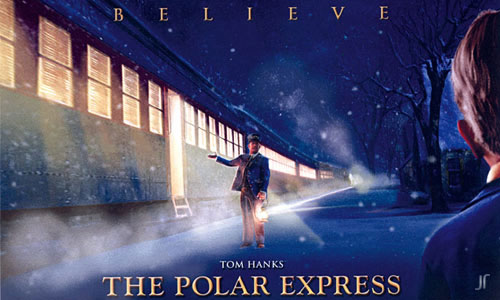
The Polar Express

Wow, I’m already at my 100th review. It hasn’t been a year yet, and I’m already at my 100th review. Anyways, I think I shall treat my 100th review with care, so in honor of my 25 days of Christmas reviews; I will look at the 2004 great Christmas special, “The Polar Express.” This film has the quality of a lot of lasting children’s entertainment. I would be lying if I didn’t say it was a little creepy though. When I mean creepy, I don’t mean it in an unpleasant way, but in a sneaky, teasing way that lets you know that strange things could happen. There’s a deeper, trembling tone, instead of a mindless jolliness of the usual Christmas movie. This one creates a world of its own, much like other classics like “The Wizard of Oz” and “Willy Wonka & the Chocolate Factory,” in which the wise child does not feel too satisfied.

Those who know the Chris Van Allsburg book will feel like they know what is going on from the opening moments, which quotes the story: “On Christmas Eve, many years ago, I lay quietly in my bed. ..." The main character to this story is never given a name, and is listening to the sound of the sleigh bells ringing. He is at just the age when the existence of Santa Claus is up for discussion.
The look of this film is extraordinary, a cross between live action and Van Allsburg’s artwork. Robert Zemeckis, the same director whose classic “Who Framed Roger Rabbit” put live action and animation together, this time merges them, using a process called “performance capture,” in which human actors perform the movements which are then transferred to lifelike animation. The characters in “The Polar Express” don’t look real, but they don’t look unreal either. They have a kind of a basic and emphasized reality that makes them visually magnetic. Many of the characters are played by the great Tom Hanks, who is the executive producer and worked with Zemeckis on the classic “Forrest Gump,” which is a film that also combined levels of reality and special effects.
Now the story: As Hero Boy (motion-capture by Tom Hanks and Josh Hutcherson), voiced by Daryl Sabara, lies awake in bed, there is a crash in the street and a train comes in front of his house. The boy runs outside with his robe and slippers, and the conductor, voiced by Hanks, tells the boy to get on board. Since he refused to sit on the lap of the mall Santa, and his little sister put out Santa’s cookies and milk, Hero Boy is getting to the point where he doesn’t know if Santa exists, and the Polar Express boards those kids to the North Pole, where seeing is believing, like Disney World’s tagline.
Already on board is Hero Girl, a sincere, gentle African American (motion-capture done by Tinashe and Chantel Valdivieso, singing voice done by Meagan Moore), voiced by Nona Gaye, who Hero Boy becomes friends with and also Lonely Boy (motion-capture by Peter Scolari and Hayden McFarland, singing voice by Matthew Hall), voiced by Jimmy Bennett, who lives on the wrong side of the tracks and always seems sad. Another character, Know-It-All (motion-capture done by Jimmy “Jax” Pinchax), voiced by Eddie Deezen, can’t give an answer without sounding obnoxious. These are our main characters, along with the Conductor, a Hobo (who lives on top of the train), Santa (both voiced by Hanks), and countless elves, voiced by Phil Fondacaro, Debbie Lee Carrington, Mark Povinelli, and Ed Gale.
Ebert has said, “There's an interesting disconnect between the movie's action and its story. The action is typical thrill-ride stuff, with the Polar Express careening down a "179-degree grade" and racing through tunnels with a half-inch of clearance, while Hero Boy and the Hobo ski the top of the train to find safety before the tunnel.” At the North Pole, there’s another dizzying ride when the kids go down a corkscrewing toy chute. You will feel like you’re on an amusement park ride during these segments.
Those scenes have a lot of skill put into them, but they are expected. Not expected is a point when the dazzling level of creativity in some other scenes. For instance, the part when Hero Girl’s lost ticket flies through the air with as much freedom is much like the floating feather at the start of “Forrest Gump.” When the hot chocolate is served on the train, waiters emerge with an acrobatic song-and-dance segment. Ebert described that the North Pole “looks like a turn-of-the-century German factory town, filled with elves who not only look mass-produced but may have been, since they mostly have exactly the same features (this is not a cost-cutting device, but an artistic decision).”
In this version, Santa is a good and decent man, and is also serious, since he is a professional man doing his job. Ebert says, “The elves are like the crowd at a political rally.” One part where the bag of toys is seen from a high angle that performs Santa’s job, but doesn’t exaggerate it. Ebert (I believe) must have joked when he said, “this is not Jolly St. Nick, but Claus Inc.” There is something scary about the elves with their intense, bony faces and their mob mentality.
What’s good about all this is that it’s the magic of “The Polar Express.” It doesn’t let us off the hook with the usual comforting Santa and Christmas clichés. When a helicopter lifts the bag of toys over the town square, it knocks the star off of the top of the Christmas tree, and an elf is almost impaled at the bottom of the tree. When Santa’s helpers prepare the reindeer, they don’t look like tame cartoon characters, but Ebert describes them as “skittish thoroughbreds.” For Lonely Boy, although he makes this trip and gets his Christmas present, and is violently protective of it, at by the end of the movie, we suspect his troubles are not over, and being lonely may not be his problem.
Here is what Ebert said in his review: “There are so many jobs and so many credits on this movie that I don't know whom to praise, but there are sequences here that are really very special. Some are quiet little moments, like a reflection in a hubcap. Some are visual masterstrokes, like a camera angle that looks straight up through a printed page, with the letters floating between us and the reader. Some are story concepts, like the train car filled with old and dead toys being taken back to the North Pole for recycling. Some are elements of mystery, like the Hobo, who is helpful and even saves Hero Boy's life but is in a world of his own up there on top of the train and doesn't become anybody's buddy (when he disappears, his hand always lingers a little longer than his body).”
“The Polar Express” is a movie for more than one season. It will become a recurrent, past down with each generation. It has a haunting, magical quality because it has an imaginative world that is fresh and plays true to it, avoiding all the tiresome Christmas clichés that children have engraved into their heads during this time of the year. The conductor at the beginning of the movie tells Hero Boy to get on the train, and you should do the same thing.
All in all, I also give this film a solid 10, since it’s also one of my absolute favorite Christmas specials. Stay tuned tomorrow when I continue my 25 days of Christmas reviews.

Sunday, December 1, 2013

Elf

Hey everyone, it’s December. You know what that means. CHRISTMAS!!!!! It’s a holiday that everyone eagerly awaits for every year. Christmas has everything: the tree, the stockings, the carols, snow, presents, the great food, and even those timeless Christmas movies that will never be outdated. Just like how ABC Family always does their 25 day countdown until Christmas, I will be doing the same thing this month. I will be reviewing 25 Christmas classics that you should watch, and ones that you should avoid. Let’s not waste any time, let’s get started with one of my personal favorite Christmas specials, the 2003 film, “Elf.”
The late Roger Ebert described this movie as, “one of those rare Christmas comedies that has a heart, a brain and a wicked sense of humor, and it charms the socks right off the mantelpiece.” He was absolutely right because when I saw this movie on “On Demand,” I just had such a happy feeling when I was done watching it. The casting is just great. Comedian Will Ferrell, who is a graduate from Saturday Night Live (SNL), plays a human who thinks that he is an elf. Comedian Bob Newhart is Ferrell’s adoptive father. One of the greatest actors, James Caan, plays Ferrell’s biological mother and Mary Steenburgen plays Caan’s wife. Singer Zooey Deschanel plays Jovie, a department store worker who Ferrell falls in love with. Faizon Love is Santa’s elf manager, and Peter Dinklage, who played a dwarf in “The Station Agent,” has a small scene where he fights Ferrell. What a great cast lineup for such amazing roles.
“Elf” was directed by the great Jon Favreau and was written by David Berenhaum. The story begins with Santa at an orphanage home delivering presents when a baby orphan crawls into Santa’s bag. This causes the baby to go with Santa to the North Pole, where he is raised by Papa Elf, played by Newhart. This baby grows up to be Buddy, played by Ferrell, who knows that he is at least four feet taller than most of the other elves, and eventually travels to New York City, where Santa, played by Edward Anser, tells Buddy that is where Buddy can find his biological father.
Meet Walter, played by Caan, a hard-bitten publisher who is not the least bit surprised or happy when Buddy walks into his office telling him that Buddy’s his son. That is until Buddy tells Walter the name of Walter’s long-lost girlfriend, and Buddy is invited home. Walter’s wife, Emily, played by Steenburgen, proves to the viewers that she is the only actress in the world who could welcome Walter’s elf son into the family, and prove to us that she means it.
The plot is pretty standard, involving a crisis at Walter’s publishing firm since he needs a best-selling children’s book, but there are very nice subplots involving Buddy’s little brother Michael, played by Daniel Tay, and his romance with the department store girl Jovie, played by Deschanel. Plus there is some unfinished business up at the North Pole.
One of the funniest scenes in the movie is when Buddy spots a department store Santa, played by comedian Artie Lange, and instantly calls him an imposter. He tells the store Santa, “You sit on a throne of lies!”
Ebert admits, “Indeed the whole world has grown too cynical, which is why Santa is facing an energy crisis this year.” Santa’s sleigh is powered by faith, and if enough people don’t believe in Santa, it won’t fly. That leads to one of the scenes where the sleigh does not have enough takeoff velocity to fly. This looks like a job for a human who thought that he was an elf for most of his life to make people believe in Santa. It should be easy.
I have to admit this is a very heartwarming movie that you should watch to build up to Christmas, and I think you’ll love it. I have to give this a solid 10, it’s one of my absolute favorite Christmas specials.
Stay tuned tomorrow when I continue my 25 days of Christmas reviews.